Monday, December 21, 2015

Mozart: Quartet in D, K. 499 (Budapest Quartet)

As I have mentioned before, this year I came into possession of four or five Budapest Quartet sets from the ensemble's vintage period (1933-35) in superb early Victor pressings. Here is one of those, a Mozart recording from 1934:

Mozart: Quartet in D Major, K. 499
The Budapest String Quartet (Roisman-Schneider-Ipolyi-Schneider)
Recorded April 5, 1934
Victor Musical Masterpiece set M-222, three 78-rpm records
Link (FLAC files, 67.87 MB)
Link (MP3 files, 40.13 MB)

It's interesting to note that the records of this set were issued in Victor's lower-priced 12" Red Seal series (9000 and up), priced at $1.50 per disk, as opposed to the $2 series (6000 and up, skipping to 14000 when 8999 was reached). Only in 1935 did the Budapest Quartet "graduate" to the higher-priced series; of course, such distinctions were erased when, in 1940, Victor dropped the price of almost all Red Seals to $1 per 12" record. (The exceptions were the operatic ensembles - Lucia sextets and Rigoletto quartets - which remained $3.50 as before.)

My best wishes to everyone for a Merry Christmas and a safe, prosperous 2016!

Friday, November 27, 2015

Sibelius: Symphony No. 2 (Barbirolli, 1940)

Jean Sibelius
Sorry for the long absence, but it's become more and more difficult for me to find time to work on this blog. I've spoiled everyone in the past with weekly posts, and now I find that one or two posts a month is the best I can do. Be that as it may, I didn't want to miss the Sibelius sesquicentennial next month (Dec. 8), and here is my little contribution to the celebrations, John Barbirolli's first recording of a Sibelius symphony:

Sibelius: Symphony No. 2 in D Major, Op. 43
New York Philharmonic conducted by John Barbirolli
Recorded May 6, 1940
Columbia Masterworks set MM-423, five 78-rpm records
Link (FLAC files, 99.37 MB)
Link (MP3 files, 66.72 MB)

This was Barbirolli's second Philharmonic session for Columbia; the first had produced this recording of another Second Symphony - that by Brahms.  In between these two sessions, Igor Stravinsky made his first recordings with the Philharmonic, conducting his own "Rite of Spring" and suite from "Petrouchka."

Wednesday, October 21, 2015

Balakirev: Piano Sonata (Louis Kentner)

Mily Balakirev
Mily Balakirev (1837-1910) is one of those composers who is more talked about than played. The founder of Russian nationalism in music, and organizer of the famous group known as "The Mighty Handful", he was eclipsed as a composer by three of the fellow members of that group - Borodin, Rimsky-Korsakov and Mussorgsky. (The fifth member, César Cui, was influential mainly as a critic.) This is unfortunate, for there is some most enjoyable, well-crafted music among his output. Typical is this piano sonata, which has its roots in a student composition, though it achieved its final form only five years before his death:

Balakirev: Sonata in B-Flat Minor (1905)
Louis Kentner, piano
Recorded June 2, 1949
English Columbia LX 8810 through 8812, three 78-rpm records
Link (FLAC files, 62.64 MB)
Link (MP3 files, 39.26 MB)

This was one of a number of recordings made under the auspices of the Maharaja of Mysore's Musical Foundation, established by Jayachamarajendra Wadijar (1919-1974), the 25th and last ruler of the Kingdom of Mysore before it was merged into the Republic of India in 1950.  The good maharaja is perhaps most famous for his sponsorship of Medtner, whose Third Piano Concerto was dedicated to him. Three Medtner Society volumes containing the composer's own interpretations of his three concertos were issued under the Foundation, as well as a volume of his songs with the composer accompanying Elisabeth Schwarzkopf. Balakirev's First Symphony was recorded by Karajan (with the Philharmonia Orchestra), and Louis Kentner made a nine-disc set of Transcendental Etudes by Sergei Lyapunov, a student of Balakirev.

Friday, October 9, 2015

Beethoven: Quartet No. 5 (Coolidge Quartet)

With this set, I'm one step closer to having a complete run of Coolidge Quartet recordings - 11 down, 8 to go! This one is part of their ill-fated Beethoven series, which only got as far as Opus 59, No. 2 before the Coolidges' recording activity abruptly ceased. This one of Opus 18, No. 5, is actually available elsewhere online, from the British Library, but we poor Americans cannot listen to those files, so I'm happy to now be able to provide our chance to hear them:

Beethoven: Quartet No. 5 in A Major, Op. 18, No. 5
The Coolidge Quartet (Kroll-Berezowsky-Moldavan-Gottlieb)
Recorded December 18, 1939
Victor Musical Masterpiece set DM-716, three 78-rpm records
Link (FLAC files, 55.40 MB)
Link (MP3 files, 37.15 MB)

My latest discographic project is an article on the Coolidge Quartet, which was published in the June, 2015, issue of the 78rpm Community's Discographer Magazine.  This can be read online here.

Wednesday, September 30, 2015

Paderewski: Piano Concerto (Sanromá, Fiedler)

As I've mentioned elsewhere, Puerto Rican-born Jesús Maria Sanromá (1902-1984) was the official pianist of the Boston Symphony and Boston Pops orchestras for over 20 years, and while there, made several recordings of piano concertos with them, including the first complete recording of Gershwin's Rhapsody in Blue, and concertos by Mendelssohn and MacDowell. Perhaps the rarest collaboration is this one of Paderewski's youthful A Minor Concerto of 1888, not only a first recording of the piece, but seemingly the first recording of any work by Paderewski requiring more than two 78-rpm sides:

Paderewski: Concerto in A Minor, Op. 17
Jesús Maria Sanromá, piano
Boston Pops Orchestra conducted by Arthur Fiedler
Recorded June 30, 1939
Victor Musical Masterpiece set M-614, four 78-rpm records
Link (FLAC files, 79.45 MB)
Link (MP3 files, 56.99 MB)

The Paderewski concerto may not be an earth-shattering masterpiece, but it is great fun, and Sanromá plays it for all it is worth. (The piece, incidentally, was tapped for the very first issue in Hyperion Records' acclaimed series "The Romantic Piano Concerto".) Paderewski played it at his American debut in 1891, and that wildly successful American tour quickly became a media circus, giving rise to such cartoons as the one shown above.

Wednesday, September 23, 2015

Saint-Saëns: Symphony No. 3 (Munch, New York Philharmonic)

Cover design by Alex Steinweiss
This Saturday, September 26, marks the birth anniversary of the great Alsatian conductor Charles Munch (1891-1968), and so I present the first recording he made in America, in 1947, not with the Boston Symphony (that appointment was to come two years later) but with the New York Philharmonic. It's also the second-only recording made anywhere of Saint-Saëns' "Organ" Symphony (after Piero Coppola's 1930 version for French HMV) - perhaps understandably, it wasn't until the stereo era that the piece became the vehicle for high-powered collaborations between famous organists and conductors that it is now:

Saint-Saëns: Symphony No. 3 in C Minor, Op. 78
Philharmonic-Symphony Orchestra of New York conducted by Charles Munch
Edouard Nies-Berger (organ); Walter Hendl (piano)
Recorded November 10, 1947
Columbia Masterworks set MM-747, four 78-rpm records
Link (FLAC files, 90.03 MB)
Link (MP3 files, 54.40 MB)

Edouard Nies-Berger (1903-2002), born in Munch's hometown of Strasbourg, was a protegé of Albert Schweitzer. He came to the USA in 1922 and was the official organist of the New York Philharmonic at the time this recording was made. Shamefully, Columbia did not even bother to identify his first name, billing him on the cover and labels as "E. Nies-Berger." But that was more information than they gave about the pianist, who was completely uncredited. James North, in his Philharmonic discography, says that Walter Hendl (1917-2007), then the assistant conductor of the orchestra, fulfilled this role.

Tuesday, September 15, 2015

Brahms: String Quartet No. 2 (Budapest Qt.)

Another gem from the 1935 incarnation of the Budapest Quartet this week, recorded at the same sessions that produced this Mendelssohn recording I uploaded some weeks ago.  This is not one of the works that made it into the Odyssey LP boxes that were discussed in comments to that post, though it did make it into a Biddulph CD set of the Budapest Quartet's Brahms recordings that appeared about 20 years ago - which, I imagine, is long out-of-print as well.

Brahms: String Quartet No. 2 in A Minor, Op. 51, No. 2
The Budapest String Quartet (Roisman-Schneider-Ipolyi-Schneider)
Recorded April 30 and May 1, 1935
Victor Musical Masterpiece set M-278, four 78-rpm records
Link (FLAC files, 85.53 MB)
Link (MP3 files, 49.35 MB)

Sunday, September 6, 2015

Happy Birthday, Antonín Dvořák!

Tuesday marks the 174th anniversary of the birth of Antonín Dvořák (1841-1904). I guess that means I'm a year ahead of celebrating a nice round number (175th), but so what? - any excuse to listen to Dvořák's music seems a good one to me. And so here is his Cello Concerto, one of the works composed in America, and suffused with nostalgia and homesickness. Of course, almost every cellist of note has recorded it, and most of these recordings that I've heard fall short of the ideal interpretation. It requires a performance of total emotional commitment, while at the same time avoiding sentimentality, and that's a fine line indeed! I think this version by Piatigorsky, himself a lifelong exile, comes as close as any I've heard (naturally, it doesn't hurt to have the support of Ormandy and his great orchestra):

Dvořák: Cello Concerto in B Minor, Op. 104
Gregor Piatigorsky, cello
Philadelphia Orchestra conducted by Eugene Ormandy
Recorded January 17, 1946
Columbia Masterworks set MM-658, five 78-rpm records
Link (FLAC files, 88.01 MB)
Link (MP3 files, 64.36 MB)

This cover design of this set affords another excuse to add to my ongoing Alex Steinweiss gallery:


Sunday, August 30, 2015

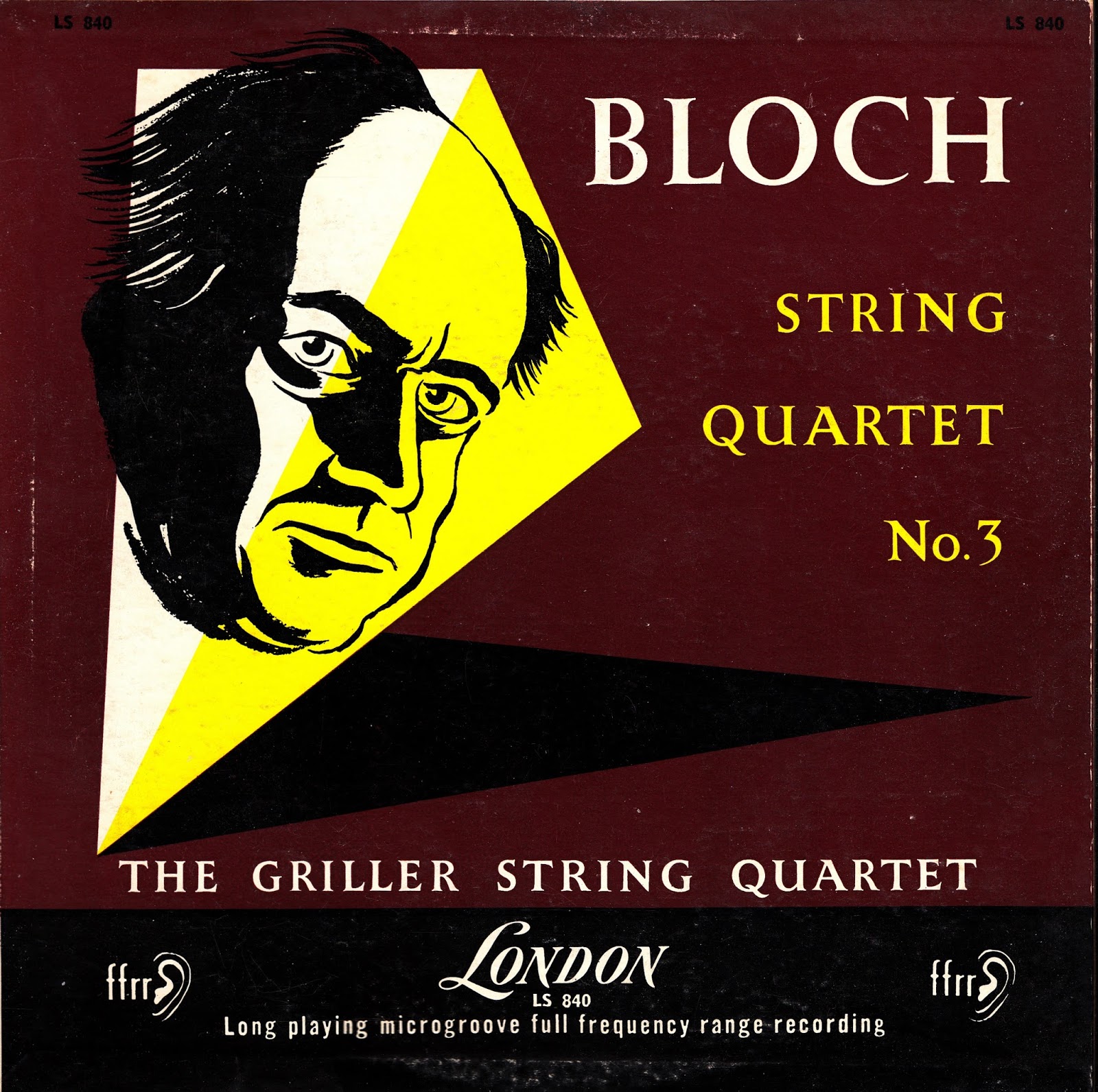
Bloch: String Quartet No. 3 (Griller Quartet)

The Griller Quartet with Ernest Bloch, 1947
About a month ago, I sprang for the recent Decca big box (53 CDs) called "Decca Sound: The Mono Years." Some real gems are rattling around in there, and one of the highlights has been the set of four Bloch string quartets played by the Griller Quartet, who were the dedicatees of the master's Third Quartet of 1952. But it struck me as I was listening to this, that the recording is different than another one that I've had on a ten-inch LP for some time, and consulting Philip Stuart's Decca discography revealed the reason why: the recording on the ten-incher was not reissued in the complete set - instead, an entirely new recording was made, even though it was a mere year later! The earlier recording, which to my knowledge has never been reissued, was made a mere five days before the British première of the piece:

Bloch: String Quartet No. 3 (1952)
The Griller String Quartet (Griller-O-Brien-Burton-Hampton)
Recorded June 16, 1953
London LS-840, one ten-inch LP record
Link (FLAC files, 63.38 MB)
Link (MP3 files, 46.29 MB)

The main difference between the two versions seems to be one of playing time: the earlier one is nearly two minutes slower than the newer one.