Sunday, January 29, 2012

Constant Lambert conducts Alan Rawsthorne

Alan Rawsthorne
Constant Lambert and Alan Rawsthorne, who were friends and drinking companions, shared not only the same year of birth (1905) but also a passion for cats and fish, and even the same wife!  (Not at the same time, of course.  Lambert died 20 years before Rawsthorne, who then married his widow, the painter Isabel Nicholas.)  It probably did no harm to their friendship that their compositional styles were utterly dissimilar.  Rawsthorne's music sounds to me like a kind of English Hindemith, neoclassical and a little dry at times, while Lambert's (to judge from the two works I know, "The Rio Grande" and the Piano Concerto) seems more like an English Gershwin.  Certainly Lambert the conductor was a persuasive advocate for the music of his friend, and he in fact made the first recordings of any of Rawsthorne's orchestral works, which I present here:

Rawsthorne: Symphonic Studies (1939) and
Rawsthorne: "Street Corner" Overture (1944)
Philharmonia Orchestra conducted by Constant Lambert
Recorded March 28 and 29, 1946
HMV C 3542 through 3544, and C 3502, four 78-rpm records
Link (FLAC files, 69.36 MB)
Link (MP3 files, 29.7 MB)

Wednesday, January 25, 2012

Roy Harris: Chamber Music

Roy Harris
During the 1930s, Oklahoma-born Roy Harris (1898-1979) was generally seen as the greatest hope for the future of American music.  After all, the facts of his life - born in a log cabin on Lincoln's birthday, worked as a truck driver while studying to be a composer - made good copy, but beyond this, the music he was writing in the 1930s was as good as, or better than, any being written in America at the time.  The two major American record companies, Victor and Columbia, were quick to seize on this, recording over a dozen of his works between 1933 and 1941 - more than any other contemporary American composer.  If this state of affairs seems incredible to us today, remember that Copland's reputation was that of an enfant terrible with his folksy ballet scores not yet written, Barber and William Schuman were in their 20s, the discovery of Ives was in its infancy, and Gershwin was considered a light music composer.

The two chamber music recordings I present here were among the last fruits of this Harris-mania, and I submit that not only are they two of Harris' finest works, but among the finest chamber music works written by an American.  That the publishers of these works (G. Schirmer and Mills Music, which is now part of Alfred Music Publishing) have allowed them to go out-of-print is a sad commentary on our musical life.

Roy Harris: Quintet for Piano and Strings (1936)
Johana Harris and the Coolidge String Quartet
Recorded January 24, 1939
Victor Musical Masterpiece set DM-752, four 78-rpm records
Link (FLAC file,  64.87 MB)
Link (MP3 file, 31.84 MB)

Roy Harris: String Quartet No. 3 (Four Preludes and Fugues, 1939)
Roth String Quartet (Roth-Weinstock-Shaier-Edel)
Recorded June 13, 1940, and January 6, 1941
Columbia Masterworks Set MM-450, four 78-rpm records
Link (FLAC files, 62.65 MB)
Link (MP3 files, 30.96 MB)

Friday, January 20, 2012

More from Ormandy

Two more vintage Ormandy recordings, one of them a request.  The request happens to be for the first-issued album set to bear Ormandy's name, his Minneapolis Symphony recording of Kodály's Háry János Suite.  Due to a loophole in the Minneapolis Symphony players' contracts, which allowed the orchestra's management to use them to make records for no additional payments, RCA Victor, within a relatively short time (a few weeks in the Januaries of 1934 and 1935), waxed an astounding 170-odd sides with the orchestra.  Among these were many first recordings, including first American recordings of Mahler and Bruckner symphonies, and this one of the Kodály suite:

Kodály: Háry János - Orchestral Suite
Minneapolis Symphony Orchestra conducted by Eugene Ormandy
Recorded January 17, 1934
Victor Musical Masterpiece Set DM-197, three 78-rpm records
Link (FLAC files, 72.69 MB)
Link (MP3 files, 39.62 MB)

Ormandy also recorded the Sibelius First Symphony in Minneapolis, but that isn't the version I have.  What I have is the remake he did in Philadelphia six years later, a set sent to me by Ken Halperin of Collecting Record Covers:

Sibelius: Symphony No. 1 in E minor, Op. 39
Philadelphia Orchestra conducted by Eugene Ormandy
Recorded October 25, 1941
Victor Musical Masterpiece Set DM-881, four 78-rpm records
Link (FLAC files, 104.2 MB)
Link (MP3 files, 58.64 MB)

Both these works share the following facts in Ormandy's discography: he recorded each four times, first in Minneapolis, then one mono and two stereo Philadelphia versions.  And of the two stereo versions, one was for Columbia and one for RCA.

Monday, January 16, 2012

"Is Everybody Happy?" - Ted Lewis

Here's a complete change of pace - my first upload of vintage popular music on this blog.  I hope those of you who have come to expect classical recordings from me will indulge me here, but I have loved the unique stylings of Ted Lewis, the "high-hatted tragedian of jazz," ever since discovering them about 20 years ago.  And when Ken Halperin of Collecting Record Covers very kindly sent me a copy of this set (and several other 78 sets) after having featured the Steinweiss cover on his blog, I was moved to share it here.  So here it is:

"Is Everybody Happy?"
Ted Lewis and his Band
1. Blues (My Naughty Sweetie Gives to Me)
2. Good Night
3. Some of These Days (with Sophie Tucker)
4. On the Sunny Side of the Street
5. Somebody Stole My Gal
6. Tiger Rag
7. Have You Ever Been Lonely?
8. The World Is Waiting for the Sunrise
Recorded 1926-33
Columbia Set C-69, four 10" 78-rpm records
Link (FLAC files, 72.72 MB)
Link (MP3 files, 28.95 MB)

Four of the above sides feature Ted's vocals, with a lazily spoken delivery that surely influenced the Ink Spots several years later.  Three of the sides feature his rather squawky clarinet playing.  Many people find these recordings corny, and because of that, many jazz historians tend to downplay Ted Lewis' influence as a jazz artist.  But in his heyday (the 1920s and early 30s) he was highly respected, and a number of great jazzmen came through his band, including both Dorsey brothers and Benny Goodman.

Wednesday, January 11, 2012

Vaughan Williams for Piano

When I was about 13, I discovered, and fell in love with, the music of Ralph Vaughan Williams (1872-1958).  I remember telling my piano teacher of this discovery, and her reply, "oh, my, but there's no good piano music!"  Well, as I have discovered since, that wasn't entirely accurate - there is some Vaughan Williams piano music, and it's all good, but it's rather hard to find.  Vaughan Williams preferred to work on a large canvas (and after all, why not? - he was a big man!) and so it's fitting that the piano work that most readily comes to mind in connection with his name is his fine Concerto, a big work in every way, written for Harriet Cohen in 1930, and recast as a concerto for two pianos in 1946.  Here is the first recording of either version, by the artists who gave the two-piano version its American première in 1949:

Vaughan Williams: Concerto for Two Pianos and Orchestra
Arthur Whittemore and Jack Lowe, duo-pianists
Robin Hood Dell Orchestra of Philadelphia conducted by Vladimir Golschmann
Recorded July 26, 1950
RCA Victor Red Seal set WDM-1597, three red vinyl 45-rpm records
Link (FLAC file, 61.44 MB)
Link (MP3 file, 32.19 MB)

This set had no 78-rpm issue, as by the time it appeared, RCA Victor had phased out the 78-rpm format in favor of their own 45-rpm discs.

Also written for Harriet Cohen was this charming Hymn Tune Prelude on a song by Orlando Gibbons:

Vaughan Williams: Hymn Tune Prelude (on Gibbons' Song 13) and
Gibbons: Five Keyboard Pieces
Harriet Cohen, piano
Recorded December 4, 1947
English Columbia DX 1552, one 78-rpm record
Link (FLAC files, 23 MB)
Link (MP3 files, 9.1 MB)

Finally, about three years ago, I presented a Sunday morning worship service at my church, the Unitarian Congregation of Gwinnett in Lawrenceville, Ga., devoted to Vaughan Williams - whose hymn tune arrangements have become basic material in most Protestant hymnals.  In lieu of a sermon, I presented a complete performance of his "Suite of Six Short Pieces" for piano, published in 1920, and later rearranged as his "Charterhouse Suite" for string orchestra.  I have posted this performance on Youtube at the following link:

Vaughan Williams: Suite of Six Short Pieces

Saturday, January 7, 2012

Mitch and the 20th Century Harpsichord

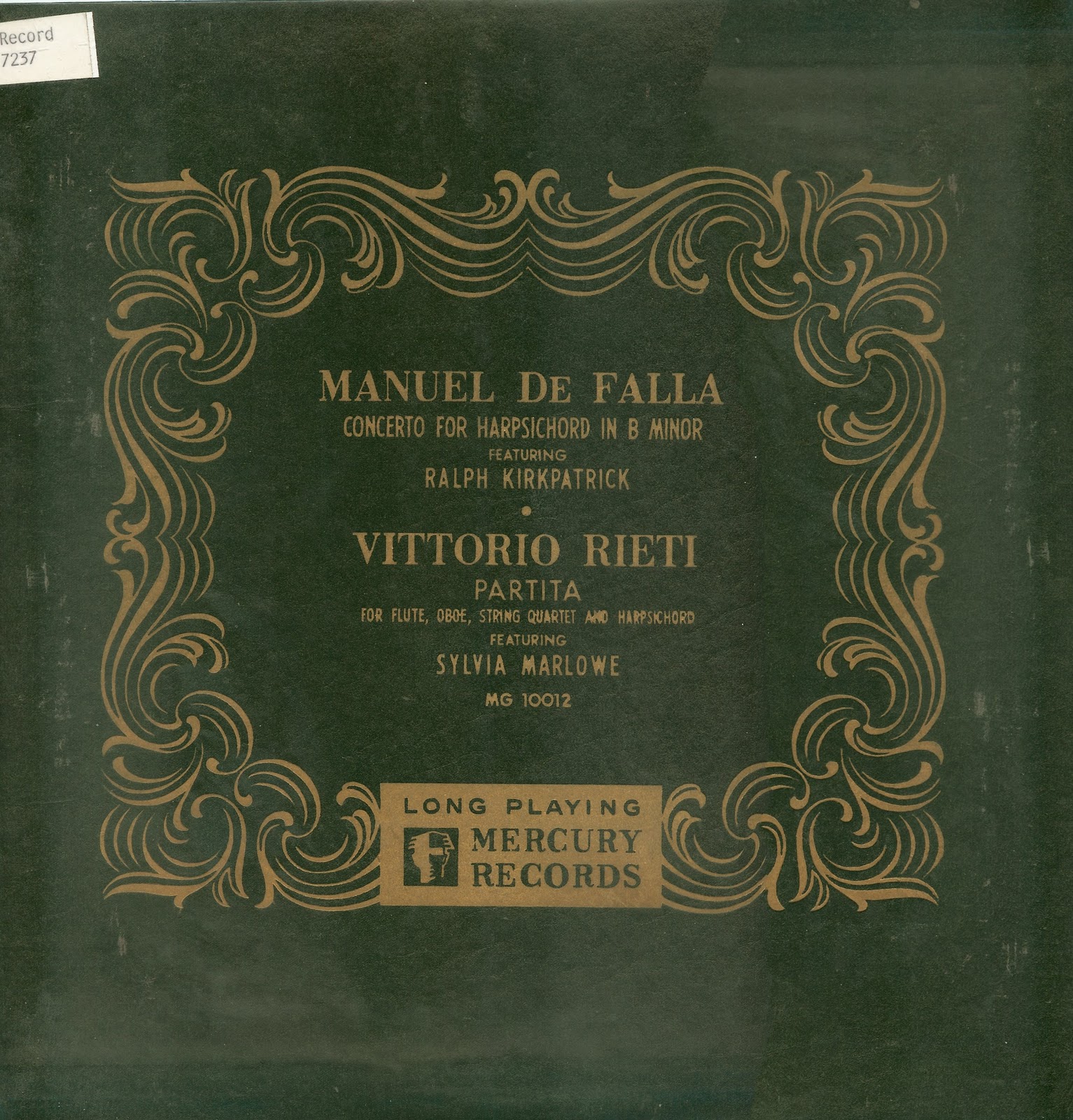
Back to mining early LPs we go, with two quite dissimilar works, the common thread being that they are both 20th century works featuring the harpsichord, and that Mitch Miller plays oboe on both.  Even the harpsichordists are different! This Mercury LP is a reissue of two 78-rpm sets of c. 1947, and by the time it appeared, in late 1949 or early 1950, Mitch Miller was the head of A & R for Mercury's pop division.  He would move to a similar position with Columbia in 1950.

First up is what I and many others consider the greatest 20th century work for harpsichord, Manuel de Falla's Concerto.  This is only its second recording, after the famous one that Falla himself made for French Columbia in 1930.  Ralph Kirkpatrick is the soloist, and he is accompanied by an ensemble consisting of Alexander Schneider, violin; Bernard Greenhouse, cello; Samuel Baron, flute; the aforementioned Mitchell Miller, oboe; and Harold Freeman, clarinet.  This was originally recorded by Keynote, a company that was subsumed by Mercury in 1947:

Falla: Harpsichord Concerto (1926)
Ralph Kirkpatrick, harpsichord, and ensemble
Recorded c. 1947
Side A of Mercury MG 10012, one 12-inch LP record
Link (FLAC files, 46.37 MB)
Link (MP3 files, 23.44 MB)

Also on this LP is the delightful Partita by Vittorio Rieti (1898-1994), a composer who should be far better known.  I like to think of him as a sort of Italian Poulenc; his music has the same sort of witty charm as the French master.  He wrote quite a lot for harpsichord: three works for Sylvia Marlowe, of which this Partita was the first.  (The others were a "Sonata all'Antica" of 1946, and a Harpsichord Concerto of 1955, both of which Miss Marlowe recorded for Decca.)  This is Sylvia Marlowe's first recording of it (she did another for Capitol in the 1950s, and a stereo version for Decca), made with the players who gave the work its première in the spring of 1946:

Rieti: Partita for Harpsichord, Flute, Oboe and Strings (1945)
Sylvia Marlowe, harpsichord; Julius Baker, flute;
Mitchell Miller, oboe; The Kroll Quartet
Recorded c. 1946
Side B of Mercury MG 10012, one 12-inch LP record
Link (FLAC files, 52.44 MB)
Link (MP3 files, 27.62 MB)

Monday, January 2, 2012

A Fifth of Ormandy

This happens to be the fifth post I have offered devoted to Eugene Ormandy (1899-1985), and so I devote it, in part, to a Fifth Symphony - Tchaikovsky's.  This is the first of five recordings he was to make of the work, with the Philadelphia Orchestra, and it's a fine one - Ormandy seldom, if ever, turned out a dull performance of Russian music:

Tchaikovsky: Symphony No. 5 in E minor, Op. 64
Philadelphia Orchestra conducted by Eugene Ormandy
Recorded March 15, 1941
Victor Musical Masterpiece Set M-828, five 78-rpm records
Link (FLAC files, 113.89 MB)
Link (MP3 files, 60 MB)

The other offering here is his 1939 recording of Richard Strauss' "Ein Heldenleben," the first of four he was to make in Philadelphia, with concertmaster Alexander Hilsberg as the violin soloist.  This was intended to replace Mengelberg's pioneering 1928 version with the New York Philharmonic in the Victor catalogue, and, therefore, was not much appreciated at the time! Heard on its own terms, what emerges is an exciting, beautifully-played account of the score:

Strauss: Ein Heldenleben (A Hero's Life), Op. 40
Philadelphia Orchestra conducted by Eugene Ormandy
Recorded April 30, 1939
Victor Musical Masterpiece Set DM-610, five 78-rpm records
Link (FLAC file, 97.41 MB)
Link (MP3 file, 48.92 MB)

Friday, December 30, 2011

The Incomparable Leon Goossens - Postscript

Leon Goossens
My Christmas present to myself this year was a new turntable - an Audio-Technica LP120 3-speed direct drive unit - meaning that it will no longer be necessary for me to switch out between turntables to handle LPs and 78s (at least, I hope it won't be!).  Here is my first project using the new table: an LP featuring two oboe concertos played by the great Leon Goossens, as a kind of postscript to the transfers of concerto recordings by him that I offered earlier:

Bach-Tovey: Concerto in A, BWV 1055, for oboe d'amore and strings
Recorded June 1, 1949, and July 30, 1952
and
Vaughan Williams: Concerto for Oboe and Strings
Recorded June 16, July 7 and September 1, 1952

Leon Goossens, with the Philharmonia String Orchestra
conducted by Walter Susskind
HMV CLP 1656, one 12-inch LP record
Link (FLAC files, 96.04 MB)
Link (MP3 files, 50.18 MB)

No doubt both of these, like the earlier Goossens concerto recordings, would have been issued as English Columbia 78 sets had not the long-delayed launch of LP by EMI in September 1952 intervened.  As it was, both recordings had to wait eleven years for full issue.  In the case of the Bach, an incomplete issue actually did occur in 1953, on American Columbia (ML 4782) - apparently only the first three 78-rpm matrices of the required four were available to CBS, with the result that the concerto, on that release, cuts off about a minute into the finale!

My best wishes to everyone for a prosperous and collectingful New Year!

Thursday, December 22, 2011

Rubinstein: Two Early Concerto Recordings


Arthur Rubinstein
For what is likely to be my last post of 2011, I present two of Arthur (spelled with an "h" on his earliest recordings) Rubinstein's earliest concerto recordings, which show the pianist, then in his early-to-mid-40s, as quite a firebrand.  The first of these is, I'm pretty sure, his very first concerto recording, with Albert Coates conducting:

Brahms: Piano Concerto No. 2 in B-Flat major, Op. 83
Arthur Rubinstein and the London Symphony conducted by Albert Coates
Recorded October 22 and 23, 1929
HMV D 1746 through 1750 (Album 90), five 78-rpm records
Link (FLAC files, 11142.MB)
Link (MP3 files, 56.1 MB)

Rubinstein himself had strong reservations against the issuance of this recording; in his autobiography, he recounts how difficult the sessions were, with the piano placed in the back of the orchestra, far away from Mr. Coates! Nor had he any chance of consulting with Coates before the sessions.  Whatever the circumstances, an exciting performance emerges from these discs, surely one of the fastest on record of the Brahms B-Flat Concerto.  Listen and judge for yourself.

For his next concerto sessions in January 1931, Rubinstein had the services of John Barbirolli, with whom he recorded two works: the Chopin F minor concerto, and this concerto by Mozart:

Mozart: Piano Concerto No. 23 in A major, K. 488
Arthur Rubinstein with the London Symphony conducted by John Barbirolli
Recorded January 7 and 8, 1931
Victor Musical Masterpiece Set M-147, three 78-rpm records
Link (FLAC files, 61.15 MB)
Link (MP3 files, 29.1 MB)

This was among the earliest recordings of any Mozart piano concerto.  It was recorded and issued concurrently with Georges Boskoff's of K. 459 on Parlophone and Magda Tagliaferro's of K. 537 on French Decca; only Dohnányi's famous Columbia recording of K. 453 of 1928 is earlier than these.  It also remained in the catalogue well into the 1950's - in contrast to the Brahms, which was displaced by Schnabel's recording of six years later.

Merry Christmas, everyone!