The Copenhagen String Quartet (Tutter Givskov and Mogens Lydolph, violins; Mogens Bruun, viola; Asger Lund Christiansen, cello) gave the first performances of most of Vagn Holmboe's string quartets from No. 7 on (there were twenty in all). For the Danish Fona label, the group recorded the first ten of these, on five LPs. I have three of them:
Holmboe: String Quartets Nos. 1 and 4
The Copenhagen String Quartet
Fona TF 109, one stereo LP record
Link (FLAC files, 215.70 MB)
Link MP3 files, 80.19 MB)
Holmboe: String Quartets Nos. 2 and 6
The Copenhagen String Quartet
Fona TF 111, one stereo LP record
Link (FLAC files, 214.24 MB)
Link (MP3 files, 77.67 MB)
Holmboe: String Quartets Nos. 9 and 10
The Copenhagen String Quartet
Fona TF 133, one stereo LP record
Link (FLAC files, 227.53 MB)
Link (MP3 files, 81.92 MB)
The first of these LPs is a 1970 reissue of a recording originally made in 1963; the other two are 1973 issues. The liner notes, included with the downloads, are all in Danish, so if anyone conversant with that language cares to translate, the rest of us would be much obliged! It should be noted that the cellist in this ensemble, Asger Lund Christiansen, had also played in the Erling Bloch Quartet, who made the first recording of any of Holmboe's quartets, in 1951.
Monday, May 28, 2018
Thursday, March 15, 2018
More Hindemith Trios
This may well be the first time on this blog that I have offered the same work in consecutive posts, or even featured the same composer. But Nick's recent postings, at Grumpy's Classics Cave, of Mozart and Beethoven string trios played by the Pougnet-Riddle-Pini trio reminded me that I had their valuable coupling of the two Hindemith trios in its third Westminster incarnation, as part of their "Collectors' Series", a mid-60s reissue series derived from monaural chamber music recordings of a decade earlier (and, thankfully, not "updated" with fake stereo trickery):
Hindemith: Two String Trios (No. 1, Op. 34; No. 2, 1933)
Jean Pougnet, violin; Frederick Riddle, viola; Anthony Pini, cello
Recorded in the autumn of 1954
Westminster W-9067, one LP record
Link (FLAC files, 110.32 MB)
Link (MP3 files, 72.90 MB)
I am indebted to Nick, not only for inspiring this post, but also for rendering practical service in eliminating the results of an awful gouge in the vinyl on the first side, affecting the first minute or so of the Op. 34 trio.
While I was working on the above transfer, it occurred to me that if I transferred one more LP, I could have available on this blog all the recordings of Hindemith's string trios to be made before the advent of digital recording (including the ones the composer participated in). I am not aware of any other recording of No. 2 besides the one I posted last month, but of No. 1, besides the incomplete one by the Amar-Hindemith Trio, a stereo LP version was made in 1968 by three young German musicians, coupled with the first recording, by a different ensemble, of Hindemith's Op. 16 string quartet:
Hindemith: String Trio No. 1, Op. 34
Rainer Kussmaul, violin; Jürgen Kussmaul, viola; Jürgen Wolf, cello
and
Hindemith: String Quartet No. 3 (old No. 2) in C, Op. 16
Schäffer Quartet (Schäffer-Szabados-Pill-Racz)
Recorded in the summer of 1968
Musical Heritage Society OR-H-297, one stereo LP record
Link (FLAC files, 239.37 MB)
Link (MP3 files, 85.52 MB)
This recording was made by an independent German recording company, Da Camera, in Heidelberg, and was part of a 9-disc retrospective of Hindemith's chamber music. In Germany the series was published as a box set, whereas in the USA each record was obtainable separately. Of the three musicians playing the Op. 34 trio, only one is still with us: Jürgen Kussmaul, born in 1944, was two years older than brother Rainer, who departed this life only last year. The cellist, Jürgen Wolf, was born in 1938 and died in 2014. Their playing of Op. 34 contrasts markedly with that the Pougnet ensemble; the latter really dig into the music while the Germans are more careful and always beautiful-sounding. The Pougnet's approach is much closer to the Amar-Hindemith's in the two movements where direct comparisons are possible.
Wednesday, February 28, 2018
Hindemith: String Trio No. 2 (Goldberg, Hindemith, Feuermann)
![]() |
| Front of booklet for Columbia Set 209 |
Hindemith: String Trio No. 2 (1933)
The Hindemith Trio (Goldberg-Hindemith-Feuermann)
Recorded January 21, 1934
Columbia Masterworks Set No. 209, three 78-rpm records
Link (FLAC files, 64.74 MB)
Link (MP3 files, 42.17 MB)
This set has the distinction of containing the first work of Hindemith to be issued on records in the USA on domestic pressings (April, 1935); hitherto, American record collectors interested in Hindemith had to rely on imported pressings (mostly from Polydor). The recording remained available until the end of Columbia's production and sale of classical 78s, about 1951 or so.
The week of this recording saw a flurry of activity in the studio for these three gentlemen. Also on January 21 (a Sunday), Goldberg and Hindemith recorded a Mozart duo (K. 424), then, the following day, the full trio recorded Beethoven's Serenade (Op. 8). On Tuesday, January 23, Goldberg had to leave for a concert tour; coming to the studio to bid his colleagues farewell, he found them listening to the playback of a Scherzo that Hindemith had written that morning for himself and Feuermann! This was intended as a filler for a recording Hindemith made the same day, on five 10-inch sides, of his solo viola sonata (Op. 25, No. 1), though in the end it was not used as such, being released instead in the Columbia History of Music, Vol. 5. On Saturday, January 27, Feuermann recorded Hindemith's solo cello sonata to complete this valuable little group of recordings. All of them were made available on American Columbia during the 1930s, though only the two trios and the Scherzo survived the purge of wartime deletions.
Friday, February 9, 2018
Howard Ferguson: Octet
![]() |
| Howard Ferguson |
Howard Ferguson: Octet, Op. 4
The Griller String Quartet (Griller-O'Brien-Burton-Hampton)
augmented by
Pauline Juler, clarinet
Cecil James, bassoon
Dennis Brain, horn
James Merrett, double bass
Recorded April 7 and May 24, 1943
Decca AK 1095 through AK 1097, three 78-rpm records
Link (FLAC files, 53.49 MB)
Link (MP3 files, 32.61 MB)
This is one of Dennis Brain's earliest recordings, and, of course, he would make many more before his untimely death in 1957 of an auto accident. It appears, however, that this is the only recording by Pauline Juler (1914-2003), a fact that seems doubly regrettable when one hears her fine account of the prominent clarinet part in Ferguson's Octet. But Juler, who had studied with Charles Draper, gave up performing publicly after her marriage to cellist Bernard Richards in 1948.
Wednesday, January 17, 2018
Beethoven: Sonata, Op. 109 (Denis Matthews)
![]() |
| Denis Matthews |
Beethoven: Piano Sonata No. 30 in E Major, Op. 109
and
Purcell: Suite No. 2 in G Minor, Z. 661
Denis Matthews, piano
Recorded May 15 and 31, 1946
Columbia DX 1509 through DX 1511, three 78-rpm records
Link (FLAC files, 57.34 MB)
Link (MP3 files, 37.02 MB)
As always, I didn't mean to be away from blogging quite so long! It's true that I haven't been acquiring records lately, certainly not at anything like my old rate, but I haven't been idle with respect to my record hobby - far from it! I was sidetracked, just before Christmas, with the exciting discovery (for me) that two vintage record magazines are now available online from the Internet Archive, both published by the H. Royer Smith Company of Philadelphia - Disques (1930-33) and The New Records (1933-56). (Granted, this is not a complete run of the latter, but it at least takes one well into the mono LP era.) So I have spent most of my free time perusing these. Particularly exciting is the chance to obtain issue dates for American Columbia releases of the early and middle 1930s, information about this period being rather hard to come by. I have updated my three Columbia discographical files to reflect what I have found:
Columbia Masterworks Sets
Columbia Blue Label -D Series
Columbia Celebrity -M Series
For the first two of these, only the information on issue dates has had to be updated, but for the Celebrity Series I have added a few actual titles of whose existence I was previously unaware.
Perhaps some day I will do a series on month-by-month issue dates of Columbia Masterworks sets in the USA.
Friday, December 8, 2017
Beethoven: Quartet No. 15 (Erling Bloch Quartet)
This year I have certainly managed to acquire a healthy batch of recordings by the Erling Bloch Quartet, and here is the latest installment, apparently the Danish ensemble's only recording of Beethoven:
Beethoven: Quartet No. 15 in A Minor, Op. 132
The Erling Bloch Quartet (Bloch-Friisholm-Kassow-Christiansen)
Recorded April 12 and 13, 1951
HMV DB 20143 through DB 20147, five 78-rpm records
Link (FLAC files, 117.62 MB)
Link (MP3 files, 70.74 MB)
It's a good, honest performance, a little broader in tempo than was customary for 78-rpm recordings of this work, particularly in the finale. It may not have the searing intensity of the 1937 version by the Busch Quartet (which, incidentally, was slated for deletion in the HMV 1950-51 catalogue), but then, which other version did? I hate making comparisons like this, but in the case of this particular piece I can't help it, because of all the Beethoven quartets Op. 132 is the one I love most, and the Busch performance is my ideal...
Monday, November 20, 2017
Happy Birthday, Benjamin Britten!
![]() |
| Benjamin Britten, 1938 |
Britten: Variations on a Theme of Frank Bridge, Op. 10
Boyd Neel String Orchestra conducted by Boyd Neel
Recorded July 15, 1938
Decca X 226 through X 228, three 78-rpm records
Link (FLAC file, 65.91 MB)
Link (MP3 file, 38.41 MB)
This is Britten's first work to be generally recognized as a masterpiece, written to Boyd Neel's commission for a 1937 appearance at the International Society of Contemporary Music Festival in Salzburg. The ISCM requested that Neel bring a new work by an English composer, and Neel despaired of finding one on short notice until he thought of Britten's high-quality (and speedily written) film work, some of which he had conducted in the studios. Neel's hunch that the young man might quickly furnish a worthwhile score was amply repaid. Britten's initial draft of the Bridge Variations was sketched in ten days, and four weeks later the piece had been fully scored - "one of the most astonishing feats of composition in my experience," said Neel.
This set was reviewed in the November, 1938, Gramophone Shop Supplement (in which it was offered for sale at $7,25, including album). "The discs are the first example of [Britten's] work to reach this country," said the anonymous reviewer. "The principal shortcoming of the present work is the inclusion of genre pieces like the Aria Italiana and Wiener Walz, very cleverly turned out but definitely lessening the effect of the remarkable Funeral March, Chant and Fugue. There is some remarkably powerful and eloquent writing in these last sections, writing that on first hearing mark Britten as a man to be watched. The whole work is an unusually attractive and interesting example of contemporary music on discs, and its best pages are an indication that not only Britain but the world has a highly significant new force to reckon with." Quite a prescient review, although I can't agree with the assertion that the lighter sections constitute shortcomings!
Friday, November 3, 2017
Piano Works of Niels Viggo Bentzon
As my last post featured 20th-century Danish piano music, so does this one, but what a contrast in styles! I had really hoped to offer the two composers together, but with the demands being made on my time lately, it simply wasn't to be. In any event, if Jørgen Jersild's influences were primarily French, those of his contemporary, the somewhat better-known Niels Viggo Bentzon (1919-2000), were undeniably Teutonic. Here are three early examples played by the composer (and an extra, played by an associate):
Bentzon: Toccata, Op. 10 (1941)
Niels Viggo Bentzon, piano
Recorded November 26, 1948
HMV Z 276, one 78-rpm record
Link (FLAC file, 17.44 MB)
Link (MP3 file, 11.33 MB)
Bentzon: Partita, Op. 38 (1945)
Niels Viggo Bentzon, piano
Recorded May 23, 1946
and
Concert Etude, Op. 40
Bengt Johnsson, piano
Recorded November 23, 1948
HMV Z 7013 through Z 7015, three 78-rpm records
Link (FLAC files, 49.16 MB)
Link (MP3 files, 30.41 MB)
Bentzon: Sonata No. 3, Op. 44 (1946-47)
Niels Viggo Bentzon, piano
Recorded June 14, 1949
HMV Z 7030 and Z 7031, two 78-rpm records
Link (FLAC file, 38.42 MB)
Link (MP3 file, 24.06 MB)
The craggy Toccata was Bentzon's calling card as a young composer; he achieved his first success with it. It is that singular anomaly, a toccata in adagio tempo. This is, in fact, its second recording, replacing one issued under the same number in 1942. The equally craggy five-movement Partita recalls Baroque models in its title only, for the work makes full use of modern piano techniques, with numerous passages written in four staves! The Third Sonata is somewhat more conventional, and bears a dedication to Georg Vásárhelyi, Bentzon's piano teacher and a co-soloist on the recording of Bentzon's Chamber Concerto that I posted three years ago. Bentzon ultimately composed an astonishing 31 piano sonatas (one has to wonder, was he trying to outdo Beethoven?), and the first one remained unfinished. All that was published of it is the Concert Etude that appears as a filler to the Partita.
Friday, October 20, 2017
Jørgen Jersild: Trois Pièces en Concert
![]() |
| Jørgen Jersild |
Jørgen Jersild: Trois Pièces en Concert
Folmer Jensen, piano
Recorded March 28, 1950
HMV Z 350 and Z 351, two 78-rpm records
Link (FLAC file, 37.36 MB)
Link (MP3 file, 24.21 MB)
The "three pieces" are all derived from French dance forms (Tambourin, Romanesque, Farandole), and therefore resembles, externally, a Baroque keyboard suite - although only the Tambourin is commonly associated with the Baroque period. Most impressive is the middle movement, "avec dix Doubles" (with ten variations), on a Renaissance dance pattern related to the Galliard.
This is a rare solo recording by Folmer Jensen (1902-1966), whose forte appears to have been accompanying; tenor Aksel Schiøtz and clarinetist Louis Cahuzac are among the artists who secured his services for that purpose in the recording studios.
Monday, September 25, 2017
Tchaikovsky: Symphony No. 3 (Beecham)
Tchaikovsky: Symphony No. 3 in D Major, Op. 29 ("Polish")
Sir Thomas Beecham conducting the Royal Philharmonic Orchestra
Recorded April, 1947
RCA Victor set DM-1279, five 78-rpm records
Link (FLAC files, 113.12 MB)
Link (MP3 files, 73.55 MB)
Of the six Tchaikovsky symphonies, the Third seems to me the most ideal vehicle for Sir Thomas' talents. This is particularly true of the three middle movements, and how fortunate are we that these are played without cuts! The outer movements do have a few judicious cuts, but to be fair, I've never heard a 78-rpm version of this work that didn't have them. The pioneering version by Albert Coates, of 1932, hacked each of the middle movements down to one side, and Hans Kindler's of 1940 and Gregor Fitelberg's of 1946 each have cuts in the outer movements, the latter hacking the Finale to one side.
Thursday, September 14, 2017
Nielsen by E. T.
No, this post has nothing to do with extra-terrestrials! Several weeks ago, I had two different conductors with the same initials featured in one composer at this post. Just so, now I present two different conductors with the initials "E.T." performing Nielsen - more fruits of my recent splurgings on Danish 78s. The details:
Nielsen: En Sagadrøm (A Saga Dream), Op. 39
Copenhagen Royal Opera Orchestra conducted by Egisto Tango
Recorded February 27, 1942
HMV DB 5263, one 78-rpm record
Link (FLAC file, 22.27 MB)
Link (MP3 file, 14.67 MB)
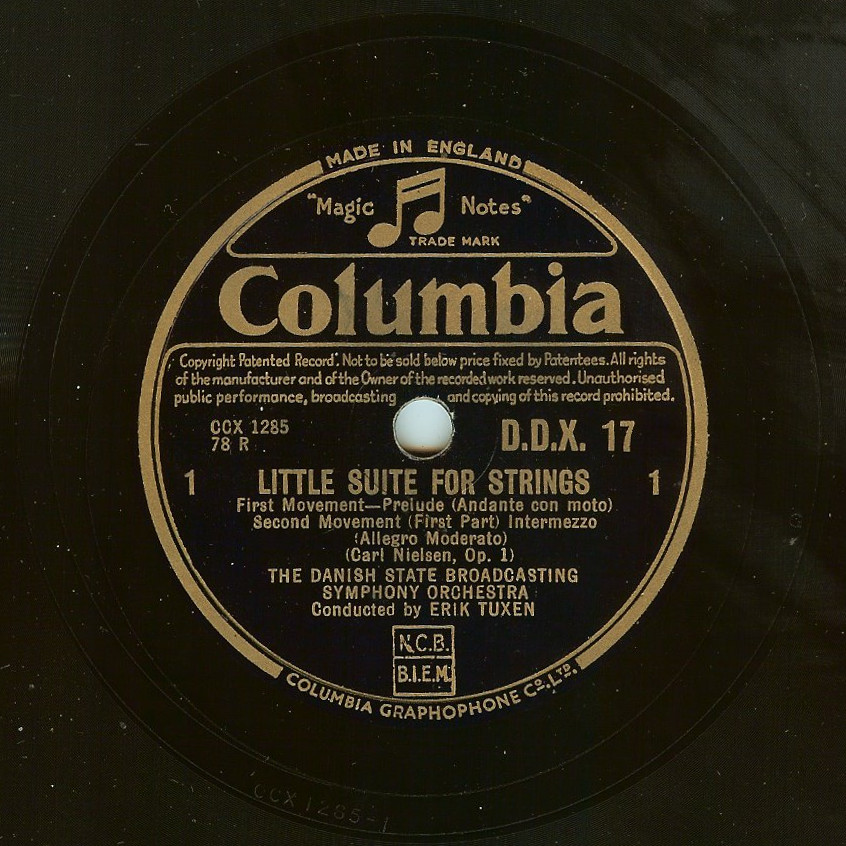
Nielsen: Little Suite for Strings, Op. 1
Danish State Broadcasting Orchestra conducted by Erik Tuxen
Recorded April 7, 1948
Columbia DDX 17 and 18, two 78-rpm records
Link (FLAC file, 38.74 MB)
Link (MP3 file, 23.71 MB)
The Sagadrøm record is a real gem, and as for the Little Suite, has there ever been an Opus 1 as accomplished, and as fully characteristic of its composer?
I didn't mean to be gone quite so long, but on top of computer problems, which I'm still working on, I've had to deal with Hurricane Irma, which we in Atlanta didn't get the full brunt of, as Florida did, but we got quite enough - sustained winds of 40 miles per hour, sometimes gusting to 60, and over 3 inches of rain in a single day. The past weekend saw me frantically elevating hundreds of records from the floor of my basement, in anticipation of water from the storm coming in, which, thankfully, didn't happen, but it's always better to be safe than sorry!
Tuesday, August 29, 2017
Holmboe: Quartet No. 1 (Erling Bloch Quartet)
![]() |
| Vagn Holmboe |
Holmboe: String Quartet No. 1, Op. 46 (1949)
The Erling Bloch Quartet (Bloch-Friisholm-Kassow-Christiansen)
Recorded April 9, 1951
HMV DB 20137 through DB 21039, three 78-rpm records
Link (FLAC files, 58.74 MB)
Link (MP3 files, 38.75 MB)
This fine three-movement quartet, the first of a remarkable series of twenty, was dedicated to, and premièred by, the Erling Bloch Quartet. Holmboe had, in fact, written no less than ten string quartets (not all of them actually completed) before the one he allowed to go out into the world as his First; at the time of its composition, he had already written six of his thirteen symphonies, and all but two of his series of thirteen chamber concertos. The first three of the numbered quartets were written in rapid succession, assigned consecutive opus numbers and recorded within five years - the Second by the Musica Vitalis Quartet for Decca, and the Third by the Koppel Quartet (the dedicatees), also for Decca. The latter was reissued on CD as part of the "Decca Sound - Mono Years" box set issued a couple of years ago.
Sunday, August 20, 2017
Goldmark: Rustic Wedding Symphony (Howard Barlow)
![]() |
| Karl Goldmark |
Goldmark: Rustic Wedding Symphony, Op. 26
Howard Barlow conducting the Columbia Broadcasting Symphony
Recorded June 19, 1939
Columbia Masterworks set MM-385, five 78-rpm records
Link (FLAC files, 92.83 MB)
Link (MP3 files, 69.18 MB)
This was only the second recording of the work - the first had been made 10 years earlier, by the Vienna Philharmonic under Robert Heger, issued in the USA by Victor but deleted shortly after this fine account by Barlow appeared.
The request for this recording was from Fred, of the excellent blog "Random Classics" which, unfortunately, he felt obliged to suspend four years ago. Fred, wherever you are, I hope you are able to enjoy this recording, seven years late...
Sunday, August 13, 2017
Bach: Harpsichord Concerto No. 7 (Anna Linde)
![]() |
| Anna Linde |
Bach: Harpsichord Concerto No. 7 in G Minor, BWV 1058
Anna Linde, harpsichord, with string orchestra
Recorded October 8, 1928
English Parlophone E 10879 and E 10880, two 78-rpm records
Link (FLAC file, 40.39 MB)
Link (MP3 file, 22.71 MB)
According to Christian Zwerg's Parlophon discography, the orchestra is that of the Berlin State Opera, and the conductor was Frieder Weissmann, Parlophon's house conductor. And the irony is that, although Weissmann's name is not on the labels, we know far more about his career than we do about the harpsichordist's, for Anna Linde is a figure shrouded in mystery. Here is what we have been able to find out about her (and I am indebted to Nick Morgan and his great sleuthing powers for this information):
She was born Johanna Anna Pincus in Bromberg, Germany (now Bydgoszcz, Poland), in 1880. During the 1910s she studied with Wanda Landowska at the Berlin Hochschule für Musik, and sometime after this adopted "Anna Linde" as her professional name. In the late 1920s she recorded a handful of sides for Parlophon, among them several with Paul Grümmer playing the viola da gamba (these can be heard at the CHARM website, as can two of her solo sides). Being Jewish, when the Nazis came to power, she was forced to flee Germany, and she went first to Italy, where she made several recordings for the anthology "Musiche Antiche Italiane" (producers of this first recording of Monteverdi's "Orfeo"). After Italy became unsafe for Jews, she emigrated to the USA, took citizenship and appears to have settled in Denver, Colorado, dying there in 1968.
The picture above is the only one I have been able to find of her, and appears to derive from Parlophon publicity material; my apologies for its awful quality but it was little better in my source, which was a reproduction in Frank Andrews and Michael Smith's discography of English Parlophone's 12-inch "E" series, published by the City of London Phonograph and Gramophone Society.
Friday, August 4, 2017
Bloch: Violin Sonata No. 1 (Josef Gingold, Beryl Rubinstein)
![]() |
| Ernest Bloch, early 1920s |
Bloch: Violin Sonata No. 1 (1920)
Josef Gingold, violin; Beryl Rubinstein, piano
Recorded c. January 1938
Victor Musical Masterpiece set AM-498, four 78-rpm records
Link (FLAC files, 69.03 MB)
Link (MP3 files, 49.67 MB)
This recording affords us a rare opportunity to hear Josef Gingold (1909-1995) as a soloist; he was much more active as a chamber and orchestral musician, being in Toscanini's NBC Orchestra and in the Primrose Quartet. Beryl Rubinstein (1898-1952), on the Cleveland Institute's faculty while Bloch was there (and subsequently its director), was one of the dedicatees of Bloch's Second Violin Sonata, along with violinist André Ribaupierre; together they premièred the work in 1925. Curiously enough, another Rubinstein, Artur. participated in the première of the First Sonata, with violinist Paul Kochanski.
Saturday, July 29, 2017
Mozart Serenades by E. F.
Two albums containing Mozart serenades this week, the common denominator to both being that a conductor with the initials "E. F." leads a (presumably) hand-picked ensemble. Here are the details:
Mozart: "Salzburg Serenades"
(Concertante and Rondo from Serenade No. 9 in D, K. 320;
Serenata Notturna in D, K. 239)
Edvard Fendler conducting the Vox Chamber Orchestra
Recorded c. 1945-46
Vox Album 161, four 10-inch 78-rpm records
Link (FLAC files, 63.91 MB)
Link (MP3 files, 41.28 MB)
Mozart: Serenade No. 10 in B-Flat, K. 361, for thirteen wind instruments
Edwin Fischer conducting his Chamber Orchestra
Recorded September 1939
Victor Musical Masterpiece set DM-743, three 78-rpm records
Link (FLAC files, 68.76 MB)
Link (MP3 files, 43.88 MB)
Leipzig-born Fendler (1902-1987), who would appear to have left Germany with the rise of Nazism, ended up with conducting jobs in places as diverse as the Dominican Republic, Costa Rica, Mobile (Alabama) and Beaumont (Texas). He had made recordings in France before the war - among them, another version of this same Serenata Notturna. The "Vox Chamber Orchestra" was, I suspect, an ad hoc body of New York players.
Edwin Fischer (1886-1960) was, of course, much better known as a pianist, but was a fine conductor as well, and he often combined the two roles, most notably with Bach. This recording, made in Berlin, manages to get Mozart's great Gran Partita onto three discs by omitting two movements and excising one of two trios of a minuet, and by scrupulously avoiding repeats. What remains, however, is very well played and conducted indeed.
Sunday, July 23, 2017
More from Morton
| Cover design by Alex Steinweiss |
String Time
1. Body and Soul (Johnny Green)
2. Laura (David Raskin)
3. Holiday for Strings (David Rose)
4. Sophisticated Lady (Duke Ellington)
5. Solitude (Duke Ellington)
6. Over the Rainbow (Harold Arlen)
7. The Surrey With the Fringe On Top (Richard Rodgers)
8. Stormy Weather (Harold Arlen)
Morton Gould and His Orchestra
Recorded July 11 and 15, 1946
Columbia Masterworks set M-663, four 10-inch 78-rpm records
Link (FLAC files, 63.38 MB)
Link (MP3 files, 43.86 MB)
Music at Midnight
1. Caravan (Duke Ellington)
2. Moonglow (Will Hudson)
3. Song of the Bayou (Rube Bloom)
4. Deserted Ballroom (Morton Gould)
5. Mood Indigo (Duke Ellington)
6. Serenade in the Night (Cesare Andrea Bixio)
7. Deep Purple (Peter de Rose)
8. Swamp Fire (Harold Mooney)
Morton Gould and His Orchestra
Recorded November 14, 15 and 22, 1950
Columbia Masterworks set MM-992, four 10-inch 78-rpm records
Link (FLAC files, 70.52 MB)
Link (MP3 files, 46.93 MB)
It will be seen that each collection contains two Duke Ellington tunes, and that "Music at Midnight" also has one of Gould's own compositions, originally a piano piece that he had recorded a decade earlier. To the expected string orchestra of "String Time" Gould's orchestrations add a harp and celesta, and, in the case of "The Surrey With the Fringe On Top" - played entirely pizzicato - also such appurtenances as sleigh bells, wood block, whip and even a banjo. "Music at Midnight" has the distinction of being Columbia's last Masterworks 78-rpm set to be released on a regular schedule concurrent with LP releases, in April, 1951. With the May releases 78s were dropped, although five set numbers (993 to 997) had been assigned, and after that, only selected Masterworks releases appeared as 78s, usually semi-classical in nature.
| Cover design by Alex Steinweiss |
Sunday, July 16, 2017
Festive Ormandy
| Cover design by Alex Steinweiss |
Respighi: Feste Romane (1928)
Philadelphia Orchestra conducted by Eugene Ormandy
Recorded April 18, 1946
Columbia Masterworks set MM-707, three 78-rpm records
Link (FLAC file, 60.69 MB)
Link (MP3 file, 39.78 MB)
About five years ago, I uploaded Ormandy's first Philadelphia recording of Sibelius' First Symphony, along with his Minneapolis recording of Kodály's Háry János Suite. I noted the existence of an earlier recording of the same symphony from Minneapolis, and have now located a copy of that, and here it is:
Sibelius: Symphony No. 1 in E Minor, Op. 39
Minneapolis Symphony Orchestra conducted by Eugene Ormandy
Recorded January 16, 1935
Victor Musical Masterpiece set DM-290, five 78-rpm records
Link (FLAC files, 110.30 MB)
Link (MP3 files, 66.42 MB)
Originally issued with a generic cover, by the time of my pressing, c. 1940, the set was sporting this simple but evocative cover design:
Tuesday, July 11, 2017
Herman D. Koppel
![]() |
| Herman D. Koppel |
Nielsen: Theme and Variations, Op. 40 and Chaconne, Op. 32
Herman D. Koppel, piano
Recorded December 13, 1940
HMV DB 5252 through DB 5254, three 78-rpm records
Link (FLAC files, 65.99 MB)
Link (MP3 files, 40.48 MB)
Koppel died on Bastille Day, and here he is playing French music - only the second recording ever made of Poulenc's delightful Trio (after the composer's own, for Columbia, in 1928):
Poulenc: Trio for Oboe, Bassoon and Piano (1926)
Waldemar Wolsing, oboe; Carl Bloch, bassoon; Herman D. Koppel, piano
Recorded c. 1950
Metronome CL 3000 and CL 3001, two 10-inch 78-rpm records
Link (FLAC file, 32.22 MB)
Link (MP3 file, 18.71 MB)
Metrnonome Records was an independent Swedish label founded in 1949 by two jazz enthusiasts, brothers Anders and Lars Burman. This was one of their few classical issues.
Labels:
Bassoon,
Bloch (Carl),
Chamber Music,
Koppel,
Nielsen,
Oboe,
Piano,
Poulenc,
Winds,
Wolsing
Thursday, July 6, 2017
Florent Schmitt: String Trio (Pasquier Trio)
![]() |
| Florent Schmitt |
Florent Schmitt: String Trio in E Minor, Op. 105
The Pasquier Trio (Jean, Pierre and Étienne Pasquier)
Recorded May 21 and December 3, 1946
Pathé PDT 103 through 106, four 78-rpm records
Link (FLAC files, 81.26 MB)
Link (MP3 files, 46.96 MB)
This is a big, satisfying work in four movements, thickly scored (often, because of double-stopping, it sounds more like a sextet), and of immense technical difficulty. Perhaps this explains its comparative neglect, even among Schmitt's works. I believe it has been recorded only once since, in the early 1980s, on an obscure French label, Cybelia - a valiant attempt, but not equal to the one played by the dedicatees. The Gramophone Shop Supplement of October, 1948, reviewed this set (which sold for $10.48), calling it "music of savage power, strange harmonies, and relentless drive. One is hard-pressed to find what may be called 'beauty'..." The anonymous reviewer was certainly right about the power and drive, but there is nothing in the harmonies that would be out of place in, say, Fauré's late chamber music. For me the piece is a real find, as much so as the Loeffler violin partita that I posted last year.
Subscribe to:
Posts (Atom)