Showing posts with label Purcell. Show all posts

Wednesday, January 17, 2018

Beethoven: Sonata, Op. 109 (Denis Matthews)

Denis Matthews
Happy New Year! For my first post of 2018, I offer the first recording by Denis Matthews of a piano sonata by Beethoven, one of two composers with which he was most closely associated (the other being Mozart):

Beethoven: Piano Sonata No. 30 in E Major, Op. 109
and
Purcell: Suite No. 2 in G Minor, Z. 661
Denis Matthews, piano
Recorded May 15 and 31, 1946
Columbia DX 1509 through DX 1511, three 78-rpm records
Link (FLAC files, 57.34 MB)
Link (MP3 files, 37.02 MB)

As always, I didn't mean to be away from blogging quite so long! It's true that I haven't been acquiring records lately, certainly not at anything like my old rate, but I haven't been idle with respect to my record hobby - far from it! I was sidetracked, just before Christmas, with the exciting discovery (for me) that two vintage record magazines are now available online from the Internet Archive, both published by the H. Royer Smith Company of Philadelphia - Disques (1930-33) and The New Records (1933-56). (Granted, this is not a complete run of the latter, but it at least takes one well into the mono LP era.) So I have spent most of my free time perusing these. Particularly exciting is the chance to obtain issue dates for American Columbia releases of the early and middle 1930s, information about this period being rather hard to come by. I have updated my three Columbia discographical files to reflect what I have found:

Columbia Masterworks Sets
Columbia Blue Label -D Series
Columbia Celebrity -M Series

For the first two of these, only the information on issue dates has had to be updated, but for the Celebrity Series I have added a few actual titles of whose existence I was previously unaware.

Perhaps some day I will do a series on month-by-month issue dates of Columbia Masterworks sets in the USA.

Thursday, February 23, 2017

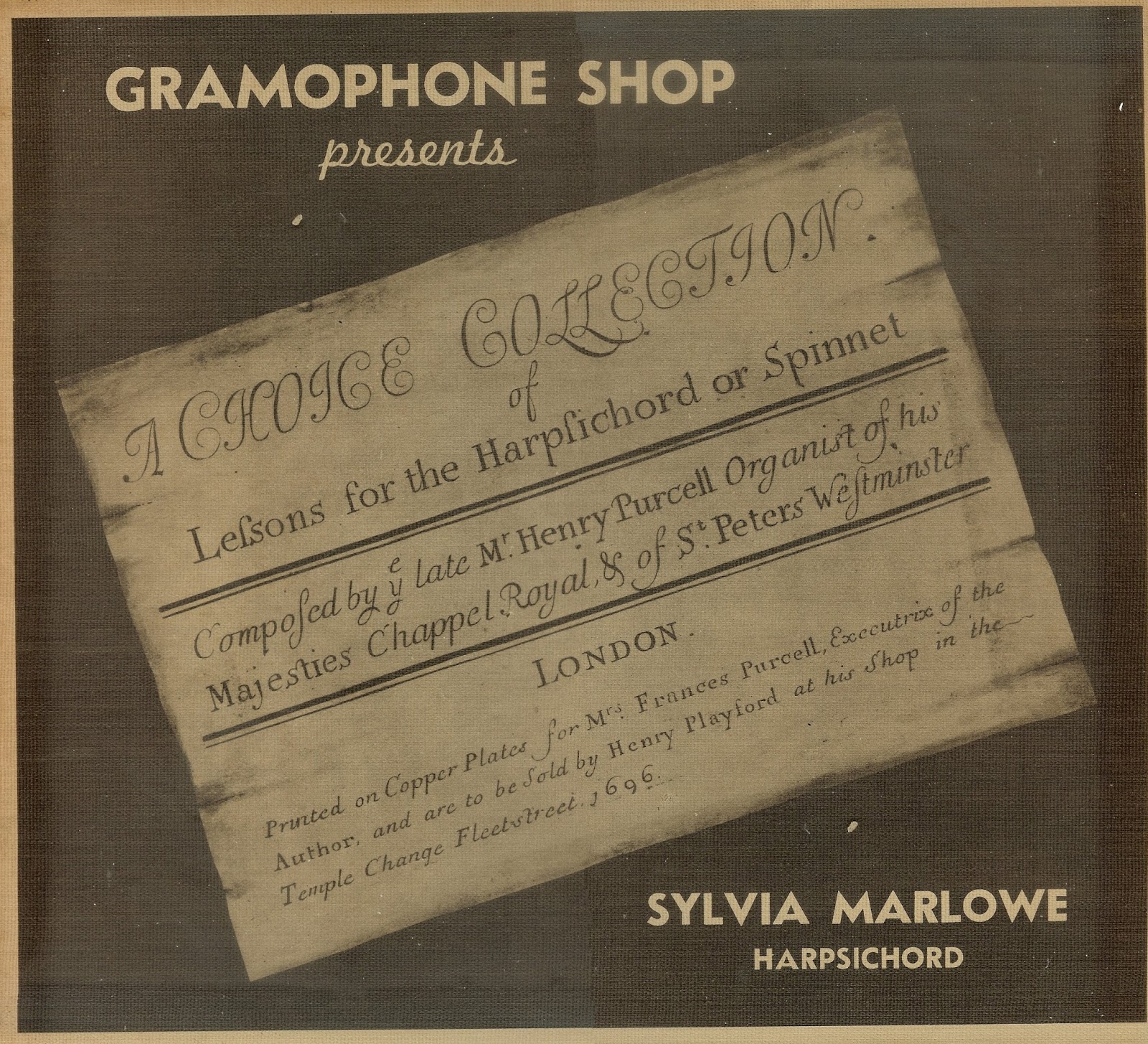
Purcell: Harpsichord Suites (Sylvia Marlowe)

I have had occasion, in the recent past, to sing the praises of New York's Gramophone Shop, and to enumerate their album series called "Gramophone Shop Celebrities" - two of which, both organ recitals by Finn Viderø, I have posted already. Here is the first offering in that illustrious series, released in December, 1946, and featuring the first integral recording of Purcell's "Choice Collection of Lessons for the Harpsichord" comprising eight suites:

Purcell: Eight Suites for Harpsichord (Z. 660/3 and Z. 666/9)
Sylvia Marlowe, harpsichord
Recorded c. 1946
Gramophone Shop Celebrities Album GSC-2, five vinyl 78-rpm records
Link (FLAC files, 122.19 MB)
Link (MP3 files, 77.73 MB)

This appears also to be one of the first recordings by Sylvia Marlowe to be circulated reasonably widely, although it is still far from common. Previous albums for General (1940 - containing boogie-woogie arrangements) and Bost (1942) do not appear to have survived wartime exigencies. 78 sets for Musicraft and American Decca would follow (one example of the latter, a jazzed-up version of Rameau's Tambourin, can be heard here), but her recording career would not truly blossom until the LP era, most notably for Capitol and, again, American Decca.

Thursday, July 9, 2015

The Early Music Revival in America

Early music - particularly music of the Baroque - has become such a part of out musical fabric in recent years that it's hard to recall a time, less than a century ago, that there had to be special advocacy for it. One of the most prominent of its advocates in the USA was the Dutch-born Ben Stad (1885-1946), who, with other members of his family, founded the Philadelphia-based American Society of the Ancient Instruments in 1929. The group consisted of Stad, playing viola d'amore; his wife, Flora, at the harpsichord; their son, Maurice, playing bass viol; Flora's brother, Josef Smit, playing viola da gamba, and a family friend, Jo Brodo, playing "quinton" (what we would now call pardessus de viole). The ensemble was modelled after the famous Société des Instruments Ancienes in France, founded in 1901 by the Casadesus family. The French ensemble made a fair number of recordings - most of them devoted to pastiche pieces written by Henri or Marius Casadesus and attributed to older composers. On the other hand, the Stad ensemble, although they surely had some of these Casadesus pastiches in their repertoire, recorded mostly genuine works:

Music of Early Composers (Set I)
1. Byrd: Pavane (The Earle of Salisbury) and Galliard
2. Purcell: Chacony in G minor, Z. 730
3. Stad [arr.]: "Suite d'Aires [sic] de la Vieille France"
4. Alessandro Marcello: Concerto in D minor - Adagio
5. Benedetto Marcello: Sonata in G minor, Op. 1, No. 4
6. Sacchini: Chimène - Allegro spiritoso
7. Mouret [attrib.]: Divertissement - Passepied
The American Society of the Ancient Instruments
Recorded October 23 and November 1, 1933, May 3, 1934, and June 5, 1935
Victor Musical Masterpiece set M-215, two 12" and two 10" 78-rpm records
Link (FLAC files, 86.93 MB)
Link (MP3 files, 58.54 MB)

I've included with this download an article about the American Society of the Ancient Instruments, from the 1988 Journal of the Viola da Gamba Society of America.

I've had occasion to talk about another American early-music pioneer, harpsichordist Lewis Richards, at this post, and now, thanks to Nick at Grumpy's Classics Cave, I have another of his three Brunswick releases.  Richards was a member of the Casadesus Société before the First World War, and he is known to have acquired music from the Casadesus family, including one or both of the following, probably spurious, pieces:

Ayrton [attrib.]: The Brook
Rameau [attrib.]: Rondeau
Lewis Richards, harpsichord
Recorded April 8 and 16, 1926
Brunswick 3205, one 10-inch 78-rpm record
Link (FLAC files, 14.81 MB)
Link (MP3 files, 8.72 MB)

Thanks again to Nick not only for providing me with the record, but also for helping with discographic details.

Friday, November 30, 2012

Howard Ferguson: Piano Sonata

Howard Ferguson
The Irish composer and pianist Howard Ferguson (1908-1999) seems to have been one of the few contemporary composers championed by the great Dame Myra Hess (one thinks of Beecham championing Delius, or Benno Moiseiwitsch his fellow Russian-turned-Englishman Medtner), who, at the outbreak of World War II, enlisted Ferguson's help in running the famous National Gallery concerts in London.  She recorded, during the war years, two of his works: the Five Bagatelles, and this fine Piano Sonata:

Ferguson: Piano Sonata in F Minor, Op. 8 (1938-40)
and
Purcell: Saraband, Minuet and Air
Myra Hess, piano
Recorded November 19, 1942, and February 1, 1943
HMV C 7580 through C 7582, three 78-rpm records
Link (FLAC files, 62.55 MB)
Link (MP3 files, 29.11 MB)

This Sonata was written in memory of the pianist Harold Samuel (1879-1937), famous as a Bach interpreter, who was Ferguson's first teacher, and through whom Ferguson met Hess.

Thursday, February 2, 2012

Marjorie Hayward plays Purcell

Earlier, when I was doing my "reissue" program, I had occasion to post a recording by Marjorie Hayward, that of the Beethoven "Kreutzer" Sonata with Una Bourne, and to direct attention to other Hayward recordings available at the CHARM website.  Well, here's one CHARM doesn't have (although they do have a very fine Frederick Grinke recording of the same work, made a quarter of a century later).  It's a perfect gem of a Purcell sonata, first published only in 1901:

Purcell: Sonata in G minor, Z. 780
Marjorie Hayward, violin; Madame Adami, piano
Recorded August 15, 1919
HMV C 935, one 78-rpm record
Link (FLAC file, 20.48 MB)
Link (MP3 file, 7.66)

Does anyone out there have any information about the elusive Mme. Adami, who accompanies Miss Hayward on this recording?  Even her first name seems lost to posterity.  She must have been the Gramophone Company's house accompanist.  The HMV catalogues of the early 1920s (downloadable from the British Library) do not appear to have deemed it neccesary to credit her by name, except for this one disc.  Nor, of the sixteen or so records that CHARM possesses for which she plays accompaniments, does her name appear on any of the labels.

Wednesday, October 19, 2011

The National Gramophonic Society, Part 1

The National Gramophonic Society was founded in 1923 by Compton Mackenzie, under the aegis of his new magazine, "The Gramophone."  Its aim was to promote and record complete works of chamber and instrumental music that had hitherto been neglected by the major record companies as being unprofitable.

In my heyday as a collector I had about a dozen of these sets, including the very first issue which is pictured above.  Either through borrowing copies back or working from tapes I had made, I managed to upload nine such sets in 2007-08; three of these I have already posted on this blog.  This is to be the first of two posts to take care of the others.  Here are four acoustically-recorded sets:

Beethoven: Quartet No. 10 in E-Flat, Op. 74 ("Harp")
Spencer Dyke String Quartet
Recorded July 30, 1924, by Columbia
National Gramophonic Society A, B, and C, three 78-rpm records
Link (FLAC files, 72.2 MB)
Link (MP3 files, 27.48 MB)

Schoenberg: Verklärte Nacht, Op. 4 (version for string sextet)
Spencer Dyke String Sextet
and
Schubert: Piano Trio No. 2 in E-Flat, Op. 100
Harold Craxton, Spencer Dyke and B. Patterson Parker
Recorded October 10 and December 30, 1924, and January 7, 1925, by Columbia
National Gramophonic Society H, I, K, L, M, N, O, and P, eight 78-rpm records
Link (FLAC files, 198.73 MB)
Link (MP3 files, 69.9 MB)

Brahms: String Sextet No. 1 in B-Flat, Op. 18
Spencer Dyke String Sextet
Recorded May, 1925, by Parlophone
National Gramophonic Society Z, AA, BB, CC, and DD, five 78-rpm records
Link (FLAC files, 83.87 MB)
Link (MP3 files, 33.06 MB)

Eugene Goossens: Two Pieces for String Quartet, Op. 15;
Orlando Gibbons: Fantasias Nos. 6 and 8;
Purcell: Four-Part Fantasia No. 4 in C minor
Music Society String Quartet
Recorded May, 1925, and February, 1926, by Parlophone
National Gramophonic Society DD, FF, and BBB, three 78-rpm records
Link (FLAC files, 43.17 MB)
Link (MP3 files, 16.35 MB)

These were first recordings of all the works concerned, and in the case of the Schoenberg, probably the first recording of any of his music.  It should be mentioned that the cellist in the Music Society String Quartet was none other than John Barbirolli, some of whose earliest recordings as a conductor were made for the N.G.S. and can be heard at the CHARM website.

Tuesday, April 5, 2011

Lucien Cailliet's Pictures

Maurice Ravel's 1922 orchestration of Mussorgsky's piano suite, "Pictures at an Exhibition," has for so long been a part of the standard orchestral repertory that one is apt to forget that many other people have tried their hand at orchestrating it too.  Among these were Sir Henry Wood, Leopold Stokowski, and the subject of this week's upload, Lucien Cailliet (1897-1985), French-born American composer, conductor, arranger and clarinettist.  In 1919 he joined the Philadelphia Orchestra in the latter two capacities, and eventually became Eugene Ormandy's orchestrator of choice.  In 1937 his version of Mussorgsky's masterpiece was unveiled and immediately elicited comparison with Ravel's, most of it negative (perhaps unsurprisingly).  Nevertheless it is worth a listen.  There are a few places where I think I actually prefer Cailliet's orchestration (the trombones in "Bydlo" as opposed to Ravel's tuba, for example), and all of the Promenades are there (Ravel had omitted the one before "Limoges").  Judge for yourself - here's the only known recording of this arrangement, made shortly after its première:

Mussorgsky (orch. Cailliet): Pictures at an Exhibition
Philadelphia Orchestra conducted by Eugene Ormandy
Recorded October 17, 1937
Victor Musical Masterpiece set DM-442, four 78-rpm records
Link (FLAC file, 67.73 MB)
Link (MP3 file, 35.28 MB)

Last summer, I uploaded another Cailliet orchestration conducted by Ormandy, of a suite from Purcell's opera "Dido and Aeneas."  This MP3 file is still available, and a FLAC file has been added:

Purcell (arr. Cailliet): Dido and Aeneas - Suite
Philadelphia Orchestra conducted by Eugene Ormandy
Recorded August 9, 1939
Victor Musical Masterpiece set M-647, two 78-rpm records
Link (FLAC file, 38.55 MB)
Link (MP3 file, 20.54 MB)

Sunday, November 21, 2010

Britten for St. Cecilia's Day

Monday, November 22, is the feast day of St. Cecilia, the patron saint of musicians, and also the 97th anniversary of the birth of Benjamin Britten (1913-1976).  To celebrate, here are three works (one of them a re-upload) by that great genius, all dating from the 1940s and all recorded within a year of their premières.  First, appropriately enough, is his "Hymn to St. Cecilia," Op. 27, for a capella 5-part chorus, with words by W. H. Auden.  It was begun while Britten was living in the USA, but not completed until he was on his way back home to England in 1942, the ship he was on under constant threat from German U-boats.  This first recording of the piece features the Fleet Street Choir, an amateur group that racked up several important gramophonic firsts, including first complete recordings of Byrd's Mass for Five Voices, Vaughan Williams' Mass in G minor, and Randall Thompson's "Alleluia."

Britten: Hymn to St. Cecilia, Op. 27
(+ Holst: This Have I Done For My True Love, Op. 34, No. 1)
Fleet Street Choir, directed by T. B. Lawrence
Recorded January 28, 1943
English Decca K 1088-89, two 78-rpm records
Link (FLAC files, 77.18 MB)
Link (MP3 files, 29.33 MB)

Next, something rather more familiar - the Young Person's Guide to the Orchestra (Variations and Fugue on a Theme of Purcell), Op. 34.  The BBC, by the way, often angered the composer when announcing the work by giving only its subtitle and omitting the "Young Person's Guide" part!  Given Britten's lifelong interest in providing musical experiences for children (almost every one of his operas includes parts for child singers), his irritation is understandable.  This first recording of the piece is conducted by Sir Malcolm Sargent, who also gave the concert première in 1946, and who conducted and narrated the film version, "Instruments of the Orchestra."  Pictured below is the Steinweiss cover design for the American Columbia issue of this set:


Britten: The Young Person's Guide to the Orchestra, Op. 34
(+ Bach-Sargent: Suite No. 3 in D - Air)
Liverpool Philharmonic Orchestra, conducted by Sir Malcolm Sargent
Recorded October 26, 1946
Columbia Masterworks Set MM-703, three 78-rpm records
Link (FLAC files, 54.81 MB)
Link (MP3 files, 25.53 MB)

Purcell's shadow also hangs heavily over the String Quartet No. 2, which was composed in 1945 to commemmorate the 250th anniversary of Purcell's death.  This is a re-upload of a recording I originally posted in May 2008, and includes Britten's only recording as a violist in the filler, the Purcell Fantasia Upon One Note:

Britten: String Quartet No. 2 in C, Op. 36
(+ Purcell: Fantasia upon One Note, arranged for string quintet)
Zorian String Quartet
Recorded October 12, 1946
HMV C 3536-39, four 78-rpm records
Link (FLAC files, 82.89 MB)
Link (MP3 files, 34.67 MB)

John Amis, married to Olive Zorian, the leader of the ensemble on this recording, recalled Britten's reticence talking about his own music during rehearsals for this work.  Amis "listened and would occasionally ask about some detail or comment with delight, 'Oh, I see, this new tune is really the old one upside down,' or something like that, at which Ben would look hard at the score and say, 'Oh, is it? Fancy that?' Sometimes he would wink as he said it.  At other times it was difficult to know whether he was fooling or not."  This anecdote comes from Humphrey Carpenter's fine 1992 biography of the composer.

Monday, November 15, 2010

Constant Lambert Conducts

This week I present several rare recordings by Constant Lambert (1905-1951), conductor, composer, raconteur, writer and wit.  As a conductor, he was renowned for his interpretations of Russian and English music, and both are featured in these downloads.  From Russia we get Lambert's brilliant and exciting interpretations of two tone poems, Tchaikovsky's Hamlet and Glazunov's Stenka Razin, and from England the Purcell Chaconne in G minor in a string orchestra arrangment.  (This is not the famous Purcell Chacony, as the first volume of the World's Encyclopedia of Music erroneously states - but an arrangement of No. 6 of the Ten Sonatas in Four Parts, which is also in G minor and also in the form of a chaconne.)  These three different recordings feature three different orchestras, and in fact the Glazunov was the first appearance of the Liverpool Philharmonic on records.  Here are the details:

Tchaikovsky: Hamlet - Overture-Fantasia, Op. 67
Hallé Orchestra conducted by Constant Lambert
Recorded October 9, 1942
Columbia Masterworks set MX-243, 2 78-rpm records
Link (FLAC file, 43.11 MB)
Link (MP3 file, 22.31 MB)

Glazunov: Stenka Razin - Symphonic Poem, Op. 13
Liverpool Philharmonic Orchestra conducted by Constant Lambert
Recorded December 22, 1942 and January 12, 1943
English Columbia DX 1107 and DX 1108, 2 78-rpm records
Link (FLAC file, 35.87 MB)
Link (MP3 file, 16.24 MB)

Purcell, arr. Whittaker: Chaconne in G minor, Z. 807
Philharmonia String Orchestra conducted by Constant Lambert
Recorded October 12, 1945
English Columbia DX 1230, 1 78-rpm record
Link (FLAC file, 22.15 MB)
Link (MP3 file, 8.98 MB)

Back in 2008 I uploaded another Constant Lambert recording, in tandem with one by Walter Goehr, as both featured orchestral works of Bizet in their first recordings.  These have been re-uploaded; the details:

Bizet: Carnival (from "Roma" Suite)
Liverpool Philharmonic Orchestra conducted by Constant Lambert
Recorded October 29, 1943
English Columbia DX 1136, 1 78-rpm record
Link (FLAC file, 17.37 MB)
Link (MP3 file, 6.63 MB)

Bizet: Symphony in C Major (+ Danse Bohemienne from "Fair Maid of Perth")
London Philharmonic Orchestra conducted by Walter Goehr
Recorded November 26, 1937
Victor Musical Masterpiece Set DM-721, 4 78-rpm records
Link (FLAC files, 67.45 MB)
Link (MP3 files, 32.23 MB)