Showing posts with label Schumann. Show all posts

Wednesday, November 5, 2014

Schumann: Second Symphony (Mitropoulos)

The Second Symphony of Robert Schumann has always been my favorite of his four, as it was, apparently, for Leonard Bernstein. Bernstein's "passionate identification" with the work (the quote is from Richard Burton's 1994 biography of Lenny) dated from the time he was an 18-year old student at Harvard, where, in January, 1937, he was part of a reception welcoming Dimitri Mitropoulos, who was in town to conduct two concerts with the Boston Symphony. Mitropoulos would became Bernstein's first mentor, in fact the first person to encourage him to become a conductor. The Greek maestro straightaway invited the young undergraduate to attend not only his concerts but all rehearsals as well, which Bernstein did, despite imminent mid-term exams. The second of these 1937 Boston programs featured a Mitropoulos specialty, Schumann's Second Symphony:

Schumann: Symphony No. 2 in C Major, Op. 61
Minneapolis Symphony Orchestra conducted by Dimitri Mitropoulos
Recorded December 3, 1940
Columbia Masterworks set M-503, five 78-rpm records
Link (FLAC files, 90.88 MB)
Link (MP3 files, 64.19 MB)

Mitropoulos' recording of this symphony was only the second to be made in America, and only the fourth worldwide - after acoustic and electric versions by Hans Pfitzner (both for Polydor), and this 1936 version by Ormandy (for Victor) which was its chief competitor during the 1940s.

Wednesday, April 2, 2014

Schumann: "Spring" Symphony (Leinsdorf)

Erich Leinsdorf
Spring is finally here, and after such a winter as we have had in the USA - one of the coldest I can remember - it's doubly welcome. And so here is Schumann's "Spring" Symphony, conducted by a young Erich Leinsdorf (1912-1993) in what appears to be his only commercial recording of the work. This was made during his first appointment conducting a major symphony orchestra, that of Cleveland, a position Leinsdorf would later characterize as "the bridge between the regimes" of Rodzinski and Szell. He was there for only three years, and all of his recordings with the orchestra were made over a period of three days in February, 1946. These include first American recordings of Dvořák's Sixth Symphony, Rimsky-Korsakov's "Antar" Symphony, and a suite from Debussy's "Pelléas et Mélisande" - the latter two sets released belatedly, after five Cleveland sets conducted by Szell had hit the market. The first of Leinsdorf's Cleveland recordings to be issued was the Schumann:

Schumann: Symphony No. 1 in B-Flat Major, Op. 38 ("Spring") and
Brahms: Chorale-Prelude "Es ist ein Ros' entsprungen" (orch. Leinsdorf)
The Cleveland Orchestra conducted by Erich Leinsdorf
Recorded February 24 and 25, 1946
Columbia Masterworks set MM-617, four 78-rpm records
Link (FLAC files, 79.06 MB)
Link (MP3 files, 55.08 MB)

Curiously, neither the cover nor the record labels indicate the symphony's familiar nickname, even though it originated from the composer himself - as discussed in Paul Affelder's liner notes. The Steinweiss cover does, however, graphically portray the transition from winter to spring.

Cover design by Alex Steinweiss
(restored by Peter Joelson)

Tuesday, February 5, 2013

Zino Francescatti Violin Recital

Cover design by Alex Steinweiss
(restored by Peter Joelson)
A modest offering for my first upload following the Mediafire debacle, but one very dear to my heart.  I first owned this set in 1974, when I was 11, having purchased it from Clark Music, the mom-and-pop store that I spoke about in this post.  As I recall, the cost was $3.94, and it was something of a revelation to me that classical music could be found on ten-inch discs in album sets!  I associated the smaller format with popular and children's records.  Here are the details:

Violin Recital
1. Tartini: Variations on a Theme of Corelli
2. Shostakovich: Polka from "The Age of Gold"
3. Debussy: La Fille aux Cheveux de Lin
4. Debussy: Minstrels
5. Schumann: The Prophet Bird
6. Wieniawski: Caprice in A minor
Zino Francescatti, violin; Max Lanner, piano
Recorded April 12 and 25, 1946
Columbia Masterworks set M-660, three 10-inch 78-rpm records
Link (FLAC files, 43.6 MB)
Link (MP3 files, 26.7 MB)

I believe this album contained the first piece I had ever heard by Shostakovich (at the time, I thought it sounded pretty weird!), as well as by Tartini and Wieniawski.

All files going back to May 2012 are now up and running.

Tuesday, October 5, 2010

Two Symphonies from Philadelphia

This week I present two recordings of symphonies from the earliest part of Eugene Ormandy's 44-year long career as conductor of the Philadelphia Orchestra (a post he held from 1936 to 1980).   First is Schumann's Second Symphony in a dynamic, virile reading which makes one regret that Ormandy never did a Schumann cycle - the only other Schumann symphony he recorded was No. 4, with the Minneapolis Symphony in 1934 (a recording I haven't heard).  This version of No. 2 was made during Ormandy's first two recording sessions with the orchestra:

Schumann: Symphony No. 2 in C, Op. 61
Philadelphia Orchestra conducted by Eugene Ormandy
Recorded December 13, 1936 and January 9, 1937
Victor Musical Masterpiece set DM-448, five 78-rpm records
Link (FLAC files, 78.13 MB)
Link (MP3 files, 37.55 MB)

The other work is a comparative rarity: the First Symphony of Colorado-born Harl McDonald (1899-1955), entitled "The Santa Fé Trail."  It's picture-postcard music with a slightly Impressionistic hue; not great music, perhaps, but fun and well-made, and superbly played by the "Fabulous Philadelphians" in a recording made in 1940:

McDonald: Symphony No. 1, "The Santa Fé Trail"
Philadelphia Orchestra conducted by Eugene Ormandy
Recorded October 20, 1940
Victor Musical Masterpiece set DM-754, three 78-rpm records
Link (FLAC files, 44.99 MB)
Link (MP3 files, 23.68 MB)

McDonald, at the time this and other recordings of his orchestral works were made, was the business manager of the Philadelphia Orchestra.  This prompted Irving Kolodin, in his 1950 "New Guide to Recorded Music," to comment rather sarcastically on the "subtlety in the art of perpetuating one's writings that hadn't occurred to such men as Copland, Barber, or Piston."

Tuesday, September 28, 2010

Albert Sammons plays Grieg

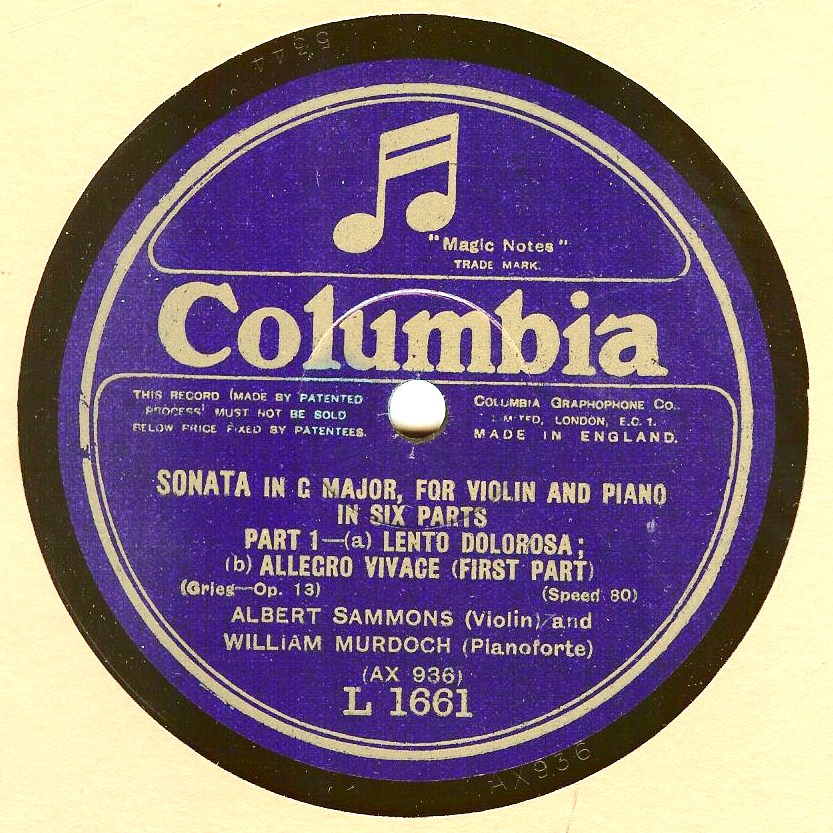
Here is a rare sonata recording by the man considered by many to be the greatest British violinist, Albert Sammons (1886-1957).  It is of Grieg's Sonata in G, Op. 13, recorded on March 12, 1925 with Sammons' longtime sonata partner William Murdoch (1888-1942) at the piano.  This was one of the last acoustical recordings made by Columbia (they had switched to the Western Electric recording process by October 1925) and consequently experienced a very short catalogue life, issued in November 1925 and deleted in Feburary 1928.

Grieg: Violin Sonata No. 2 in G, Op. 13
Albert Sammons, violin; William Murdoch, piano
Recorded March 12, 1925
English Columbia L 1661 through L 1663, three 78-rpm records
Link (FLAC files, 63.25 MB)
Link (MP3 files, 24.61 MB)

The three Grieg violin sonatas enjoyed a much greater circulation 75-100 years ago than today.  Heifetz recorded Op. 13 in the 1930s, and there's a famous 1928 recording of Op. 45 in C minor by Fritz Kreisler and Sergei Rachmaninoff.  This Sammons recording appears to be the first one made of Op. 13, a charming work.

Only a month after making this recording, and still by the acoustical recording process, Sammons made his first complete recording of a violin concerto, and his only recording of a non-British concerto at that.  This was Bruch's Violin Concerto No. 1, with an unidentified orchestra conducted by Sir Hamilton Harty.  Early in 2008 I did a transfer of this recording, which is still available for download:

Bruch: Violin Concerto No. 1 in G minor, Op. 26
Albert Sammons, violin, with orchestra conducted by Sir Hamilton Harty
Recorded April 9, 1925
Columbia Masterworks Set No. 30, three 78-rpm records
Link (FLAC file, 65.85 MB)
Link (MP3 file, 24.17 MB)

Albert Sammons, for all his many achievements as a soloist, was also a great quartet leader.  He was one of the founding members of the London String Quartet in 1908 and played first violin in it for nine years, until being called up for military service in 1917.  The Fall 2010 issue of Classic Recordings Quarterly features a fine article by Tully Potter about the LSQ and its recordings.  Late in 2007 I did transfers of a group of LSQ recordings from 1915-17 (when Sammons was still in it), featuring music by Mozart, Schubert, Schumann and Tchaikovsky, which are still available for download:

Mozart: Quartet No. 16 in E-Flat, K. 428
Schubert: Quartet No. 12 in C minor, D. 703 ("Quartettsatz")
Schumann: Quartet No. 3 in A, Op. 41, No. 3
Tchaikovsky: Quartet No. 1 in D, Op. 11: Scherzo
London String Quartet (led by Albert Sammons)
Recorded 1915-17
English Columbia L 1015, 1043, 1044, 1199, 1200, 5 78-rpm records
Link (FLAC files, 105.6 MB)
Link (MP3 files, 38.35 MB)