Showing posts with label Tchaikovsky. Show all posts

Monday, September 25, 2017

Tchaikovsky: Symphony No. 3 (Beecham)

Early in 1949, to honor the upcoming 70th birthday of Sir Thomas Beecham, RCA Victor put on the American market some half-dozen albums of the conductor's latest HMV recordings with the Royal Philharmonic Orchestra, all sporting the above generic cover created for the occasion. This was the largest of these sets:

Tchaikovsky: Symphony No. 3 in D Major, Op. 29 ("Polish")
Sir Thomas Beecham conducting the Royal Philharmonic Orchestra
Recorded April, 1947
RCA Victor set DM-1279, five 78-rpm records
Link (FLAC files, 113.12 MB)
Link (MP3 files, 73.55 MB)

Of the six Tchaikovsky symphonies, the Third seems to me the most ideal vehicle for Sir Thomas' talents. This is particularly true of the three middle movements, and how fortunate are we that these are played without cuts! The outer movements do have a few judicious cuts, but to be fair, I've never heard a 78-rpm version of this work that didn't have them. The pioneering version by Albert Coates, of 1932, hacked each of the middle movements down to one side, and Hans Kindler's of 1940 and Gregor Fitelberg's of 1946 each have cuts in the outer movements, the latter hacking the Finale to one side.

Sunday, October 30, 2016

Tchaikovsky: Piano Concerto No. 1 (Levant)

Cover design by Alex Steinweiss
This posting is in response to a request. I obtained this set of Oscar Levant playing "the" Tchaikovsky concerto, graced with one of Alex Steinweiss' most delightful cover designs, about five years ago from Ken Halperin of Collecting Record Covers. I duly made a transfer, then shelved it, not sure if it would be of interest to anybody. Then, two months ago, after I posted Levant's debut album, there was a request for it, and I am delighted to be able to oblige:

Tchaikovsky: Piano Concerto No. 1 in B-Flat Minor, Op. 23
Oscar Levant, piano; Philadelphia Orchestra conducted by Eugene Ormandy
Recorded December 12, 1947
and
Rachmaninoff: Prelude in G Major, Op. 32, No. 5
Oscar Levant, piano
Recorded November 19, 1947
Columbia Masterworks set MM-785, five 78-rpm records
Link (FLAC files, 86.99 MB)
Link (MP3 files, 60.07 MB)

This was Oscar Levant's first concerto recording other than of works by Gershwin, with whom he was so closely associated; on the very next day, however, he was in New York recording the Grieg concerto with Efrem Kurtz! With Ormandy, the Tchaikovsky was his second recording, after the best-selling "Rhapsody in Blue" of 1945. That, however, was not Levant's first phonographic outing with the Rhapsody; that honor belongs to a Brunswick issue of 1927, with Frank Black's Orchestra, which I recently discovered here on YouTube. Writing in his best-selling book, "A Smattering of Ignorance", Levant said of this recording that "contrary to the common impression that composers do not think highly of their own abilities as performers, Gershwin was quite firm in his preference for his own version on Victor. At this distance [twelve years] I can acknowledge that it is much superior."

Sunday, April 26, 2015

Tchaikovsky: Symphony No. 6 (Ormandy)

In 1937, the name of Leopold Stokowski must have seemed inextricably bound with that of the Philadelphia Orchestra, as far as record buyers were concerned, for it had appeared so for nearly 20 years on Victor Records. The set I present today heralded a new order, for it was the first-issued recording by the Orchestra under its new music director, Eugene Ormandy (he and Stokowski were actually co-conductors there during his first two years), just arrived from Minneapolis:

Tchaikovsky: Symphony No. 6 in B minor, Op. 74  ("Pathétique")
Philadelphia Orchestra conducted by Eugene Ormandy
Recorded December 13, 1936, and January 9, 1937
Victor Musical Masterpiece set DM-337, five 78-rpm records
Link (FLAC files, 98.34 MB)
Link (MP3 files, 68.09 MB)

This recording, as well as that of Schumann's Second Symphony, was made during Ormandy's first two sessions with the Philadelphia Orchestra, the first two of over 400 sessions he would undertake with them over the next 46 years. Information about these comes from a marvelous new volume by Richard A. Kaplan, "The Philadelphia Orchestra: An Annotated Discography" - published just this year by Rowman & Littlefield. Kaplan believes that the Philadelphia Orchestra's move to Columbia in 1943 was more than anything else a strategic move on Ormandy's part, and indeed the evidence shows that Victor was not particularly interested in promoting him. Stokowski continued to record with the Orchestra through 1940, even after Ormandy had become the sole music director, and then there was Toscanini's ill-fated series of sessions with the Orchestra in 1941-42. Small wonder that Ormandy jumped at the chance to move to Columbia, where he quickly became the star attraction.

The evocative cover design pictured above was not original to the set, but a wartime reissue. I have borrowed the image from Ken Halperin's marvelous site Collecting Record Covers, for my own copy of DM-337, a slightly worn pre-war edition, has a generic cover.

Thursday, February 26, 2015

Tchaikovsky: Symphony No. 2 (Mitropoulos)

Cover design by Alex Steinweiss
This weekend - March 1 - marks the 119th birth anniversary of the great Greek maestro, Dimitri Mitropoulos (1896-1960), principal conductor of the Minneapolis Symphony Orchestra from 1937 to 1949. From 1939 to 1946 the orchestra and its conductor recorded exclusively for Columbia, afterwards signing on with RCA Victor. From their last series of Columbia sessions came this exciting version of Tchaikovsky's "Little Russian" Symphony:

Tchaikovsky: Symphony No. 2 in C minor, Op. 17 ("Little Russian")
Minneapolis Symphony Orchestra conducted by Dimitri Mitropoulos
Recorded March 10 and 11, 1946
Columbia Masterworks set MM-673, five 78-rpm records
Link (FLAC files, 85.70 MB)
Link (MP3 files, 58.08 MB)

Sunday, January 4, 2015

Mozart: Symphony No. 39 (Szell)

Cover design by Alex Steinweiss
(restored by Peter Joelson)
Growing up in the 70s, I would hear the term "Big Five" bandied about as it applied to American orchestras - those of New York, Philadelphia, Boston, Chicago and Cleveland.  Thirty years prior, the number was the "Big Three" - neither the Chicago nor the Cleveland orchestras reached that exalted status until Fritz Reiner took over the one, and George Szell (1897-1970) the other.  Szell assumed the directorship in Cleveland in 1946, and held the post until his death, transforming the orchestra in the process.  Among the first of their many recordings is the following:

Mozart: Symphony No. 39 in E Flat Major, K. 543
Cleveland Orchestra conducted by George Szell
Recorded April 22, 1947
Columbia Masterworks set MM-801, three 78-rpm records
Link (FLAC files, 66.44 MB)
Link (MP3 files, 43.76 MB)

This wasn't Szell's first recording of the Mozart E Flat Symphony.  One of his earliest recordings featured it, an acoustical version for German Odeon with the orchestra of the Berlin Staatsoper in 1924.  Of great rarity, I should imagine - I've never encountered it.

The Cleveland Orchestra was already a fine one when Szell took it over, as many recordings with it by Nikolai Sokoloff, Artur Rodzinski and Erich Leinsdorf prove.  One of the first I ever owned is this one by Rodzinski of an old warhorse:

Tchaikovsky: Marche Slave, Op. 31
Cleveland Orchestra conducted by Artur Rodzinski
Recorded December 14, 1940
Columbia 11567-D, one 78-rpm record
Link (FLAC file, 22.00 MB)
Link (MP3 file, 13.59 MB)

This is one of the reclaimed records that I talk about in this post; I bought it new from Clark Music in Decatur, Ga., in 1974, when I was 11, and I have been, so far, the only owner of this copy.

Thursday, December 19, 2013

Borodin and Tchaikovsky by Mitropoulos

Cover design by Karl Kezer
Dimitri Mitropoulos, like his Minneapolis predecessor Eugene Ormandy, never disappoints in performances of Russian music.  (My first exposure to Tchaikovsky's Fourth Symphony, almost 40 years ago, was through a blazing Mitropoulos reading on a Columbia 78 set - and oh, how I wish I still had it!)  Here is an LP coupling two Russian masterpieces.  The Borodin Second Symphony was a specialty of Mitropoulos, but the CD reissue companies invariably have tapped his 1941 Minneapolis performance for release, never this New York version which, I believe, deserves attention as well.  The Tchaikovsky First Suite is a rarity as well, and this is only the second recording of it (after Walter Goehr's for Concert Hall, which can be heard here).  Unfortunately the third movement (Intermezzo) is omitted, presumably in the interest of getting the Suite on one side.  What remains is delightful, particularly its final galumphing Gavotte which surely influenced Prokofiev when he came to write his own Gavotte for his "Classical Symphony."

Borodin: Symphony No. 2 in B Minor
Recorded November 2, 1953
and
Tchaikovsky: Suite No. 1 in D Minor, Op. 43
Recorded October 18 and November 17, 1954
Philharmonic-Symphony Orchestra of New York
conducted by Dimitri Mitropoulos
Columbia Masterworks ML-4966, one LP record
Link (FLAC files, 152.15 MB)
Link (MP3 files, 94.15 MB)

Saturday, October 19, 2013

Tchaikovsky: Suite No. 3 (Little Orchestra Society)

I've been spending a lot more time lately with LPs than with 78s (easier, for one thing), particularly "6-eye" Columbias, and here's a comparatively rare one. Thomas K. Scherman (1917-1979) was the founder of the Little Orchestra Society, still going strong after 66 years, and right away established himself and the orchestra as a force for presenting new and unrecorded works on Columbia (as with this recording of Dello Joio's Harp Concerto). But it's likely that folks in the 1950s were more familiar with his speaking voice than with his conducting, simply because he presented so many spoken analysis records in connection with the Book-of-the-Month Club's series of Music Appreciation Records, of which Scherman was the musical director. (His father, Harry Scherman, had founded Book-of-the-Month Club in 1926.) Today I present the last recording I can trace that he made for Columbia:

Tchaikovsky: Suite No. 3 in G Major, Op. 55
Little Orchestra Society conducted by Thomas Scherman
Recorded February 1, 1955
Columbia ML-5256, one LP record
Link (FLAC files, 100.90 MB)
Link (MP3 files, 65.49 MB)

This was only the second recording of Tchaikovsky's delightful Third Suite with pretensions to completeness - in those days only its famous variation finale was usually heard. I say "pretensions" because an unfortunate cut is made in the second movement (Valse mélancolique), robbing it of almost half its length. The same cut was made in Walter Goehr's 1952 recording, for Concert Hall (which can be heard here), suggesting that a performing edition of the suite was floating around incorporating this cut.

Sunday, August 25, 2013

Tchaikovsky: Symphony No. 4 (Ormandy)

Cover design by Alex Steinweiss
The Ormandy series continues with what Columbia proudly hailed in its liner notes for this set as "the first recording of a Tchaikovsky symphony that Eugene Ormandy and The Philadelphia Orchestra have made for Columbia Masterworks" - the Fourth.  (Of course, they had already recorded the Fifth and Sixth - but that was for Victor.)  This is the first of four recordings the Fabulous Philadelphians were to make of Tchaikovsky's "Fate" symphony (the others were in 1953, 1963 and 1973):

Tchaikovsky: Symphony No. 4 in F Minor, Op. 36
Philadelphia Orchestra conducted by Eugene Ormandy
Recorded December 3-4, 1947
Columbia Masterworks set MM-736, five 78-rpm records
Link (FLAC files, 112.24 MB)
Link (MP3 files, 53.86 MB)

Thursday, June 13, 2013

Tchaikovsky: Fifth Symphony (Rodzinski)

In 1939, Columbia Records, under the new ownership of CBS, began a serious push to compete with RCA Victor in the field of orchestral recording.  At this time Victor had the Philadelphia Orchestra, the Boston Symphony, and  its own NBC Symphony under Toscanini.  Columbia, which hitherto had been content to import orchestral recordings from Europe (particularly Beecham's and Weingartner's), saw this source of supply threatened by the onset of war, and began signing up orchestras all over America.  In short order they  acquired the Chicago Symphony, the Cleveland Orchestra, the Minneapolis Symphony, the New York Philharmonic, and the Pittsburgh Symphony for the Masterworks line.  Except for the Pittsburgh, none of these orchestras were new to records, but the contracts they had with other companies (chiefly Victor) had been allowed to lapse.  Several of the conductors involved, however, were new to records, among them Minneapolis' Mitropoulos, Pittsburgh's Reiner, and Cleveland's Polish-born firebrand Artur Rodzinski (1892-1958), whose recording career began in December 1939 with several major works - Strauss' "Ein Heldenleben", Rimsky-Korsakov's "Scheherazade" and this exciting reading of Tchaikovsky's Fifth Symphony:

Tchaikovsky: Symphony No. 5 in E minor, Op. 64
Cleveland Orchestra conducted by Artur Rodzinski
Recorded December 13, 1939, and January 8, 1940
Columbia Masterworks set MM-406, five 78-rpm records
Link (FLAC files, 103.87 MB)
Link (MP3 files, 55.42 MB)

Anyone interested in Columbia's classical 78 sets owes it to themselves to check out Sam Hopper's online Columbia Masterworks 78rpm Album Discography, which I have just stumbled across.  This is a first-rate piece of research, some four years in the making, and I cannot recommend it too highly.

Wednesday, December 5, 2012

Tchaikovsky: Rococo Variations (Tortelier)

Paul Tortelier
Today I present an early recording by the great French cellist, Paul Tortelier (1914-1990), famous for his interpretation of Strauss' Don Quixote, which he played under the composer's direction, and which he recorded with Sir Thomas Beecham in 1947.  (Beecham said to him, "my boy, you will succeed in England because you have temperament.")  The next year, he made this recording of Tchaikovsky's delightful Rococo Variations (it seems to me that some of Tchaikovsky's happiest music was in the variation form - think of the Orchestral Suite No. 3, or the great Piano Trio):

Tchaikovsky: Variations on a Rococo Theme, Op. 33
Paul Tortelier, cello, with orchestra conducted by Norman Del Mar
Recorded March 23, 1948
HMV C 3776 and C 3777, two 78-rpm records
Link (FLAC file, 40.49 MB)
Link (MP3 file, 18.88 MB)

This must have been the first recording made by Norman Del Mar (1919-1994) as a conductor, though he had appeared on records as early as 1944, playing second horn to Dennis Brain in a Decca recording of Brahms' Op. 17 part songs for women's choir, horns and harp, with the Nottingham Oriana Choir and harpist Gwendolyn Mason.  This recording can be heard at the CHARM website.

Monday, January 2, 2012

A Fifth of Ormandy

This happens to be the fifth post I have offered devoted to Eugene Ormandy (1899-1985), and so I devote it, in part, to a Fifth Symphony - Tchaikovsky's.  This is the first of five recordings he was to make of the work, with the Philadelphia Orchestra, and it's a fine one - Ormandy seldom, if ever, turned out a dull performance of Russian music:

Tchaikovsky: Symphony No. 5 in E minor, Op. 64
Philadelphia Orchestra conducted by Eugene Ormandy
Recorded March 15, 1941
Victor Musical Masterpiece Set M-828, five 78-rpm records
Link (FLAC files, 113.89 MB)
Link (MP3 files, 60 MB)

The other offering here is his 1939 recording of Richard Strauss' "Ein Heldenleben," the first of four he was to make in Philadelphia, with concertmaster Alexander Hilsberg as the violin soloist.  This was intended to replace Mengelberg's pioneering 1928 version with the New York Philharmonic in the Victor catalogue, and, therefore, was not much appreciated at the time! Heard on its own terms, what emerges is an exciting, beautifully-played account of the score:

Strauss: Ein Heldenleben (A Hero's Life), Op. 40
Philadelphia Orchestra conducted by Eugene Ormandy
Recorded April 30, 1939
Victor Musical Masterpiece Set DM-610, five 78-rpm records
Link (FLAC file, 97.41 MB)
Link (MP3 file, 48.92 MB)

Monday, November 28, 2011

Three by the Budapest Quartet

The reissue program continues with three recordings by the great Budapest String Quartet, from three different points in their career.  First is one of their early recordings, from the time when the Quartet's lineup still boasted two Hungarians, and three of its founding members.  These were first violinist Emil Hauser, violist István Ipolyi, and the Dutch cellist Harry Son; the newcomer was second violinist Josef Roisman, a Russian who would eventually become the quartet's leader:

Tchaikovsky: Quartet No. 2 in F, Op. 22 and
Dittersdorf: Quartet No. 6 in A - Minuet
Budapest String Quartet (Hauser-Roisman-Ipolyi-Son)
Recorded February 8, 9 and 11, 1929
HMV Album Series No. 134, five 78-rpm records
Link (FLAC files, 121.83 MB)
Link (MP3 files, 48.98)

By the time of the following recording, Roisman had moved to the first violin chair, and only Ipolyi was left from the original lineup.  The Schneider brothers (Alexander and Mischa) now occupied the second violin and cello positions, respectively.  This lineup (1932-36) is considered by many to be the Budapest Quartet's greatest, and one of the few recordings from this period that has apparantly never been reissued on LP or CD is this, the only Haydn quartet that the Budapest Quartet was permitted to record for HMV after the Pro Arte Quartet was engaged to do its series for the Haydn Quartet Society.  (This particular work had, in fact, been part of the very first Society volume, but that was already out-of-print by the time this release appeared.)

Haydn: Quartet in G, Op. 54, No. 1
Budapest String Quartet (Roisman-Schneider-Ipolyi-Schneider)
Recorded April 24, 1935
Victor Musical Masterpiece Set DM-869, two 78-rpm records
Link (FLAC files, 42.36 MB)
Link (MP3 files, 18.76)

Lastly, here is one of the Budapest Quartet's few recordings of a contemporary work, one actually written for them.  Even though Columbia had already successfully launched the LP format by the time of its issue, this recording was issued only on 78s, with the result that it is probably one of the Budapest Quartet's rarest recordings.  By this time, Boris Kroyt had long since replaced István Ipolyi as violist (so that now the group consisted entirely of Russians), and Alexander Schneider had left the Quartet in 1944 to freelance.  He returned in 1955, but in the meantime a succession of second violinists replaced him; at the time of this recording it was Edgar Ortenberg:

Hindemith: Quartet [old No. 5, new No. 6] in E-Flat
Budapest String Quartet (Roisman-Ortenberg-Kroyt-Schneider)
Recorded April 2, 1945
Columbia Masterworks Set MM-797, three 78-rpm records
Link (FLAC files, 64.08 MB)
Link (MP3 files, 31.15 MB)


A word about the numbering of Hindemith's quartets, which is a very confusing issue indeed!  During his lifetime he published six: Op. 10, Op. 16, Op. 22, Op. 32, and two in E-Flat, one in 1943 and one in 1945 - Hindemith stopped using opus numbers after Opus 50.  (The present Columbia set doesn't identify a number, merely "Quartet in E-Flat (1943)", but the 1943 quartet was published as "No. 5.")  During the 1990s, however, an early Quartet, Op. 2, was published and added to the canon; this - unfortunately - became Quartet No. 1, and the numbers of all the succeeding quartets were bumped ahead by one!  Hence, the Op. 22, his most popular, is now known as "No. 4" where it previously was known as "No. 3"; worse still, the 1943 E-Flat is now "No. 6" - while formerly the 1945 quartet was known as "No. 6 in E-Flat"!  What I wonder is, why couldn't the Op. 2 quartet have been labelled "No. 0" as with Bruckner's early D minor symphony?

Sunday, November 6, 2011

The Catterall Quartet


Label showing Victor sticker for importation into the USA
Part 2 of my reissue series devoted to Arthur Catterall continues with all three complete string quartets recorded and issued by the Catterall Quartet (Arthur Catterall and John S. Bridge, violins; Frank S. Park, viola; Johan C. Hock, cello) - Beethoven's Op. 18, Nos. 1 and 2, and Brahms' Op. 51, No. 1.  (The group also subsequently recorded a third Beethoven quartet, presumably complete, on nine sides - No. 13 in B-Flat, Op. 130, a work otherwise unrecorded acoustically - but this, alas, was unissued.)  Here are the details:

Beethoven: Quartet No. 1 in F, Op. 18, No. 1 and
Tchaikovsky: Quartet No. 2 in F, Op. 22 - Scherzo
Catterall Quartet
Recorded May 8, 1922, and April 30 and June 18, 1923
HMV D 947 through D 950, four 78-rpm records
Link (FLAC files, 94.53 MB)
Link (MP3 files, 31.75 MB)

Beethoven: Quartet No. 2 in G, Op. 18, No. 2
Catterall Quartet
Recorded June 19, 1923, and May 6, 1924
HMV D 997 through D 999, three 78-rpm records
Link (FLAC files, 67.22 MB)
Link (MP3 files, 23.27 MB)

Brahms: Quartet No. 1 in C minor, Op. 51, No. 1
Catterall Quartet
Recorded June 18 and 19, 1923
HMV D 791 through D 794, four 78-rpm records
Link (FLAC files, 89.84 MB)
Link (MP3 files, 31.38 MB)

Included in all three packages is a text file containing information about all the Catterall Quartet's recordings, for both HMV and Columbia, of which I'm aware.

The Catterall Quartet's recording career for HMV effectively ended when the Virtuoso String Quartet was formed by the Gramophone Company in 1924.  The Catterall Quartet moved to Columbia after the introduction of electrical recording, but their repertoire there consisted mainly of potboilers, the only Beethoven being the slow variations movement of Op. 18, No. 5 (the only Beethoven quartet that Columbia's "star" ensemble of the period, the Léner Quartet, didn't record until the 1930s).  Here is that sole Beethoven recording:

Beethoven: Quartet No. 5 in A, Op. 18, No. 5 - Andante cantabile
The Catterall Quartet
Recorded June 16, 1926
English Columbia 9141, one 78-rpm record
Link (FLAC file, 21.13 MB)
Link (MP3 file, 7.9 MB)

Tuesday, November 1, 2011

Symphonies from Sir Landon

Back in 2008 I posted three acoustically-recorded symphonies conducted by the Gramophone Company's "house conductor," Sir Landon Ronald (1873-1937).  Actually, he wasn't yet "Sir" when the first of these was made (he was knighted in 1922):

Dvořák: Symphony No. 9 in E minor, Op. 95 ("From the New World")
Royal Albert Hall Orchestra, conducted by Landon Ronald
Recorded November 1, 1919, and September 8 & November 29, 1921
HMV D 536, 537, 587 and 613, four 78-rpm records
Link (FLAC files, 90.14 MB)
Link (MP3 files, 33.38 MB)

All movements are cut except the Scherzo, and I've spelled out the cuts in detail, in a text file accompanying the download.  As of July, 2010, this had proven my most popular download, with Mediafire calculating 545!  Sir Landon did re-record the "New World" electrically, and complete, in 1927.  This is available from Historic Recordings, in Damian's fine transfer.

Landon Ronald's next recording of a symphony was of Beethoven's Fifth, a work that holds the distinction of being the symphony recorded complete the most times during the acoustic era.  Ronald's version is the fifth, after Friedrich Kark's for Odeon (in 1910), Artur Nikisch's for Deutsche Grammophon (1913), Josef Pasternack's for Victor (completed in 1917) and François Ruhlmann's for Pathé (of unknown date, but surely before 1922):

Beethoven: Symphony No. 5 in C minor, Op. 67
Royal Albert Hall Orchestra, conducted by Sir Landon Ronald
Recorded in September and October, 1922
Victor Blue Label 55250 through 55253, four 78-rpm records
Link (FLAC files, 95.07 MB)
Link (MP3 files, 37.89 MB)

I have the original album, a handsome "Music Arts Library of Victor Records" production, and I have included JPEGs of each sleeve, on each of which are printed liner notes in a florid style characteristic of the time.


Ronald also re-recorded the Beethoven Fifth electrically.  He did not, however, re-record the Tchaikovsky "Pathétique" (this job fell to Albert Coates):

Tchaikovsky: Symphony No. 6 in B minor, Op. 74 ("Pathétique")
Royal Albert Hall Orchestra, conducted by Sir Landon Ronald
Recorded in January, May and June, 1923
Victor Blue Label 55240 through 55244, five 78-rpm records
Link (FLAC files, 123.66 MB)
Link (MP3 files, 42.7 MB)

Sir Landon made two further acoustical recordings of symphonies: the Schubert "Unfinished" (a complete version of 1923 to replace an abridged version of 1912), and the Brahms Second.  The latter can be heard at the CHARM website.  He also made the first electrical recording of a symphony: Tchaikovsky's Fourth (which, again, is available in Damian's transfer at Historic Recordings).

Friday, October 28, 2011

Some Early Orchestral Red Seals

Leopold Stokowski, 1924

As I mentioned earlier, back in 2008 I posted a whole series of acoustical orchestral and chamber music recordings.  Most of these were of European (chiefly British) origin, simply because that's where most of this  recording activity took place.  I did offer two American-made sets, however, and here they are:

Tchaikovsky: Symphony No. 5 in E minor, Op. 64 - Andante and
Rimsky-Korsakov: Dance of the Tumblers (from "The Snow Maiden")
Philadelphia Symphony Orchestra conducted by Leopold Stokowski
Recorded April 20 and March 19, 1923
Victor Red Seal 6430 and 6431, two 78-rpm records
Link (FLAC files, 50.01 MB)
Link (MP3 files, 18.3 MB)

This recording is complete as issued; apparently, there was no thought of recording the entire symphony (which, of course, Stokowski did several times in subsequent years).  An incredible wealth of information about Stokowski's recordings can be found at Larry Huffman's amazing site, http://www.stokowski.org/.

Alfred Hertz

Wagner: Parsifal - Prelude and Good Friday Spell
San Francisco Symphony Orchestra conducted by Alfred Hertz
Recorded January 24, 26, 31 and February 2, 1925
Victor Red Seal 6498 through 6500, three 78-rpm records
Link (FLAC files, 74.17 MB)
Link (MP3 files, 26.25 MB)

Alfred Hertz (1872-1942) was the San Francisco Symphony's second music director (the first was Henry Hadley), and this was the first appearance on records of that organization, whose concertmaster at the time was Louis Persinger, Yehudi Menuhin's (and later Ruggiero Ricci's) first violin teacher.  Hertz himself was intimately associated with Wagner's "Parsifal," having given the first performances of the opera outside of Bayreuth with the Metropolitan Opera, New York, in 1903.

Thursday, December 2, 2010

Band Classics, part 2

This post is a follow-up to my August post of recordings by Arthur Pryor's Band, though the range is a little bit broader, including a few "popular" selections, and including one recording in the spirit of the Christmas season - though it actually was recorded four days after Christmas, 1909, and released for the Easter 1910 trade!  Perhaps a hundred years ago the Hallelujah Chorus was associated more with Easter than with Christmas, which makes sense, given its placement in the Handel oratorio.  In any case, it's sung here by a mighty chorus of eight, accompanied by Sousa's Band.  It's one of thirteen pieces in this collection of downloads, from five different concert bands, one from south of the border and one from "across the pond."  Here are the details (fuller discographic information is given in the text file included with the downloads):

EMMETT: Dixie (Pryor's Band, 1907)
GOTTSCHALK: The Dying Poet (Sousa's Band, 1912)
GOTTSCHALK: The Last Hope (Vessella's Italian Band, 1914)
HANDEL: Hallelujah Chorus (Victor Chorus and Sousa's Band, 1909)
LAMPE (arr.): Sunny South Medley (Pryor's Band, 1908)
MEYERBEER: Coronation March (Pryor's Band, 1918)
PERRY: The Warbler's Serenade (Pryor's Band, 1913)
PRYOR: The Whistler and His Dog (Pryor's Band, 1913)
ROSSINI: Semiramide Overture (Police Band of Mexico, 1907)
SOUSA: Wedding March (Sousa's Band, 1918)
TCHAIKOVSKY: Overture 1812 (H.M. Grenadier Guards Band, 1915)
VERDI: Reminiscences of Verdi (Sousa's Band, 1912)
WAGNER: A Dream of Wagner - Fantasie (Pryor's Band, 1912)

Of the music itself it isn't necessary to say much, except that Sousa's "Wedding March" was composed in 1918 to replace those of Wagner and Mendelssohn due to anti-German sentiments during World War I - which, thank goodness, it obviously didn't do!  And I make no apologies for including "Dixie" - a grand old tune still loved by many of us Southerners even though the words no longer really represent us.  What better excuse to enjoy a band arrangement?

Link (FLAC files, 143.2 MB)
Link (MP3 files, 53.62 MB)

All of these are Victor recordings except the one of Tchaikovsky's "Overture 1812," which was one of the few acoustic recordings made by the Grenadier Guards Band for English Columbia to be released in the US by American Columbia.

Monday, November 15, 2010

Constant Lambert Conducts

This week I present several rare recordings by Constant Lambert (1905-1951), conductor, composer, raconteur, writer and wit.  As a conductor, he was renowned for his interpretations of Russian and English music, and both are featured in these downloads.  From Russia we get Lambert's brilliant and exciting interpretations of two tone poems, Tchaikovsky's Hamlet and Glazunov's Stenka Razin, and from England the Purcell Chaconne in G minor in a string orchestra arrangment.  (This is not the famous Purcell Chacony, as the first volume of the World's Encyclopedia of Music erroneously states - but an arrangement of No. 6 of the Ten Sonatas in Four Parts, which is also in G minor and also in the form of a chaconne.)  These three different recordings feature three different orchestras, and in fact the Glazunov was the first appearance of the Liverpool Philharmonic on records.  Here are the details:

Tchaikovsky: Hamlet - Overture-Fantasia, Op. 67
Hallé Orchestra conducted by Constant Lambert
Recorded October 9, 1942
Columbia Masterworks set MX-243, 2 78-rpm records
Link (FLAC file, 43.11 MB)
Link (MP3 file, 22.31 MB)

Glazunov: Stenka Razin - Symphonic Poem, Op. 13
Liverpool Philharmonic Orchestra conducted by Constant Lambert
Recorded December 22, 1942 and January 12, 1943
English Columbia DX 1107 and DX 1108, 2 78-rpm records
Link (FLAC file, 35.87 MB)
Link (MP3 file, 16.24 MB)

Purcell, arr. Whittaker: Chaconne in G minor, Z. 807
Philharmonia String Orchestra conducted by Constant Lambert
Recorded October 12, 1945
English Columbia DX 1230, 1 78-rpm record
Link (FLAC file, 22.15 MB)
Link (MP3 file, 8.98 MB)

Back in 2008 I uploaded another Constant Lambert recording, in tandem with one by Walter Goehr, as both featured orchestral works of Bizet in their first recordings.  These have been re-uploaded; the details:

Bizet: Carnival (from "Roma" Suite)
Liverpool Philharmonic Orchestra conducted by Constant Lambert
Recorded October 29, 1943
English Columbia DX 1136, 1 78-rpm record
Link (FLAC file, 17.37 MB)
Link (MP3 file, 6.63 MB)

Bizet: Symphony in C Major (+ Danse Bohemienne from "Fair Maid of Perth")
London Philharmonic Orchestra conducted by Walter Goehr
Recorded November 26, 1937
Victor Musical Masterpiece Set DM-721, 4 78-rpm records
Link (FLAC files, 67.45 MB)
Link (MP3 files, 32.23 MB)

Tuesday, September 28, 2010

Albert Sammons plays Grieg

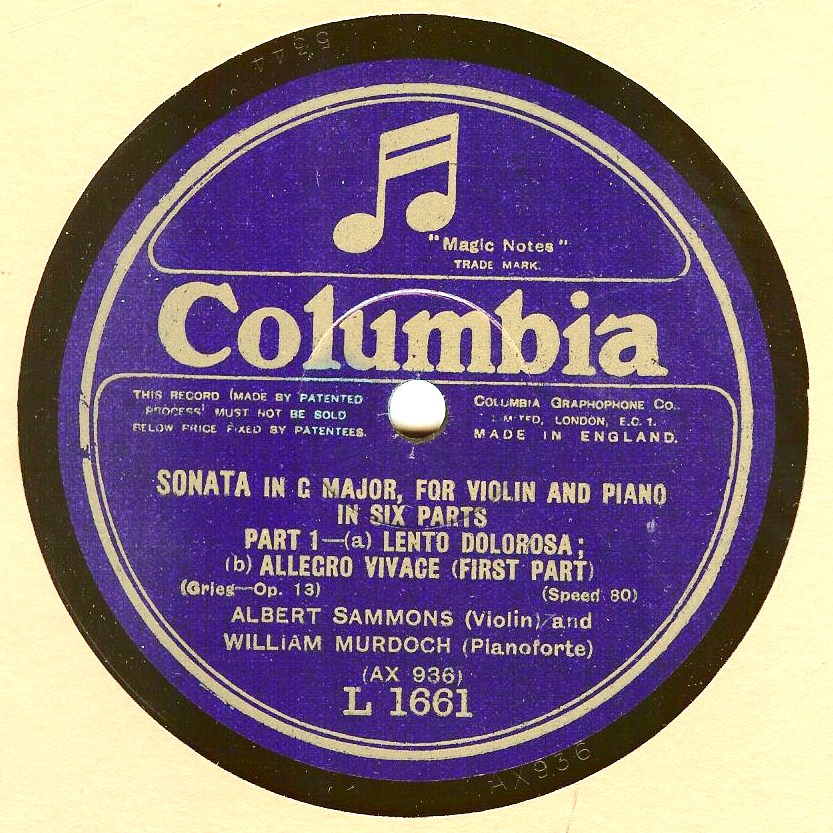
Here is a rare sonata recording by the man considered by many to be the greatest British violinist, Albert Sammons (1886-1957).  It is of Grieg's Sonata in G, Op. 13, recorded on March 12, 1925 with Sammons' longtime sonata partner William Murdoch (1888-1942) at the piano.  This was one of the last acoustical recordings made by Columbia (they had switched to the Western Electric recording process by October 1925) and consequently experienced a very short catalogue life, issued in November 1925 and deleted in Feburary 1928.

Grieg: Violin Sonata No. 2 in G, Op. 13
Albert Sammons, violin; William Murdoch, piano
Recorded March 12, 1925
English Columbia L 1661 through L 1663, three 78-rpm records
Link (FLAC files, 63.25 MB)
Link (MP3 files, 24.61 MB)

The three Grieg violin sonatas enjoyed a much greater circulation 75-100 years ago than today.  Heifetz recorded Op. 13 in the 1930s, and there's a famous 1928 recording of Op. 45 in C minor by Fritz Kreisler and Sergei Rachmaninoff.  This Sammons recording appears to be the first one made of Op. 13, a charming work.

Only a month after making this recording, and still by the acoustical recording process, Sammons made his first complete recording of a violin concerto, and his only recording of a non-British concerto at that.  This was Bruch's Violin Concerto No. 1, with an unidentified orchestra conducted by Sir Hamilton Harty.  Early in 2008 I did a transfer of this recording, which is still available for download:

Bruch: Violin Concerto No. 1 in G minor, Op. 26
Albert Sammons, violin, with orchestra conducted by Sir Hamilton Harty
Recorded April 9, 1925
Columbia Masterworks Set No. 30, three 78-rpm records
Link (FLAC file, 65.85 MB)
Link (MP3 file, 24.17 MB)

Albert Sammons, for all his many achievements as a soloist, was also a great quartet leader.  He was one of the founding members of the London String Quartet in 1908 and played first violin in it for nine years, until being called up for military service in 1917.  The Fall 2010 issue of Classic Recordings Quarterly features a fine article by Tully Potter about the LSQ and its recordings.  Late in 2007 I did transfers of a group of LSQ recordings from 1915-17 (when Sammons was still in it), featuring music by Mozart, Schubert, Schumann and Tchaikovsky, which are still available for download:

Mozart: Quartet No. 16 in E-Flat, K. 428
Schubert: Quartet No. 12 in C minor, D. 703 ("Quartettsatz")
Schumann: Quartet No. 3 in A, Op. 41, No. 3
Tchaikovsky: Quartet No. 1 in D, Op. 11: Scherzo
London String Quartet (led by Albert Sammons)
Recorded 1915-17
English Columbia L 1015, 1043, 1044, 1199, 1200, 5 78-rpm records
Link (FLAC files, 105.6 MB)
Link (MP3 files, 38.35 MB)

Monday, August 23, 2010

Classics from Arthur Pryor's Band

In the earliest days of commercial recording (roughly, from 1890 to 1910), military and concert bands, unlike orchestras, were frequent visitors to the recording studio. The reason for this is simple: massed strings didn't record well, while brass and woodwinds did. Bands recorded everything: popular songs of the day, medleys from operettas and musical shows, dance music, and, of course, marches. This upload, however, focuses on band transcriptions of standard orchestral repertoire. The following works are presented:

GRIEG: Peer Gynt Suite - "Morning" and "Death of Ase"
LISZT: Hungarian Rhapsody No. 2
LISZT: Hungarian Rhapsody No. 9 - Finale
ROSSINI: William Tell Overture
SCHUBERT: Unfinished Symphony - First movement (abridged)
TCHAIKOVSKY: Marche Slave (abridged)
WAGNER: Tannhäuser Overture (abridged)

These were all recorded between 1905 and 1914 (complete recording details are supplied in a text file accompanying the recordings) by Arthur Pryor's Band, one of the most active concert bands making records in the USA during this period.

Link (FLAC files, 134.31 MB)
Link (MP3 files, 49.75 MB)


Arthur Pryor (1870-1942) was a virtuoso trombonist who joined Sousa's Band in 1892, becoming assistant conductor of that legendary organization before leaving to form his own band in 1903. It was Pryor who actually conducted Sousa's Band on records - apparently the great man considered recording beneath him. He was also a composer, his most famous piece being "The Whistler and His Dog." (Fans of "The Little Rascals" films will remember Buckwheat pretending to whistle while a somewhat damaged record plays behind a curtain; "The Whistler and His Dog" is the tune in question.)

A particularly pioneering effort is represented by the movement from Schubert's Unfinished Symphony, which was recorded in 1910 and released in November of that year. It would appear that this was the very first time Victor recorded any part of a symphony. The record must have sold reasonably well, for the band had to remake it two years later. Clearly, the record-buying public had a taste for "serious" symphonic fare. Certainly my copy of Victor 31798 was much loved by its original owner!


In 1912, Victor embarked on a program of recording abridged symphonic works, not with a band, but with its own in-house orchestra, the Victor Concert Orchestra. Two Haydn and two Mozart symphonies, the Beethoven Fifth and the Schubert Unfinished, as well as movements from Mendelssohn's "Italian" and Dvorak's "New World," were among the offerings. Most of these do not credit any conductor, though Walter B. Rogers, Victor's house conductor, was probably responsible for most of them. Nearly three years ago, I uploaded to the newsgroup "rec.music.classical.recordings" (RMCR) a selection of these recordings, containing the following:

HAYDN: Military Symphony (No. 100 in G)
MOZART: Symphony in G minor (No. 40, K. 550)
MOZART: Jupiter Symphony (No. 41 in C, K. 551)
BEETHOVEN: Leonore Overture No. 3 (Op. 72a)
BEETHOVEN: Symphony No. 4 - Adagio
    (played by Vessella's Italian Band, as a filler for the Leonore Overture)

These are still available for download at the following links:

Link (FLAC files, 181.49 MB)
Link (MP3 files, 67.8 MB)