Monday, November 15, 2010

Constant Lambert Conducts

This week I present several rare recordings by Constant Lambert (1905-1951), conductor, composer, raconteur, writer and wit.  As a conductor, he was renowned for his interpretations of Russian and English music, and both are featured in these downloads.  From Russia we get Lambert's brilliant and exciting interpretations of two tone poems, Tchaikovsky's Hamlet and Glazunov's Stenka Razin, and from England the Purcell Chaconne in G minor in a string orchestra arrangment.  (This is not the famous Purcell Chacony, as the first volume of the World's Encyclopedia of Music erroneously states - but an arrangement of No. 6 of the Ten Sonatas in Four Parts, which is also in G minor and also in the form of a chaconne.)  These three different recordings feature three different orchestras, and in fact the Glazunov was the first appearance of the Liverpool Philharmonic on records.  Here are the details:

Tchaikovsky: Hamlet - Overture-Fantasia, Op. 67
Hallé Orchestra conducted by Constant Lambert
Recorded October 9, 1942
Columbia Masterworks set MX-243, 2 78-rpm records
Link (FLAC file, 43.11 MB)
Link (MP3 file, 22.31 MB)

Glazunov: Stenka Razin - Symphonic Poem, Op. 13
Liverpool Philharmonic Orchestra conducted by Constant Lambert
Recorded December 22, 1942 and January 12, 1943
English Columbia DX 1107 and DX 1108, 2 78-rpm records
Link (FLAC file, 35.87 MB)
Link (MP3 file, 16.24 MB)

Purcell, arr. Whittaker: Chaconne in G minor, Z. 807
Philharmonia String Orchestra conducted by Constant Lambert
Recorded October 12, 1945
English Columbia DX 1230, 1 78-rpm record
Link (FLAC file, 22.15 MB)
Link (MP3 file, 8.98 MB)

Back in 2008 I uploaded another Constant Lambert recording, in tandem with one by Walter Goehr, as both featured orchestral works of Bizet in their first recordings.  These have been re-uploaded; the details:

Bizet: Carnival (from "Roma" Suite)
Liverpool Philharmonic Orchestra conducted by Constant Lambert
Recorded October 29, 1943
English Columbia DX 1136, 1 78-rpm record
Link (FLAC file, 17.37 MB)
Link (MP3 file, 6.63 MB)

Bizet: Symphony in C Major (+ Danse Bohemienne from "Fair Maid of Perth")
London Philharmonic Orchestra conducted by Walter Goehr
Recorded November 26, 1937
Victor Musical Masterpiece Set DM-721, 4 78-rpm records
Link (FLAC files, 67.45 MB)
Link (MP3 files, 32.23 MB)

Thursday, November 11, 2010

Mozart by the Pro Arte Quartet

Here is one of three Mozart string quintets recorded by the original members of the Pro Arte Quartet, an ensemble which is still with us today (and poised to celebrate its centennial in 2012).  From 1921 to 1939 its members were Alphonse Onnou and Laurent Halleux, violins; Germain Prevost, viola; and Robert Maas, cello.  All but Maas were founding members of the ensemble, which was formed in Belgium in 1912.  The Pro Arte Quartet began recording for HMV in 1931, commencing with their famous Haydn series which ultimately ran to 29 string quartets, most of them in their first recordings.  Their recorded output during the 1930s was vast, some 280 issued 78-rpm sides, and included collaborations with pianists Artur Rubinstein, Alfredo Casella, and, most famously, Artur Schnabel.

As I mentioned above, they recorded three Mozart string quintets with British-born violist Alfred Hobday (1870-1942).  Hobday got around; he's featured as second violist in innumerable quintet and sextet recordings of the period, not just with the Pro Arte but also with the Budapest Quartet, and he was in the very first recording of a Mozart quintet, that of K. 516 in G minor with the London String Quartet in 1917, which has been transferred by Jolyon -see here.  My transfer is of the Quintet in D, K. 593:

Mozart: String Quintet No. 5 in D, K. 593
Pro Arte Quartet with Alfred Hobday, second viola
Recorded November 18, 1936
Victor Musical Masterpiece set DM-350, three 78-rpm records
Link (FLAC files, 56.68 MB)
Link (MP3 files, 24.47 MB)

Alfred Hobday's wife was the pianist Ethel Hobday, née Sharpe (1872-1947).  Her recording, with the London String Quartet, of Schumann's Piano Quintet for Vocalion was the one which converted Compton Mackenzie, who founded Gramophone Magazine in 1923, into a gramophile.  Alas, I don't have that (though Jolyon does - see the link above), but I do have her recording of Elgar's Piano Quintet, made for the National Gramophonic Society in 1925.  Elgar himself had been approached to play the piano part in this recording, but he declined, recommending Mrs. Hobday instead.  I have re-uploaded this recording, which I originally transferred early in 2008:

Elgar: Piano Quintet in A minor, Op. 84
Ethel Hobday, piano, with the Spencer Dyke String Quartet
Recorded December, 1925 by Vocalion
National Gramophonic Society NN through RR, five 78-rpm records
Link (FLAC files, 96.56 MB)
Link (MP3 files, 36.97 MB)

Sunday, November 7, 2010

Gladys Ripley sings "Sea Pictures"

This post features the British contralto Gladys Ripley (1908-1955), a beautiful woman with a beautiful voice, whose life, sadly, was cut short by throat cancer at the age of 47 (the age I am now!).  Here she sings Elgar's fine orchestral song cycle, "Sea Pictures" (composed in 1897-99) with, as a filler, a surprisingly gloomy song by Haydn, "The Spirit's Song" ("Hark! Hark what I tell to thee").  This 1946 recording features the collaboration of that greatly underrated conductor, George Weldon (1908-1963), who conducts the Philharmonia Orchestra.

Elgar: Sea Pictures, Op. 37 (+ Haydn: The Spirit's Song)
Gladys Ripley, contralto
Philharmonia Orchestra conducted by George Weldon
Recorded May 28, 1946
HMV C 3498 through C 3500, three 78-rpm records
Link (FLAC files, 63.46 MB)
Link (MP3 files, 32.17 MB)

I have up several other George Weldon recordings with the orchestra of which he was Music Director from 1944 to 1951, the City of Birmingham Orchestra.  (That's Birmingham, England, of course - not Birmingham, Alabama! Those of us here in the Southern US have to be reminded of that periodically.)  The first of these is a new offering, and the others are re-uploads of transfers I made over three years ago; however, the Dvořák symphony upload now contains scans of the booklet for the set that I was unable to provide earlier.  Here are the details:

Sibelius: King Christian II Suite - Elegie and Musette
City of Birmingham Orchestra, conducted by George Weldon
Recorded March 22, 1945
Columbia DX 1220, one 78-rpm record
Link (FLAC files, 18.53 MB)
Link (MP3 files, 7.76 MB)

Edward German: Welsh Rhapsody
City of Birmingham Orchestra, conducted by George Weldon
Recorded April 16, 1945
Columbia DX 1274 and 1275, two 78-rpm records
Link (FLAC file, 43.43 MB)
Link (MP3 file, 19.7 MB)

Dvořák: Symphony No. 5 in F, Op. 76, and
Glinka: Ruslan and Ludmilla - Overture
City of Birmingham Orchestra, conducted by George Weldon
Recorded June 25-27, 1945 (Dvořák) and June 7, 1946 (Glinka)
Columbia DX 1315 through 1319, five 78-rpm records
Link (FLAC files, 105.57 MB)
Link (MP3 files, 48.23 MB)

For those interested in reading further about George Weldon, there's a free downloadable biography (in PDF format) available here.

Thursday, November 4, 2010

Early Haydn by Beecham

This time I present what I believe to be Sir Thomas Beecham's only recording of an early Haydn symphony (from 1763), or indeed any Haydn symphony other than the last twelve (the "London" Symphonies, Nos. 93-104).  Someone correct me if I'm wrong!  Anyway, here it is:

Haydn: Symphony No. 40 in F Major
Royal Philharmonic Orchestra conducted by Sir Thomas Beecham
Recorded April 20, 1948
HMV DB 6823 and 6824, two 78-rpm records
Link (FLAC files, 35.47 MB)
Link (MP3 files, 15.75 MB)

On the eve of the Haydn anniversary year, 2009 (the 200th anniversary of his passing), I uploaded to RMCR four vintage recordings of his symphonies by four different British conductors (including Beecham).  I've re-uploaded these; here are the details:

Haydn: Symphony No. 22 in E-Flat Major ("The Philosopher")
London Baroque Ensemble, conducted by Karl Haas
Recorded July 4, 1951
Parlophone SW 8122 and 8123, two 78-rpm records
Link (FLAC files, 37.7 MB)
Link (MP3 files, 17.35 MB)

Haydn: Symphony No. 45 in F-Sharp minor ("Farewell")
London Symphony Orchestra, conducted by Sir Henry J. Wood
Recorded April 19, 1934
Columbia LX 323 through 325, three 78-rpm records
Link (FLAC files, 57.34 MB)
Link (MP3 files, 24.42 MB)

Haydn: Symphony No. 95 in C minor
London Symphony Orchestra, conducted by Sir Hamilton Harty
Recorded October 14, 1935
Decca K 798 and 799, two 78-rpm records
Link (FLAC files, 38.17 MB)
Link (MP3 files, 16.33 MB)

Haydn: Symphony No. 102 in B-Flat Major
Royal Philharmonic Orchestra, conducted by Sir Thomas Beecham, Bart.
Recorded June and October, 1949
HMV DB 9449 through 9451, three 78-rpm records
Link (FLAC files, 48.67 MB)
Link (MP3 files, 25.55 MB)

Finally, for anyone interested in hearing my own piano playing, about this time last year I participated in a Haydn commemorative concert at my church, the Unitarian Universalist Congregation of Gwinnett in Lawrenceville, Ga.  From this concert I have uploaded two works: the "Gypsy Rondo" Piano Trio in G (with violinist Laura Reynolds and cellist James Woodall), and the wonderful Andante with Variations in F minor for piano solo.  Enjoy, but don't expect note-perfect playing!

Link (FLAC files, 95.58 MB)
Link (MP3 files, 35.6 MB)

Friday, October 29, 2010

Howard Barlow conducts Vaughan Williams

Here's a delightful recording conducted by the all-but-forgotten Howard Barlow (1892-1972), a broadcasting pioneer and champion of unusual repertoire (you can find a nice appreciation of his legacy here).  This is of Gordon Jacob's orchestration of Vaughan Williams' military band classic, the English Folk Song Suite (1923).  In 1940, when this recording was issued, this may well have seemed unusual repertoire, and indeed it appears to be the first (and, in the 78-rpm era, only) recording of the 1924 Jacob orchestration, which has since become standard.

Of course, for me, a good excuse to listen to any Barlow-Columbia Symphony recording is to hear the beautiful oboe playing of Mitch Miller, and here he doesn't disappoint - just listen to that oboe solo at the beginning of the second movement!

This recording was also issued, naturally enough, in England, and was reviewed in the September 1940 issue of The Gramophone.  The recording was still listed in the 1954-55 UK Columbia Catalogue, though it was slated for deletion with that issue.

Vaughan Williams (arr. Jacob): English Folk Song Suite
Columbia Broadcasting Symphony, conducted by Howard Barlow
Recorded December 19, 1939
Columbia Masterworks set X-159, two 10-inch 78-rpm records
Link (FLAC file, 29.41 MB)
Link (MP3 file, 15.45 MB)

Monday, October 25, 2010

Janáček's Confidential Letters

Here is the first recording of the last major work by Leoš Janáček, his String Quartet No. 2 of 1928 (subtitled "Confidential Letters" on the record labels, though nowadays more commonly translated as "Intimate Letters").  The quartet, like many of the works of Janáček's last ten years, was inspired by his unrequited love for Kamila Stösslová, a married woman 38 years his junior, and its title was Janáček's own.  It is played in this recording by the Černý Quartet, which was really the Prague String Quartet - however, the recording was made during the Nazi occupation of Czechoslovakia, and the Nazis forbade "nationalistic" names for native organizations, so the ensemble became known after its violist, Ladislav Černý (1891-1975).  The other players were Alexander Plocik and Herbert Berger, violins; the cellist was either Iwan Vectomov or Josef Simandl.

Janáček: String Quartet No. 2 ("Confidential Letters")
Černý Quartet
Recorded April 5, 1943
Ultraphon G 12968 through G 12970, three 78-rpm records
Link (FLAC files, 57.03 MB)
Link (MP3 files, 24.63 MB)

About two years ago I posted an earlier Prague String Quartet recording, which I have re-uploaded:

Dvořák: String Quintet in E-Flat, Op. 97
Prague String Quartet with Richard Kosderka, second viola
Recorded November 17, 1937
Victor Musical Masterpiece set DM-811, four 78-rpm records
Link (FLAC files, 100.61 MB)
Link (MP3 files, 54.5 MB)

As you all can see, I am back after my hiatus with the Bach Brandenburg. It went reasonably well, despite the fact that a string broke on my harpsichord just minutes before the concert, as I was tuning it. I don't think I'll be playing the harpsichord again any time soon. Temperamental beasts, they are. I've even changed my picture on this blog from one of me playing the harpsichord to one of me as I looked when I began seriously collecting 78-rpm records. I love the Brandenburg #5 and would gladly play it again, but the next time it will be on a modern piano. After all, if Cortot, Serkin, Lukas Foss and Murray Perahia could play it, beautifully, on the piano, why can't I? Their recordings, especially Cortot's, blow all the harpsichord recordings of the piece out of the water. If only Artur Schnabel had recorded it! - it was in his repertoire.

Wednesday, October 13, 2010

Sanromá and the Boston Pops

Puerto Rico-born Jesús Maria Sanromá (1902-1984) was for 20 years the official pianist of the Boston Symphony Orchestra.  While in this capacity, he recorded six concerted works for piano and orchestra with the Boston Pops under Arthur Fiedler, one each year between 1935 and 1940.  This is the offering from 1938, the Mendelssohn Piano Concerto No. 1 in G minor, taken from a slightly worn copy of Victor set AM-780.  The concerto takes 5 sides of the three records; on the last side is a solo recording by Sanromá of two of Mendelssohn's "Songs Without Words":

Link (FLAC files, 52.04 MB)
Link (MP3 files, 26.98 MB)

This might be my last post for a couple of weeks, as I have been asked to perform the solo harpsichord part of Bach's Brandenburg Concerto No. 5 with a local community orchestra on Oct. 24, and preparing this will be taking up most of my free time between now and then.  So to tide everybody over, here are links to all the Arthur Fiedler-Boston Pops recordings I had transferred and posted previously to RMCR, one of them another of the Sanromá piano concertos:

Gluck-Mottl: Ballet Suite No. 1
Recorded March 24, 1940
Victor Musical Masterpiece set M-787 (2 records)
Link (FLAC file, 39.29 MB)
Link (MP3 file, 21.07 MB)

Khatchaturian: Masquerade Suite (Waltz, Nocturne, Mazurka, Romance, Galop)
Recorded June 18, 1947
RCA Victor set DM-1166 (2 records)
Link (FLAC file, 43.13 MB)
Link (MP3 file, 20.92 MB)

MacDowell: Piano Concerto No. 2 in D minor, Op. 23 (with Jesús Maria Sanromá)
and
Ibert: Divertissement
Recorded July 1, 1936
Victor Musical Masterpiece set M-324 (5 records)
Link (FLAC files, 89.35 MB)
Link (MP3 files, 46.28 MB)

Rossini-Britten: Matinées Musicales (March, Nocturne, Waltz, Pantomime, Moto perpetuo)
and
Rossini-Britten: Soirées Musicales - Tarantella
Recorded June 21, 1947
RCA Victor set DM-1204 (3 10-inch records)
Link (FLAC files, 38.9 MB)
Link (MP3 files, 19.2 MB)

And, one with the Fiedler Sinfonietta (a chamber orchestra composed of Boston Symphony players);

Telemann: Don Quichotte Suite
Recorded March 21, 1940
Victor Musical Masterpiece set DM-945 (2 records)
Link (FLAC file, 40.43 MB)
Link (MP3 file, 16.86 MB)

Friday, October 8, 2010

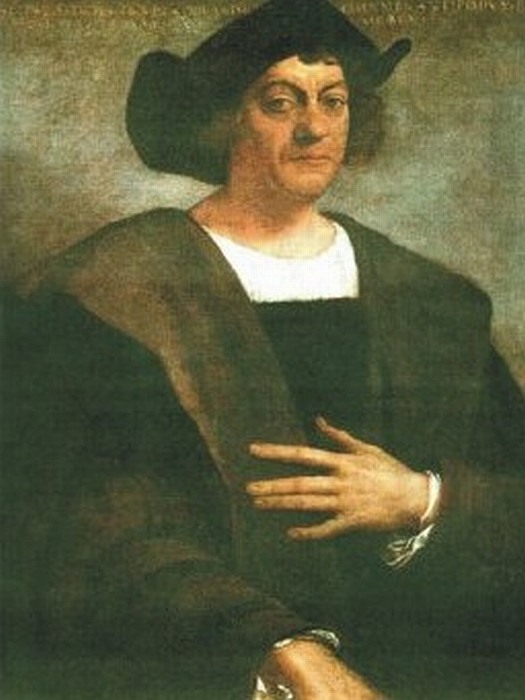
Preludio a Cristobal Colón

Columbus Day weekend is here, and to celebrate, a weird tribute to the great explorer from a musical explorer, the Mexican Julián Carrillo (1875-1965).  This is the "Preludio a Cristobal Colón" (1922), his first work to employ the principles of the 13th Sound, his system of dividing the octave into smaller intervals than the 12 half-tones normally found in Western music (hence, the "13th" sound - beyond 12 - get it?).  If you think of the note "C" on the piano, a white key, and the black key beside it, "C-sharp", and then imagine seven more notes between these two (corresponding to quarter, eighth, and sixteenth-tones), you will get an idea how Carrillo's system works.

Despite its apparent complexity, the system actually produced some quite listenable, if strange-sounding, music.  This "Preludio," scored for wordless soprano and 5 instruments, ends up being a rather lugubrious piece with an E-Flat-minorish feel, its mournful quality probably not surprising when you consider the ill effects of European settlements, as begun by Columbus, on Native American populations, of which Carrillo was a descendant.

Carrillo: Preludio a Cristobal Colón
13th Sound Ensemble directed by Angel Reyes
Recorded February 7, 1930
Columbia Masterworks 7357-M, one 78-rpm record
Link (FLAC file, 20 MB)
Link (MP3 file, 7.47 MB)

This record stayed in the Columbia catalogue for about 20 years, and was frequently cited in reference works of the time as an example of the most experimental music available on records.  David Hall, in his 1948 "Record Book," described the "resulting sounds as...not unlike those one hears from insect life in a field on a hot summer afternoon."

Exactly one other recording existed in the Columbia catalogue of a piece that employed microtones - a movement of a Duo for two violins by Czech composer Alois Hába (1893-1973).  It was to be found as the last item in the Columbia History of Music, Vol. 5, dealing with 20th-century music, which roughly ordered its 16 selections from the most musically conservative to the most far-out.  The Hába piece was placed even after a piece by Varèse!  Two years ago I transferred this entire volume of the Columbia History, which has been newly uploaded here:

Columbia History of Music, Vol. 5
Recorded 1934-37
Columbia Masterworks set M-361, eight 10-inch records
Link (FLAC files, 122.08 MB)
Link (MP3 files, 53.29 MB)

Tuesday, October 5, 2010

Two Symphonies from Philadelphia

This week I present two recordings of symphonies from the earliest part of Eugene Ormandy's 44-year long career as conductor of the Philadelphia Orchestra (a post he held from 1936 to 1980).   First is Schumann's Second Symphony in a dynamic, virile reading which makes one regret that Ormandy never did a Schumann cycle - the only other Schumann symphony he recorded was No. 4, with the Minneapolis Symphony in 1934 (a recording I haven't heard).  This version of No. 2 was made during Ormandy's first two recording sessions with the orchestra:

Schumann: Symphony No. 2 in C, Op. 61
Philadelphia Orchestra conducted by Eugene Ormandy
Recorded December 13, 1936 and January 9, 1937
Victor Musical Masterpiece set DM-448, five 78-rpm records
Link (FLAC files, 78.13 MB)
Link (MP3 files, 37.55 MB)

The other work is a comparative rarity: the First Symphony of Colorado-born Harl McDonald (1899-1955), entitled "The Santa Fé Trail."  It's picture-postcard music with a slightly Impressionistic hue; not great music, perhaps, but fun and well-made, and superbly played by the "Fabulous Philadelphians" in a recording made in 1940:

McDonald: Symphony No. 1, "The Santa Fé Trail"
Philadelphia Orchestra conducted by Eugene Ormandy
Recorded October 20, 1940
Victor Musical Masterpiece set DM-754, three 78-rpm records
Link (FLAC files, 44.99 MB)
Link (MP3 files, 23.68 MB)

McDonald, at the time this and other recordings of his orchestral works were made, was the business manager of the Philadelphia Orchestra.  This prompted Irving Kolodin, in his 1950 "New Guide to Recorded Music," to comment rather sarcastically on the "subtlety in the art of perpetuating one's writings that hadn't occurred to such men as Copland, Barber, or Piston."