Thursday, March 15, 2012

Gould: American Concertette

Cover by Alex Steinweiss
The more works by New York-born Morton Gould (1913-1996) I hear, the more I am convinced that he is one of the most seriously underrated of American composers.  I'm sure the abundance of popular-music stylings that pop up in his pieces hasn't helped his case any, nor has the fact that, in the 1940s and 1950s at least, he made his share of Kostelanetz-like arrangements of popular tunes which he recorded with his own orchestra.  But the best of his work has wit, charm and craftsmanship second to none for an American composer.  Typical is this gem of a miniature piano concerto from 1943, which he originally called "American Concertette" - it didn't receive the subtitle "Interplay" until turned into a ballet two years later:

Morton Gould: Interplay (American Concertette), for piano and orchestra
Robin Hood Dell Orchestra of Philadelphia
Morton Gould, pianist and conductor
Recorded August 1, 1947
Columbia Masterworks set MX-289, two 78-rpm records
Link (FLAC file, 39.55 MB)
Link (MP3 file, 20.96 MB)

The piece is in four short movements, the second of which is a quirky Gavotte, and the third a Blues that took on a life of its own as a solo piano piece.  Incidentally, the suffix "-ette" to denote works of smaller structure than full scale ones (e.g., "Concertette," "Symphonette") was Gould's invention, which he subsequently came to regret.

Sunday, March 11, 2012

Bach by Wood

It's been an insanely busy weekend, and I've had time to prepare only morsels, but they are, I think, tasty ones, and I hope you will agree: two string-orchestra arrangements of Bach conducted by the great Sir Henry J. Wood (1869-1944).  Here they are:

Bach-Wilhemj: Orchestral Suite No. 3 in D, BWV 1068 - Air and
Bach-Wood: Unaccompanied Violin Partita No. 3 in E, BWV 1006 - Gavotte
String Orchestra conducted by Sir Henry J. Wood
Recorded June 16, 1932
English Columbia DX 475, one 78-rpm record
Link (FLAC files, 23.28 MB)
Link (MP3 files, 9.94 MB)

The label incorrectly identifies the orchestra as the London Symphony; American and British catalogues identify the record as by the British Symphony Orchestra, which Weingartner and Bruno Walter also conducted for records, and which I suspect was a pseudonym for an ad hoc group.  On the same session, Wood and the orchestra also recorded Bach's Brandenburg Concerto No. 3, which I uploaded earlier at this post.

Tuesday, March 6, 2012

The Incomparable Emanuel Feuermann: Postscript

Emanuel Feuermann with daughter Monica, 1942
In the comments section of my last post about Emanuel Feuermann, somebody put in a request for his impassioned, magisterial performance of Ernest Bloch's "Schelomo."  Well, I'm happy to report that the records I have of this (the only other Feuermann 78s I have besides those in the last post) are in fine shape, so, here is my transfer:

Bloch: Schelomo - Hebrew Rhapsody for Cello and Orchestra (1916)
Emanuel Feuermann with the Philadelphia Orchestra
conducted by Leopold Stokowski
Recorded March 27, 1940
Victor Musical Masterpiece Set M-698, three 78-rpm records
Link (FLAC file, 42.18 MB)
Link (MP3 file, 21.5 MB)

March 27, 1940, was a busy day for Stokowski's Philadelphians, for it began with a recording of Glière's "Ilya Murometz" Symphony (No. 3) on eleven sides, then continued with Debussy's "Afternoon of a Faun," Harl McDonald's "Legend of the Arkansas Traveler" and the Prelude to Act III of Wagner's "Lohengrin" before Feuermann joined them for this "Schelomo" recording.  Whew!

Speaking of Victor sets, a correspondent recently shared with me a list of Victor Musical Masterpiece sets that Steven Smolian prepared in 1964 for the American Record Guide, which filled in many gaps that I had in my own listing posted on this blog last year.  (Mr. Smolian, incidentally, supplied me with a number of the rare chamber music sets that I have transferred here.)  I have therefore updated my own Victor list, and have also updated my previous post linking to it, but for those who don't want to take the trouble to look that up, here's the new link:

Link (PDF file, 624.25 KB)

Friday, March 2, 2012

Ormandy: Three American Symphonies

Eugene Ormandy may not have been as visible a supporter of contemporary American music as, say, Serge Koussevitzky in Boston or Leonard Bernstein almost everywhere, but he certainly did his part in keeping it before the public.  Here are three American symphonies performed and recorded by him in the 1950s - I believe all three were once offered as an Albany Records CD, which is now out-of-print:

William Schuman: Symphony No. 6 (1948)
Philadelphia Orchestra conducted by Eugene Ormandy
Recorded November 15, 1953
Side 1 of Columbia Masterworks ML-4992, one vinyl LP record
Link (FLAC file, 66.37 MB)
Link (MP3 file, 37.01 MB)

Walter Piston: Symphony No. 4 (1950)
Philadelphia Orchestra conducted by Eugene Ormandy
Recorded April 15, 1954, under the auspices of the
Walter W. Naumberg Foundation
Side 2 of Columbia Masterworks ML-4992, one vinyl LP record
Link (FLAC files, 69.2 MB)
Link (MP3 files, 39.98 MB)

Roy Harris: Symphony No. 7 (1952)
Philadelphia Orchestra conducted by Eugene Ormandy
Recorded October 23, 1955
Side 1 of Columbia Special Products CML-5095, one vinyl LP record
Link (FLAC file, 56.24 MB)
Link (MP3 file, 24.57)

About the works themselves, I can say little beyond that the Piston symphony is one of his most accessible scores, the Schuman one of his thornier ones.  The Harris, a one-movement work like his famous Third, seems to me one of his finest (of course, I've only heard two others - the Third and the "Symphony 1933"), a variation form based on a long, passacaglia-like theme similar to that in the Piano Quintet uploaded earlier.  I don't have original liner notes for this record, as it came in a generic Columbia Special Products sleeve, so I offer with the download an extract from Dan Stehman's 1984 monograph on the composer, analyzing the symphony.


Sunday, February 26, 2012

Happy Birthday, Denis Matthews!

Monday marks the 92nd birth anniversary of the British pianist Denis Matthews, who came to a sad end - he committed suicide on Christmas Day, 1988.  He was most famous for his recordings of Mozart and Beethoven, with at least eight of Mozart's concertos in his discography.  Here is the first of these, made in 1944, when he was in R.A.F. uniform:

Mozart: Piano Concerto No. 23 in A, K. 488
Denis Matthews with the Liverpool Philharmonic Orchestra
conducted by George Weldon
Recorded August 28, 1944
English Columbia DX 1167 through DX 1169, three 78-rpm records
Link (FLAC files, 64.79 MB)
Link (MP3 files, 27.79 MB)

A little over a year ago, I presented several single discs of Matthews playing solo works by Haydn, Mozart, Beethoven and John Field.  Here is another to add to that collection:

Bach: Prelude and Fugue No. 8 in E-Flat minor (Well-Tempered Clavier, Book I)
Denis Matthews, piano
Recorded April 25, 1949
English Columbia DX 1635, one 78-rpm record
Link (FLAC file, 21.54 MB)
Link (MP3 file, 9.66 MB)

According to CHARM, Matthews recorded at least five of the Bach "Well-Tempered Clavier" preludes and fugues, but only this one and the No. 1 in C were actually issued.  Matthews' Bach discography is rather meager, but it does include a fine version of the Triple Concerto in C, BWV 1064, with Edwin Fischer and Ronald Smith, from the Bach anniversary year of 1950, available on an EMI CD.

Wednesday, February 22, 2012

Nielsen: Violin Concerto (Telmányi)

Carl Nielsen, 1910
Most people, if they remember the name of the Hungarian-born violinist Emil Telmányi (1892-1988) at all, remember it as belonging to the inventor of the spurious Bach bow (or Vega bow), designed to be able to play on, and sustain, all four strings of the violin simultaneously, for use in the unaccompanied Bach violin works.  But Telmányi was also the first internationally famous exponent of the music of Carl Nielsen (whose daughter, Anne Marie, he married in 1918), and made this first recording of Nielsen's Violin Concerto, for me one of the most delightful of all twentieth-century violin concertos, in 1947:

Nielsen: Concerto for violin and orchestra, Op. 33 and
Mozart: Serenade No. 7 in D, K. 250 ("Haffner") - Menuetto
Emil Telmányi with the Orchestra of the Royal Opera House, Copenhagen,
conducted by Egisto Tango
Recorded June 3-7, 1947
Tono X-25081 through X-25085, five 78-rpm records
Link (FLAC files, 99.4 MB)
Link (MP3 files, 42.37 MB)

Friday, February 17, 2012

"Glorious John"

Sir John Barbirolli and Ralph Vaughan Williams on the occasion of the première of the latter's Sinfonia Antartica, 1953
"Glorious John" - that was Ralph Vaughan Williams' nickname, and subsequently everybody else's, for Sir John Barbirolli (1899-1970), and it comes from the inscription on the score of Vaughan Williams' Eighth Symphony - "for glorious John, with love and admiration from Ralph."  Barbirolli also received the dedication of Vaughan Williams' previous symphony, the Sinfonia Antartica.  Well, here's the first recording by "Glorious John" of a Vaughan Williams symphony, made a decade before these dedications, exactly sixty-eight years ago today (I didn't plan it that way, either!):

Vaughan Williams: Symphony No. 5 in D Major
Hallé Orchestra conducted by John Barbirolli
Recorded February 17, 1944
HMV C 7599 through C 7603, five 78-rpm records
Link (FLAC files, 96.06 MB)
Link (MP3 files, 41.13 MB)

This was Barbirolli's second-ever recording with the Hallé Orchestra (the first was of Bax's Third Symphony), of which he had assumed control beginning with the 1943-44 season, having returned to England fron New York.  There, as director of the Philharmonic-Symphony, he had had a rocky relationship with the music critics, who constantly compared him unfavorably with Toscanini, whom he had succeeded as the Philharmonic's music director.  While in New York, however, Barbirolli had made some important recordings, first for Victor and then for Columbia, including symphonies by Sibelius (the First and Second), Schubert (the Fourth) and this brisk, bracing account of Mozart's "little G minor" symphony:

Mozart: Symphony No. 25 in G minor, K. 183
Philharmonic-Symphony Orchestra of New York conducted by John Barbirolli
Recorded November 3, 1941
Columbia Masterworks set MX-217, two 78-rpm records
Link (FLAC files, 53.51 MB)
Link (MP3 files, 32.51 MB)

Monday, February 13, 2012

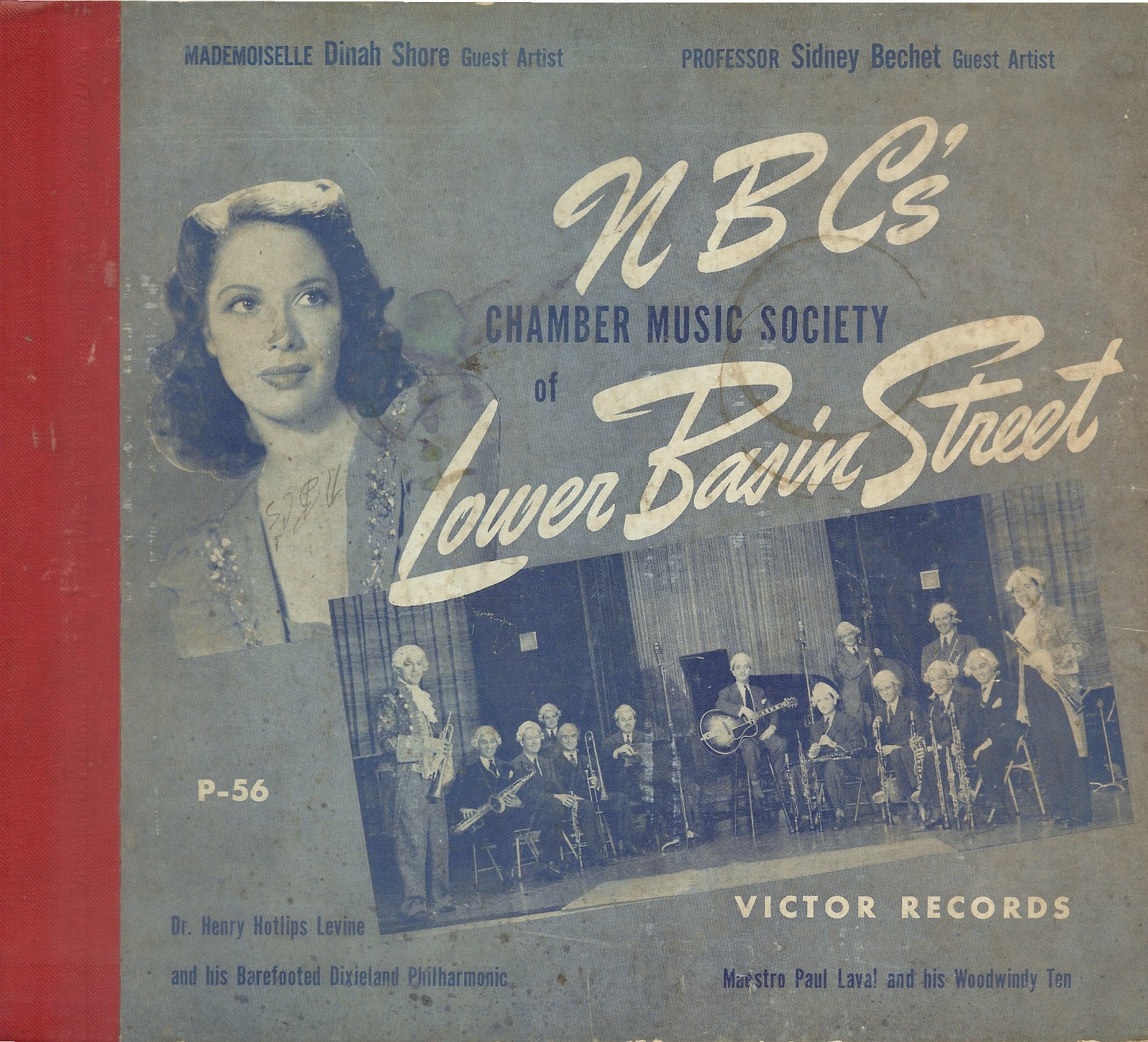
The Chamber Music Society of Lower Basin Street

The Chamber Music Society of Lower Basin Street was a weekly radio program that began on NBC's Blue Network in 1940.  (The National Broadcasting Company originally had two radio networks, the Red and the Blue; the latter was sold off in 1942 and became the American Broadcasting Company - ABC - in 1945.)  The show featured some of the finest jazz musicians of the day, and had two resident bands (which shared the same rhythm section) - Henry Levine's Dixieland Octet, whose leader was a former member of the Original Dixieland Jazz Band, and Paul Laval's Woodwindy Ten.  On the Society's debut album, which I present here, Levine's group was rechristened the "Barefooted Dixieland Philharmonic" - although, as can be seen in the slightly coffee-stained picture, the members are not only very much shod, but periwigged!  For the Society's offerings, broadcast and recorded, were usually presented in a mock-serious format that poked fun at the stuffy classical music presentations of the day.  The album even comes with a booklet mimicking those of the Victor Musical Masterpiece Series, with tongue-in-cheek analyses of each song (a PDF file of this booklet is included with the download).

NBC's Chamber Music Society of Lower Basin Street
1. Mood Indigo (with Dinah Shore)
2. Muskrat Ramble (with Sidney Bechet)
3. Runnin' Wild
4. Dinah's Blues (with Dinah Shore)
5. Shoemaker's Holiday
6. Basin Street Blues
Recorded November 11, 1940
Victor set P-56, three 10" 78-rpm records
Link (FLAC files, 65.08 MB)
Link (MP3 files, 40.36 MB)

For me, the last three sides are the most enjoyable.  "Dinah's Blues" manages to work into its lyrics the names of the show's two corporate sponsors, NBC and its parent, RCA Victor; "Shoemaker's Holiday" is a delightful romp featuring the bassoon, and this arrangement of "Basin Street Blues," with its ending that spoofs Haydn's "Farewell" Symphony (the bass being the instrument left to finish the piece "in the doghouse, but good"), was apparently also the ending number on every broadcast.

Wednesday, February 8, 2012

The Incomparable Emanuel Feuermann

Emanuel Feuermann
Today I present three recordings featuring the man whom many, myself included, consider the greatest cellist of all time, the tragically short-lived Emanuel Feuermann (1902-1942).  He really should have lived into the era of stereo recording, but he died at age 39 of complications from an operation for hemorrhoids; Toscanini, who was one of the pallbearers at his funeral, is said to have wept during the procession, saying, "this is murder!"  At the time of his death, Feuermann was planning to take up the viola da gamba, so that he could present Bach's three sonatas for that instrument as authentically as possible.

Despite the short time available to him, he left a precious recorded legacy.  But, alas, no unaccompanied Bach suites - I suppose these works were perceived at the time as belonging to Casals, so Feuermann never got to record one - so the closest we can get to what that may have sounded like is via his 1938 set of a Reger suite, and this unaccompanied sonata by his friend, Paul Hindemith:

Hindemith: Sonata for unaccompanied cello, Op. 25, No. 3
Emanuel Feuermann, cello
Recorded January 27, 1934
Japanese Columbia S-1032, one 78-rpm record
Link (FLAC file, 22.17 MB)
Link (MP3 file, 9.3 MB)


Feuermann left us several concerto recordings, including a wonderful Brahms Double with Heifetz, and this one of the Haydn D major:

Haydn: Cello Concerto in D major, Op. 101
Emanuel Feuermann with orchestra conducted by Dr. Malcolm Sargent
Recorded November 25, 1935
Columbia Masterworks set MM-262, four 78-rpm records
Link (FLAC files, 76.38 MB)
Link (MP3 files, 37.26)

On a personal note: this is the third copy of MM-262 that I have owned; the first one I had as a boy of ten, inherited from the discarded 78 library of Emory University, where my mother was teaching music at the time.  It was my introduction to Feuermann's art, and to this day the Haydn D major is my favorite of all cello concertos, largely on the strength of this recording.

Finally, for fans of Eugene Ormandy, another of his early Victor recordings, featuring Feuermann - the first of four recordings Ormandy was to make of Strauss' "Don Quixote," but the only one with a cellist other than first-desk Philadelphia players:

Richard Strauss: Don Quixote, Op. 35
Philadelphia Orchestra conducted by Eugene Ormandy
Emanuel Feuermann, cello
Samuel Lifschey, viola
Alexander Hilsberg, violin
Recorded February 24, 1940
Victor Musical Masterpiece set DM-720, five 78-rpm records
Link (FLAC file, 87.25)
Link (MP3 file, 45.26)