Friday, March 22, 2013

Franck: Symphony (Ormandy)

Cover design by Alex Steinweiss
(restored by Peter Joelson)
My vintage Ormandy series continues, with the first of his three studio versions of the Franck Symphony in D Minor, from 1945.  (The others, also for Columbia, were from 1953 and 1961.)  I'm quite fond of this recording, as it was my introduction to the glories of this great symphony.  In particular, the buildup in the coda of the first movement is most excitingly done.  The English horn solo in the second movement is, unfortunately, uncredited on the labels or album, but it must have been played by John Minsker, the English horn player in the Philadelphia Orchestra from 1936 to 1959.

Franck: Symphony in D Minor
Philadelphia Orchestra conducted by Eugene Ormandy
Recorded March 15, 1945
Columbia Masterworks set MM-608, five 78-rpm records
Link (FLAC files, 101.95 MB)
Link (MP3 files, 53.68 MB)

This recording was reissued in 1948 as part of Columbia's launch of LP, as ML-4024.  Some copies of this have the same Steinweiss cover art as the 78 set, as shown in this scan lifted from Ken Halperin's wonderful site Collecting Record Covers:


Sunday, March 17, 2013

Mendelssohn's Octet: The First Recording

It seems almost unbelievable, when one looks at the 1948 Gramophone Shop Encyclopedia of Recorded Music, to realize that Mendelssohn's youthful Octet, that freshest example of his teenage genius, was unavailable to the record buyer except for three recordings of the Scherzo in Mendelssohn's own orchestration (as intended for the première performance of his First Symphony).  Such, however, was the case, since this first recording, from 1929, had long been deleted, and the second recording, by the Pro Musica Ensemble led by Henri Merckel, from French Polydor, had not yet been issued.  And the first recording had not even received very wide circulation, being aimed at the British market, with no representation on Victor:

Mendelssohn: Octet in E-Flat, Op. 20
International String Octet
Recorded February 18 and 22, 1929
HMV C 1672 through C 1675, four 78-rpm records
Link (FLAC files, 87.96 MB)
Link (MP3 files, 35.65 MB)

The rather enigmatically-named "International String Octet" was really two separate string quartets, the International String Quartet headed by André Mangeot and the Poltronieri String Quartet headed by Alberto Poltronieri.  Both groups were active in the recording studios - but for the National Gramophonic Society, not HMV; and the Poltronieri Quartet also recorded for Columbia.

Tuesday, March 12, 2013

Symphonies at 16⅔ R.P.M.

This one is, frankly, little more than a curiosity, and until about a week ago, I had forgotten that I even owned it.  But my memory was piqued upon seeing this YouTube video featuring a rare record changer, in which the presenter states that it's difficult to find a 16-rpm record that isn't of "Christmas music, crappy music, or talking books."  Well, Dvořák's "New World" Symphony, though it might be overplayed, certainly isn't "crappy music," and his comment triggered a memory of buying, some twenty years ago in a used book shop, this and three other symphonic works on 7-inch 16⅔-rpm records for a dollar each.  A bit of searching around the house produced the little records in question, all by anonymous performers, in a short-lived series designed as supplementary to the producing company's main business, which was, in fact, "talking books."  It isn't hard to see why the series was so short-lived.  The slower speed really doesn't lend itself well to music, especially when pressed on such inferior material as Audio Book was using at the time (1956) - the same type of cheap plastic that Columbia was pressing its 45s in.  I confess that my main reason for offering this transfer here is to find out if anyone out there knows anything about these records, and especially what source Audio Book may have been drawing from for the recordings.  Any guesses as to the identity of the orchestra and conductor are welcome!

Dvořák: Symphony No. 9 in E minor, Op. 95 ("From the New World")

Anonymous orchestra and conductor
Issued in 1956
Audio Book Music Series WG-805, one 7-inch 16⅔-rpm record
Link (FLAC files, 113.12 MB)
Link (MP3 files, 52.92 MB)

The Audio Book Company, incidentally, is still very much with us, and is still purveying many of the same "talking book" recordings they first offered as small 16-rpm records in the 1950s, only now as cassettes and CDs here at their website.  One that I have particularly fond memories of is Marvin Miller's virtuosic reading of Carlo Collodi's "Pinocchio" in unabridged form on 4 CDs.  I had it in the early 70s as a set of five 16-rpm discs, purchased from the same shop where I bought 78-rpm Young Peoples Records - the Educational Record Center in Decatur, Ga.

Tuesday, March 5, 2013

Prokofiev: String Quartet No. 1 (Stuyvesant Quartet)

With this post I now have available all the sets that the Stuyvesant String Quartet made for Columbia prior to the American Federation of Musicians' recording ban of 1942.  I stumbled upon this set, in fact, while I was doing research for my last post featuring the group; in order to make the claim that their recording of Ravel's Introduction and Allegro was the only one to feature John Dembeck on second violin, I had to make sure he wasn't on this Prokofiev Quartet, so I did a Google search on "prokofiev stuyvesant" and lo and behold, this set had just gone up for sale on eBay, and quite reasonably priced, too!  Unfortunately, it was minus the album, since the radio station that had owned it previously had "their own way of cataloguing" its records.  But the music is what really matters, after all, and here it is:

Prokofiev: Quartet No. 1 in B minor, Op. 50
The Stuyvesant String Quartet (Shulman-Glickman-Kievman-Shulman)
Recorded January 15, 1941
Columbia Masterworks set MM-448, three 78-rpm records
Link (FLAC files, 58.93 MB)
Link (MP3 files, 28.48 MB)

Thursday, February 28, 2013

Happy Birthday, Dimitri Mitropoulos!

Dimitri Mitropoulos
Tomorrow, March 1, is the birthday of the great Greek conductor Dimitri Mitropoulos (1896-1960), and so I present his first recording of a piece that was one of his specialties, the often-maligned "Scotch" Symphony of Mendelssohn. David Hall, in a supplement to his 1940 Record Book, confessed that this symphony was not a favorite of his among Mendelssohn's works, but that Mitropoulos' "arresting and revelatory reading" had forced him to revise his opinion!  And indeed Mitropoulos finds just the right blend of excitement and poetry in the piece:

Mendelssohn: Symphony No. 3 in A minor, Op. 56 ("Scotch")
Minneapolis Symphony Orchestra conducted by Dimitri Mitropoulos
Recorded December 6, 1941
Columbia Masterworks set MM-540, four 78-rpm records
Link (FLAC file, 86.58 MB)
Link (MP3 file, 39.98 MB)

This recording was made on the Saturday of that fateful weekend when the Japanese attacked Pearl Harbor, drawing the USA into World War II; I'm sorry to say that this pressing was made under wartime conditions with recycled shellac, but I have done what I could with it.  Mitropoulos recorded the symphony again twelve years later, with the New York Philharmonic.

Cover design by Alex Steinweiss
(restored by Peter Joelson)

I was saddened yesterday to hear of the death of Van Cliburn, who had been suffering from bone cancer since last August.  His New York Philharmonic debut, in 1954, was under Mitropoulos' direction, and Cliburn is the only person I am aware of to repeat Mitropoulos' feat of simultaneously playing and conducting Prokofiev's Third Piano Concerto - once, at a concert memorializing Mitropoulos!

Cliburn's famous 1958 recording of the Tchaikovsky concerto, incidentally, appears to have been the last extended classical work ever to have been issued in a short-playing format - 3 extended-play 45s (RCA Victor set ERC-2252), with the first movement spread out over four sides just as it was in the days of 78s!

Thursday, February 21, 2013

Lewis Richards, American Harpsichordist

Lewis Richards
Michigan-born Lewis Richards (1881-1940) appears to have been the first American to figure in the harpsichord revival of the early 20th century.  He acquired a Pleyel harpsichord in Brussels, where he had trained as a pianist, and embarked on a career with it in 1923, becoming the first harpsichordist to play a concerto with an American orchestra - the Haydn D major in Minneapolis - beating Wanda Landowska to the honor by a matter of months.  In 1927 he was the first harpsichordist in modern times to play at the White House, for President Calvin Coolidge.  (One hopes that "Silent Cal" enjoyed the recital more than he did most societal functions.  One unfortunate lady, seated next to him at a dinner party, is supposed to have said, "Mr. Coolidge, I've made a bet with a friend who said it's impossible to get more than two words out of you." His reply: "You lose.") Richards made pitifully few recordings; only three ten-inch Brunswick issues, with this coupling (which duplicated a coupling by Landowska on Victor) being the first:

Mozart: Rondo alla turca ("Turkish March")
Handel: Air and Variations ("The Harmonious Blacksmith")
Lewis Richards, harpsichordist
Recorded May 21, 1925
Brunswick 2930, one ten-inch 78-rpm record
Link (FLAC files, 19.12 MB)
Link (MP3 files, 8.29 MB)

This was almost certainly the first electrical recording of the harpsichord, done by Brunswick's "Light Ray" process only about a month after the company began using it.  The Mozart side is frankly experimental - it begins and ends quietly, with a crescendo in the middle and a diminuendo at the end which are impossible on the harpsichord.  Although some of this can perhaps be attributed to registration, it really sounds to me as though the engineers were getting the effect by playing with the controls!

Sunday, February 17, 2013

Debussy and Ravel by Newell and Wummer (and others)

Laura Newell, John Wummer, Milton Katims
Two sets this week, the common denominator of both being not only French impressionism, but the same harpist and flutist.  These are Laura Newell, active in the 1940s and 1950s as a freelance harpist (she was Robert Shaw's choice for both recordings by his Robert Shaw Chorale of Britten's Ceremony of Carols), and John Wummer, principal flute of the New York Philharmonic from 1942 to 1965.  They're both joined by Milton Katims, who played second viola on a number of Budapest Quartet recordings of Mozart and Beethoven quintets, and later conducted the Seattle Symphony, for this Debussy trio:

Debussy: Sonata No. 2, for flute, viola and harp
John Wummer, Milton Katims, Laura Newell
Recorded April 24, 1945
Columbia Masterworks set MX-282, two 78-rpm records
Link (FLAC file, 49.8 MB)
Link (MP3 file, 27.1 MB)
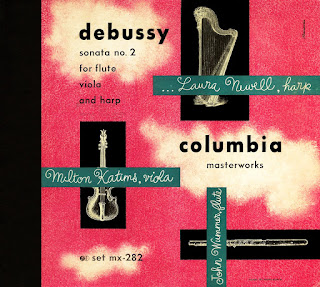
Cover design by Alex Steinweiss
(restored by Peter Joelson)

Laura Newell was also associated with the brothers Sylvan and Alan Shulman, all three being members of the group "New Friends of Rhythm" for which Alan Shulman wrote jazz-influenced arrangements and compositions.  So it's natural that she should have recorded Ravel's Introduction and Allegro with the Shulmans' Stuyvesant String Quartet:

Ravel: Introduction and Allegro
Laura Newell, harp; John Wummer, flute; Ralph McLane, clarinet
Stuyvesant String Quartet (Shulman-Dembeck-Kievman-Shulman)
and
Debussy: The Maid with the Flaxen Hair (arr. Grandjany)
Laura Newell, harp
Recorded March 22, 1940
Columbia Masterworks set MX-167, two 78-rpm records
Link (FLAC files, 34.1 MB)
Link (MP3 files, 21.6 MB)

As I mentioned in an earlier post about the Stuyvesant Quartet, the two inner parts changed hands several times during their first few years of existence.  This appears to have been the only recording that John Dembeck, who that same year moved to Toronto and eventually became a Canadian citizen, made as their second violinist.

All my old files are now up and running; and the links from my blog have been changed to the new ones.

Sunday, February 10, 2013

Shostakovich: Symphony No. 13 (Ormandy)

Cover design by Thomas Upshur
Shostakovich's Thirteenth Symphony, based on five poems by Yevgeny Yevtushenko, is one of the Russian master's most powerful works, and represents the closest he ever came to outright public dissent against the Soviet government.  So close was it to the composer's heart that he celebrated the date of its completion, July 20, 1962, as an anniversary for the rest of his life; only the date of the première of his First Symphony enjoyed a similar honor.  The Soviet authorities, naturally, did their best to suppress the Thirteenth Symphony, banning it after two performances.  An unofficial recording of the second of these performances, conducted by Kiril Kondrashin, somehow turned up on Everest in 1967, in terrible sonics made worse by their unfortunate application of fake stereo.  This recording by Ormandy was the first professionally made one, done in the wake of the Western première, from a score that had to be smuggled out of the USSR:

Shostakovich: Symphony No. 13, Op. 113 ("Babi Yar")
Philadelphia Orchestra conducted by Eugene Ormandy
with Tom Krause, baritone, and the Male Chorus of the Mendelssohn Club
Recorded January 21 and 23, 1970
RCA Red Seal LSC-3162, one stereo LP record
Link (FLAC files, 293.23 MB)
Link (MP3 files, 113.5 MB)

I'm very fond of this recording; I got to know the work through it some thirty-seven years ago from, believe it or not, an 8-track tape!  Ormandy went on to make early recordings of Shostakovich's last two symphonies; I also had the Fifteenth as an 8-track.

Links for my previous posts are now restored going as far back as April, 2011, and I hope to have everything back up and running within the week.

Tuesday, February 5, 2013

Zino Francescatti Violin Recital

Cover design by Alex Steinweiss
(restored by Peter Joelson)
A modest offering for my first upload following the Mediafire debacle, but one very dear to my heart.  I first owned this set in 1974, when I was 11, having purchased it from Clark Music, the mom-and-pop store that I spoke about in this post.  As I recall, the cost was $3.94, and it was something of a revelation to me that classical music could be found on ten-inch discs in album sets!  I associated the smaller format with popular and children's records.  Here are the details:

Violin Recital
1. Tartini: Variations on a Theme of Corelli
2. Shostakovich: Polka from "The Age of Gold"
3. Debussy: La Fille aux Cheveux de Lin
4. Debussy: Minstrels
5. Schumann: The Prophet Bird
6. Wieniawski: Caprice in A minor
Zino Francescatti, violin; Max Lanner, piano
Recorded April 12 and 25, 1946
Columbia Masterworks set M-660, three 10-inch 78-rpm records
Link (FLAC files, 43.6 MB)
Link (MP3 files, 26.7 MB)

I believe this album contained the first piece I had ever heard by Shostakovich (at the time, I thought it sounded pretty weird!), as well as by Tartini and Wieniawski.

All files going back to May 2012 are now up and running.