Tuesday marks the 174th anniversary of the birth of Antonín Dvořák (1841-1904). I guess that means I'm a year ahead of celebrating a nice round number (175th), but so what? - any excuse to listen to Dvořák's music seems a good one to me. And so here is his Cello Concerto, one of the works composed in America, and suffused with nostalgia and homesickness. Of course, almost every cellist of note has recorded it, and most of these recordings that I've heard fall short of the ideal interpretation. It requires a performance of total emotional commitment, while at the same time avoiding sentimentality, and that's a fine line indeed! I think this version by Piatigorsky, himself a lifelong exile, comes as close as any I've heard (naturally, it doesn't hurt to have the support of Ormandy and his great orchestra):
Dvořák: Cello Concerto in B Minor, Op. 104
Gregor Piatigorsky, cello
Philadelphia Orchestra conducted by Eugene Ormandy
Recorded January 17, 1946
Columbia Masterworks set MM-658, five 78-rpm records
Link (FLAC files, 88.01 MB)
Link (MP3 files, 64.36 MB)
This cover design of this set affords another excuse to add to my ongoing Alex Steinweiss gallery:
Sunday, September 6, 2015
Sunday, August 30, 2015
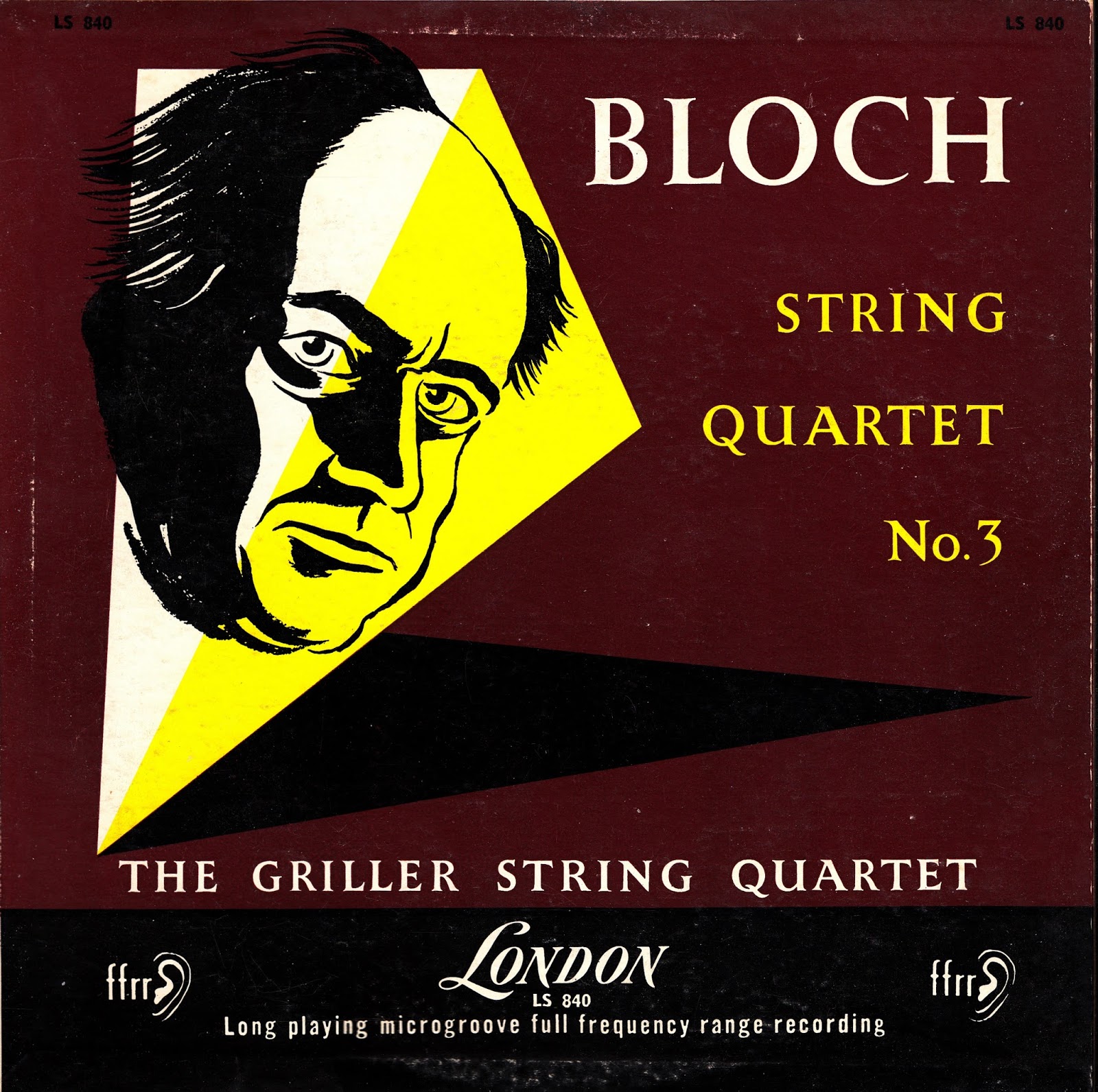
Bloch: String Quartet No. 3 (Griller Quartet)
![]() |
| The Griller Quartet with Ernest Bloch, 1947 |
About a month ago, I sprang for the recent Decca big box (53 CDs) called "Decca Sound: The Mono Years." Some real gems are rattling around in there, and one of the highlights has been the set of four Bloch string quartets played by the Griller Quartet, who were the dedicatees of the master's Third Quartet of 1952. But it struck me as I was listening to this, that the recording is different than another one that I've had on a ten-inch LP for some time, and consulting Philip Stuart's Decca discography revealed the reason why: the recording on the ten-incher was not reissued in the complete set - instead, an entirely new recording was made, even though it was a mere year later! The earlier recording, which to my knowledge has never been reissued, was made a mere five days before the British première of the piece:
Bloch: String Quartet No. 3 (1952)
The Griller String Quartet (Griller-O-Brien-Burton-Hampton)
Recorded June 16, 1953
London LS-840, one ten-inch LP record
Link (FLAC files, 63.38 MB)
Link (MP3 files, 46.29 MB)
The main difference between the two versions seems to be one of playing time: the earlier one is nearly two minutes slower than the newer one.
Sunday, August 23, 2015
Beethoven's Ninth - The First Recording
This is my 300th post on this blog - can you believe it? Something really big seemed called for, so I offer a recording that I have posted before, but this time, it's complete! Seven years ago I offered all I had of this pioneering recording of Beethoven's Ninth Symphony, almost certainly the first complete one ever made, but that was only the first two movements. Now I have the whole thing, complete with album (the cover is pictured above) and I am pleased to present it now:
Beethoven: Symphony No. 9 in D Minor, Op. 125
Neues Symphonie-Orchester conducted by Bruno Seidler-Winkler
with soloists and the chorus of the Berlin Staatskapelle
Recorded c. 1923
Deutsche Grammophon 69607 through 69613, seven 78-rpm records
Link (FLAC files, 185.69 MB)
Link (MP3 files, 114.34, MB)
Bruno Seidler-Winkler (1880-1960), the hero of this undertaking, had been the music director of Deutsche Grammophon since 1903, and left that position the year this recording was issued, so this must have seemed at the time a fitting cap to his career there. But in fact, it was the opening salvo in Deutsche Grammophon's bid to have all nine Beethoven symphonies recorded and available for sale. In the same month as this Beethoven Ninth recording was issued (December, 1923), Seidler-Winkler's of the Fifth and Pfitzner's of the Sixth were also released, according to Claude Arnold's "The Orchestra on Record, 1896-1926" (Greenwood Press, 1997). Here are the details of DGG's first Beethoven symphony cycle, in order by catalogue number:
69607-13: No. 9 (Neues S.O./Seidler-Winkler, issued Dec. 1923)
69638-41: No. 5 (Neues S.O./Seidler-Winkler, issued Dec. 1923)
69642-47: No. 6 (Neues S.O./Pfitzner, issued Dec. 1923)
69659-62: No. 7 (Berlin Staatskapelle/Walter Wohllebe, issued March 1924)
69663-67: No. 4 (Berlin Staatskapelle/Pfitzner, issued Aug. 1924)
69706-11: No. 3 (Berlin Staatskapelle/Oskar Fried, issued July 1924)
69760-63: No. 1 (Berlin Staatskapelle/Klemperer, issued Dec. 1924)
69786-88: No. 8 (Berlin Staatskapelle/Klemperer, issued May 1925)
69799-802: No. 2 (Berlin Staatskapelle/Fried, issued Nov. 1925)
Parlophon, with the same pool of Berlin players working under Eduard Mörike and Frieder Weissmann, entered the race as well in 1924 (intriguingly, also with the Ninth). By March, 1925, they had all nine recorded and available for sale, while DGG lagged with their last two issues.
The Seidler-Winkler Ninth seems to have been more widely disseminated than some of the other Beethoven symphony sets. Vocalion in the USA carried it - in fact it appears to be the only album set they ever issued from DGG sources. They took out an ad in the Talking Machine World magazine of November 15, 1924 (image borrowed from Allan Sutton's "Recording the Twenties", Mainspring Press, 2008):
And from eBay I borrowed this image of one of the Vocalion labels (notice their characteristic red shellac was used):
In Europe, outside Germany, the set was first marketed with the "dogless" Gramophone label (one of the spookiest designs on a record label I have ever encountered! - again, an image borrowed from eBay):
My copy, however, is a German one, with Nipper in full-color glory:
Wednesday, August 19, 2015
Ravel: Daphnis and Chloe (Phillippe Gaubert)
| Phillippe Gaubert |
Ravel: Daphnis et Chloé - Suite No. 2
Orchestre des Concerts Straram conducted by Phillippe Gaubert
Recorded March 24, 1930
Columbia Masterworks set MX-32, two 78-rpm records
Link (FLAC file, 43.19 MB)
Link (MP3 file, 27.85 MB)
My thanks go to Adam Schweigert for the loan of this and several other sets that I have posted here earlier this year, among them Szell's first Cleveland recording of Mozart's 39th Symphony, Stock's of Brahms' Tragic Overture; Barbirolli's of Brahms' Second; Kubelik's of excerpts from Smetana's Ma Vlást, and excerpts from the film Humoresque played by Isaac Stern.
Thursday, August 13, 2015
Early Music from Germany in the 1930s
Well, I'm back online, thank God, and on a new laptop to boot. So for my first offering post-crisis, something easy for me to prepare, and that means dipping into my reclaimed record pile. These two records are somewhat related, for they both were recorded in Berlin in the 1930s, and they both are of German music of an earlier time. Here are the particulars:
Gluck: Don Juan - Selections from the Ballet (1761)
Hans von Benda's Chamber Orchestra
Recorded November 21, 1935
Victor 13648, one 78-rpm record
Link (FLAC file, 20.58 MB)
Link (MP3 file, 14.20 MB)
Philipp Heinrich Erlebach: Suite No. 3 in C Major (1693)
Kammermusikkreis Scheck-Wenzinger
Recorded October, 1938
HMV EH 1221, one 78-rpm record
Link (FLAC file, 23.65 MB)
Link (MP3 file, 13.46 MB)
As will be seen in the picture above, Victor did not deign to correctly identify Herr von Benda's orchestra, substituting instead its own pseudonym in something reminiscent of the days of acoustical recording. Irving Kolodin, in his 1941 Guide to Recorded Music, rightfully took a dim view of this, praising the performance (and giving the conductor his rightful credit) while commenting, sourly, about the "implication of the label that it was made in America by a conductor so obscure that his name need not be mentioned...Surely Victor cannot expect us to endorse such feeble anti-Nazism as this evasion of a reasonable responsibility."
Saturday, August 1, 2015
Poulenc: Double Concerto (Whittemore & Lowe)
I'm having ISP problems right now, and having to type this on the fly using my church's wi-fi (a friend did the actual uploading of the files), so I don't have time to say anything more about this set than that it appears to be the first recording of this delightful work:
Poulenc: Concerto in D minor for two pianos and orchestra
Arthur Whittemore and Jack Lowe, duo-pianists
RCA Victor Symphony Orchestra conducted by Dimitri Mitropoulos
Recorded December 15, 1947
Link (FLAC files, 52.52 MB)
Link (MP3 files, 39.45 MB)
Poulenc: Concerto in D minor for two pianos and orchestra
Arthur Whittemore and Jack Lowe, duo-pianists
RCA Victor Symphony Orchestra conducted by Dimitri Mitropoulos
Recorded December 15, 1947
Link (FLAC files, 52.52 MB)
Link (MP3 files, 39.45 MB)
Monday, July 27, 2015
Mendelssohn: Quartet No. 1 (Budapest Quartet)
I've lately managed to acquire a few sets by the Budapest String Quartet in their glory days - when the group still boated one Hungarian in their lineup (István Ipolyi, viola) but was otherwise transitioning to the all-Russian ensemble that defined them for later generations. These recordings date from 1933-35, and in most cases my copies are really nice ones on Victor "scroll" labels as depicted above. One of the rarest is of this Mendelssohn quartet, which seems to have lasted only a couple of years in the Victor catalogue:
Mendelssohn: Quartet No. 1 in E-Flat Major, Op. 12
The Budapest String Quartet (Roisman-Schneider-Ipolyi-Schneider)
Recorded April 29, 1935
Victor Musical Masterpiece set M-307, three 78-rpm records
Link (FLAC files, 69.62 MB)
Link (MP3 files, 42.83 MB)
This is the quartet that has the famous "Canzonetta" - which was often recorded as a separate piece in those days, but this appears to be the only recording of the complete quartet made during the 78 era.
Tuesday, July 21, 2015
Hans Kindler
Slava Rostropovich, for all his achievements, was far from being the first cellist to make for himself a successful conducting career. He wasn't even the first cellist to become the music director of the National Symphony Orchestra in Washington. That honor goes to the orchestra's founder, the Rotterdam-born Hans Kindler (1892-1949). Kindler's recording career began in 1916 with Victor, as a cellist, on their lower-priced Blue Label series (five of these sides can be heard at the Library of Congress' National Jukebox). In 1919 he was promoted to Red Seals. Then, nine years after founding the National Symphony Orchestra in 1931, he came back to Victor as a conductor, with some 64 issued sides to his credit made between 1940 and 1945. The most interesting of these were on single records, including American works by Chadwick, William Schuman and Mary Howe. I'm sorry to say I don't have any of those, but here are three singles I do have, the first two listed being from the reclaimed record pile:
Corelli-Arbós: Suite for Strings
Recorded November 8, 1940
Victor 11-8111, one 78-rpm record
Liszt-Kindler: Hungarian Rhapsody No. 6
Recorded January 17, 1945
Victor 11-9154, one 78-rpm record
Mussorgsky-Kindler: Boris Godunov - "Love Music" (Act III)
Recorded April 2, 1942
Shostakovich: The Age of Gold - Polka
Recorded January 29, 1941
Victor 11-8239, one 78-rpm record
All by the National Symphony Orchestra (Washington, D.C.)
Hans Kindler, conductor
Link (FLAC files, 53.80 MB)
Link (MP3 files, 38.14 MB)
A number of Kindler's National Symphony recordings received a new lease on life in the 1950s, on the RCA Camden reissue label, including the Liszt record above. The pseudonym used was the "Globe Symphony Orchestra."
Tuesday, July 14, 2015
Honegger Conducts his "Symphonie Liturgique"
Last year, I was able to offer, in time for Bastille Day, the first recording of a symphony by Honegger, the Second, in a riveting performance by Charles Munch. I'm afraid I'm a little late for Bastille Day this year, but here's the other Honegger symphony to be recorded on 78s, his very powerful and equally war-weary Third, called "Liturgique" on account of the titles of its three movements, each named after a part of the Requiem Mass. These titles are actually announced on this recording conducted by the composer, who, presumably, is the announcer as well:
Honegger: Symphony No. 3 ("Liturgique")
Symphony Orchestra conducted by Arthur Honegger
Recorded c. 1947
French Decca A-15004 through A-15007, four 78-rpm records
Link (FLAC files, 78.55 MB)
Link (MP3 files, 51.95 MB)
Honegger: Symphony No. 3 ("Liturgique")
Symphony Orchestra conducted by Arthur Honegger
Recorded c. 1947
French Decca A-15004 through A-15007, four 78-rpm records
Link (FLAC files, 78.55 MB)
Link (MP3 files, 51.95 MB)
Subscribe to:
Posts (Atom)