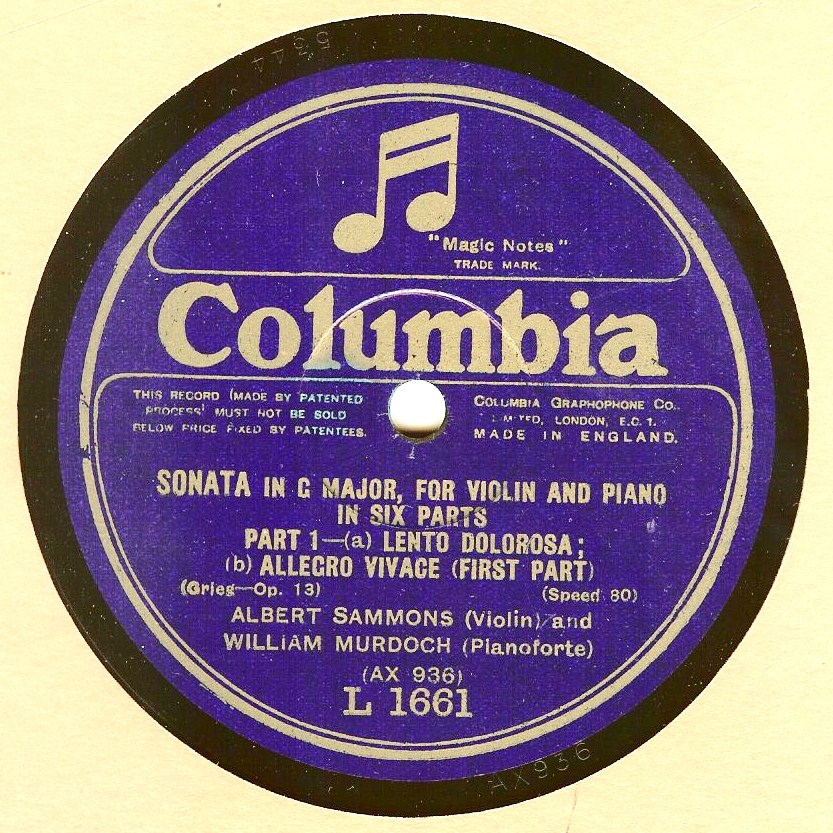
Here is a rare sonata recording by the man considered by many to be the greatest British violinist, Albert Sammons (1886-1957). It is of Grieg's Sonata in G, Op. 13, recorded on March 12, 1925 with Sammons' longtime sonata partner William Murdoch (1888-1942) at the piano. This was one of the last acoustical recordings made by Columbia (they had switched to the Western Electric recording process by October 1925) and consequently experienced a very short catalogue life, issued in November 1925 and deleted in Feburary 1928.
Grieg: Violin Sonata No. 2 in G, Op. 13
Albert Sammons, violin; William Murdoch, piano
Recorded March 12, 1925
English Columbia L 1661 through L 1663, three 78-rpm records
Link (FLAC files, 63.25 MB)
Link (MP3 files, 24.61 MB)
The three Grieg violin sonatas enjoyed a much greater circulation 75-100 years ago than today. Heifetz recorded Op. 13 in the 1930s, and there's a famous 1928 recording of Op. 45 in C minor by Fritz Kreisler and Sergei Rachmaninoff. This Sammons recording appears to be the first one made of Op. 13, a charming work.
Only a month after making this recording, and still by the acoustical recording process, Sammons made his first complete recording of a violin concerto, and his only recording of a non-British concerto at that. This was Bruch's Violin Concerto No. 1, with an unidentified orchestra conducted by Sir Hamilton Harty. Early in 2008 I did a transfer of this recording, which is still available for download:
Bruch: Violin Concerto No. 1 in G minor, Op. 26
Albert Sammons, violin, with orchestra conducted by Sir Hamilton Harty
Recorded April 9, 1925
Columbia Masterworks Set No. 30, three 78-rpm records
Link (FLAC file, 65.85 MB)
Link (MP3 file, 24.17 MB)
Albert Sammons, for all his many achievements as a soloist, was also a great quartet leader. He was one of the founding members of the London String Quartet in 1908 and played first violin in it for nine years, until being called up for military service in 1917. The Fall 2010 issue of Classic Recordings Quarterly features a fine article by Tully Potter about the LSQ and its recordings. Late in 2007 I did transfers of a group of LSQ recordings from 1915-17 (when Sammons was still in it), featuring music by Mozart, Schubert, Schumann and Tchaikovsky, which are still available for download:
Mozart: Quartet No. 16 in E-Flat, K. 428
Schubert: Quartet No. 12 in C minor, D. 703 ("Quartettsatz")
Schumann: Quartet No. 3 in A, Op. 41, No. 3
Tchaikovsky: Quartet No. 1 in D, Op. 11: Scherzo
London String Quartet (led by Albert Sammons)
Recorded 1915-17
English Columbia L 1015, 1043, 1044, 1199, 1200, 5 78-rpm records
Link (FLAC files, 105.6 MB)
Link (MP3 files, 38.35 MB)
Tuesday, September 28, 2010
Thursday, September 23, 2010
Happy Birthday, Dmitri Shostakovich!
One of my all-time favorite composers, Dmitri Shostakovich, was born 104 years ago this Saturday, on September 25, 1906. To celebrate, I present two early recordings of his music, including one that might very well be the earliest. This is of two excerpts from his 1929 ballet, "The Golden Age" - the Polka and Russian Dance. It was recorded in the early 1930's for Pathé (issued by Columbia in the US and Britain) by the Orchestre Symphonique de Paris under Julius Ehrlich - the exact recording date is unknown. The other contender for the title of "First Shostakovich Recording" would be Stokowski's November 1933 account of the First Symphony, with the Philadelphia Orchestra, which has been reissued on CD by Pearl. Both recordings were reviewed in the September 1934 issue of Gramophone Magazine, which I would love to be able to link to, but, maddeningly, this review does not appear to have been scanned into Gramophone's archive, nor do PDF scans of the actual pages appear to be downloadable as in the past. (Fortunately, about a year ago, I did get to download PDF scans of a number of Columbia ads from the magazine, including one that advertises this Ehrlich recording, and have included it in the ZIP file at the link below.) The record of "Golden Age" excerpts was one of a pair designed to show how "far-out" the music from Bolshevik Russia had become. The other record features orchestral music that graphically illustrates the noise made by machinery - Mossolov's "Steel Foundry" and Meytuss' "Dnieper Water Power Station." The whole package was called, in its American release, "Strange Music of the Modern Russian School" - a hilarious title, I think! Here are the links for this set:
"Modern Russian Music"
Orchestre Symphonique de Paris conducted by Julius Ehrlich
Columbia Masterworks set M-347, two 10-inch 78-rpm records
Link (FLAC files, 27.12 MB)
Link (MP3 files, 12.81 MB)
The other Shostakovich recording I present is of the Ninth Symphony of 1945, for me one of the most delightful of his fifteen symphonies. This is only the second recording made of it, by the New York Philharmonic (or, as it was called in those days, the "Philharmonic-Symphony Orchestra of New York") conducted by Russian-born Efrem Kurtz (1900-1995). It's a fine one, marred only by the extremely slow tempo that he takes for the second movement, probably resulting from an incorrect metronome marking in the earliest scores of the symphony published in America. It was released at the same time as the first recording, by Koussevitzky and the Boston Symphony (currently available on a Biddulph CD). I've also included, as a bonus, a transfer of a single record by Kurtz and the New York Philharmonic, of a Shostakovich Waltz and a Prokofiev March:
Shostakovich: Symphony No. 9, Op. 70; Waltz from "The Golden Mountains"
Prokofiev: March, Op. 99*
Philharmonic-Symphony Orchestra of New York conducted by Efrem Kurtz
Recorded April 8, 1947, and *April 20, 1946
Columbia Masterworks set MM-688, four 78-rpm records and
Columbia Masterworks 12881-D, one 78-rpm record
Link (FLAC files, 82.33 MB)
Link (MP3 files, 41.48 MB)
Below I reproduce the cover art for the 78-rpm album of the Shostakovich Ninth (thanks to Buster, Joe and others for the advice on how to do scans of large record covers!). It's by the inimitable Alex Steinweiss, Columbia's art director during the 40s. Note the stick figures in the background: there are nine of them, to match the fact that it's a "Symphony No. 9" - a typical Steinweissism.
Friday, September 17, 2010
Bach by Bartlett, Robertson and Barbirolli
This time I present a fairly rare recording of a Bach concerto by the British husband-and-wife piano duo team of Ethel Bartlett (1896-1978) and Rae Robertson (1893-1956), pictured above with tenor Peter Pears on the left. (The picture was taken by Benjamin Britten - who wrote three works for the Robertsons - while he and Pears were staying at the couple's California home during the summer of 1941. It was while staying here that Britten ran across a magazine article about George Crabbe, that ultimately led to the creation of his most famous opera, "Peter Grimes.") The Robertsons were of diminutive stature - notice how Pears is standing on a lower stair in the picture - but there was nothing diminutive about their piano-playing.
This recording of Bach's Concerto in C, BWV 1061, was made in London in 1933 with a pickup orchestra conducted by John Barbiroll (who in previous years had given cello recitals with Bartlett as his accompanist). It seems to have been the first recording of the work, although a much more famous one was made only three years later, also by HMV, featuring pianist Artur Schnabel and his son Karl Ulrich Schnabel, with Adrian Boult conducting the strings of the London Symphony. The Bartlett-Robertson version, however, must have still had some customers, as it was much cheaper - only 8 shillings for two Plum Label records, versus 18 shillings for three Red Label records in the Schnabels' version! In any case, the Bartlett-Robertson records remained available until 1943.
Bach: Concerto in C for two claviers and strings, BWV 1061
Ethel Bartlett and Rae Robertson, pianos
Orchestra conducted by John Barbirolli
Recorded December 20, 1933
HMV C 2648 and C 2649, two 78-rpm records
Link (FLAC file, 43.19 MB)
Link (MP3 file, 18.1 MB)
Over three years ago I posted to RMCR two other Bach recordings by Ethel Bartlett, one with her husband, one with Barbirolli in one of his rare cello recordings. These are still available for download; the details:
Bach: Organ Sonata No. 1 in E-Flat, BWV 525, arranged for two pianos
Ethel Bartlett and Rae Robertson, pianists
Recorded July 20, 1933
HMV C 2614, one 78-rpm record
Link (FLAC file, 21.26 MB)
Link (MP3 file, 7.94 MB)
Bach: Sonata in G, BWV 1027, for viola da gamba and harpsichord
John Barbirolli, cello, and Ethel Bartlett, piano
Recorded July 1, 1929, by Columbia
National Gramophonic Society 133-134, 2 78-rpm records
Link (FLAC file, 35.67 MB)
Link (MP3 file, 16.13 MB)
Labels:
Bach,
Barbirolli,
Bartlett and Robertson,
Cello,
Concertos,
NGS,
Piano
Monday, September 13, 2010
Roussel: Symphony No. 3
Well, Satyr has been giving us a number of fine recordings by Albert Wolff lately, over on the blog "78 toeren en LPs," and here's my contribution to the Wolff-fest: the first recording of Roussel's Third Symphony, from a set of French Polydor 78s. This was recorded c. 1932, shortly after Wolff and the Lamoureux Orchestra gave the Paris premiére of the symphony, and only a year or two after the world premiére, in October 1930, by the Boston Symphony under Koussevitzky, who commissioned the work as part of the orchestra's 50th anniversary celebrations. It was a rare honor in those days for a contemporary work to be recorded so soon after its unveiling!
Roussel: Symphony No. 3 in G minor, Op. 42
Lamoureux Orchestra conducted by Albert Wolff
Recorded c. 1932
French Polydor 566126 through 566128, three 78-rpm records
Link (FLAC files, 56.18 MB)
Link (MP3 files, 25.75 MB)
Albert Roussel (1869-1937) is one of those curious composers (like Scriabin or Szymanowski) whose works written in the last fifteen or so years of his life are so unlike his earlier, yet fully mature works that it's sometimes hard to believe they're by the same composer. In Roussel's case, he migrated from a post-Impressionistic style to a somewhat abrasive neo-classicism as found in this Third Symphony.
Wednesday, September 8, 2010
Vaughan Williams: Violin Concerto
Here is another recording première: the Vaughan Williams Concerto in D Minor for violin and string orchestra, written in 1925 for Yelly d'Aranyi, and given the rather ironic subtitle "Concerto Accademico" - a subtitle the composer came to dislike. Ironic, because there really is nothing academic about it; it's earthy, vigorous and boasts a particularly beautiful slow movement. There is the slight aura of Bach about it: if Villa-Lobos could write works he called "Bachianas Brasileiras" (Bach in Brazilian style) then this is surely a "Bachianas Anglicanas" or something like that - Bach in English peasant dress. In any case, I loved this concerto on first hearing it at age 13, and it remains one of my very favorite Vaughan Williams works.
Vaughan Williams: Concerto in D minor (Concerto Accademico)
Frederick Grinke, violin, with the Boyd Neel String Orchestra
Recorded May 8, 1939
English Decca X 248 and X 249, two 78-rpm records
Link (FLAC file, 44.85 MB)
Link (MP3 file, 17.8 MB)
This recording features Winnipeg-born Frederick Grinke as the violin soloist, with the Boyd Neel String Orchestra conducted by - you guessed it - Boyd Neel. While Grinke moved from Canada to England as a young man, Neel made the reverse transition in middle age, becoming head of Toronto's Royal Conservatory of Music in 1953. The strong Canadian ties of both men ensure that a fair number of their recordings can be heard at The Virtual Gramophone (see my list of links at the right), but this Vaughan Williams concerto is not among them. Nor are two other Boyd Neel String Orchestra recordings that I posted to RMCR previously, which are still available for download:
Dvorak: Serenade for Strings in E, Op. 22
Boyd Neel String Orchestra (leader: Frederick Grinke) conducted by Boyd Neel
Recorded Dec. 10, 1937 and February 18, 1938
English Decca X 214 through X 217, four 78-rpm records
Link (FLAC files, 64.39 MB)
Link (MP3 files, 27.49 MB)
Stravinsky: Apollon Musagètes - Ballet (1928)
Boyd Neel String Orchestra (leader: Louis Willoughby) conducted by Boyd Neel
Recorded Feb. 17 and April 29, 1937
English Decca X 167 through X 170, four 78-rpm records
Link (FLAC file, 71.62 MB)
Link (MP3 file, 29.09 MB)
The Stravinsky ballet is also a first recording (though Koussevitzky, with the Boston Symphony, had recorded one section of it in 1928), and the Dvorak Serenade might be, too.
Friday, September 3, 2010
Griffes: Poem for Flute and Orchestra
Here is something that will delight flute fans and fans of American music: the first-ever recording of the impressionistic Poem for Flute and Orchestra, composed in 1918 by Charles Tomlinson Griffes (1884-1920), who is pictured above. It is played, magnificently, by Joseph Mariano (1911-2007), Professor of Flute at the Eastman School of Music from 1935 to 1974, with Eastman's director, Howard Hanson, leading the Eastman-Rochester Symphony Orchestra. This is from a somewhat battered copy of Victor 11-8349, recorded May 8, 1942 - and not helped by the fact that it was pressed during World War II in recycled shellac! But the beauty of the performance, I think, makes up for the less-than-perfect sound.
Arguably, no other man ever did more for the cause of American classical music than Howard Hanson, who once estimated that over 2,000 works by 500 American composers (including, of course, himself) were premiered in Rochester during his 40-year tenure as director of the Eastman School. Earlier I posted to RMCR several of Hanson's early Victor recordings with the Eastman-Rochester Orchestra, including two of his own works. These are still available for download. The details:
Howard Hanson: The Lament for Beowulf, Op. 25
with the Eastman School Choir
Recorded May 7, 1941
and
Spencer Norton: Prologue from Dance Suite
Recorded May 9, 1941
Victor set DM-889, three 78-rpm records
Link (FLAC files, 52.27 MB)
Link (MP3 files, 25.72 MB)
Howard Hanson: Symphony No. 1 in E minor, Op. 21 ("Nordic")
Recorded May 7, 1942
Victor set DM-973, three 78-rpm records
Link (FLAC files, 65.99 MB)
Link (MP3 files, 29.36 MB)
Charles Martin Loeffler: A Pagan Poem, Op. 14 (after Virgil)
Piano obbligato: Irene Gedney; English horn: Richard Swingly
Recorded May 10, 1941
Victor set DM-876, three 78-rpm records
Link (FLAC file, 56.21 MB)
Link (MP3 file, 27.85 MB)
Monday, August 30, 2010
Happy 100th, William Schuman!
Okay, so I'm a little late to the party here, since the 100th anniversary of the birth of William Schuman (1910-1992) was at the beginning of the month (August 4) and here we are nearing the end of it, but what's a few weeks between friends? In any case, to celebrate, here's the first recording of any of William Schuman's five string quartets (the first of which was withdrawn).
William Schuman: String Quartet No. 3 (1939)
Gordon String Quartet
Recorded c. 1946-47
Concert Hall Society Release AB, three vinyl 78-rpm records
Link (FLAC files, 58.2 MB)
Link (MP3 files, 28.42 MB)
The Concert Hall Society was established in 1946 as a mail-order subscription label, and dedicated to presenting esoteric classical repertoire. (Concert Hall Society also made the first recording of a William Schuman symphony - his fifth, the Symphony for Strings.) Although RCA Victor had been using vinyl as a pressing material since 1945 for a limited number of releases, Concert Hall Society was one of the first two record labels to employ vinyl exclusively (the other was Young Peoples' Records, founded about the same time, and also as a mail-order subscription label). For more information about the Concert Hall Society, click here.
We've certainly had a lot of important composer birthdays this year! Two great American composers' centennials (William Schuman and Samuel Barber) and the 200ths of Chopin and the other Schuman(n) - Robert.
Monday, August 23, 2010
Classics from Arthur Pryor's Band
In the earliest days of commercial recording (roughly, from 1890 to 1910), military and concert bands, unlike orchestras, were frequent visitors to the recording studio. The reason for this is simple: massed strings didn't record well, while brass and woodwinds did. Bands recorded everything: popular songs of the day, medleys from operettas and musical shows, dance music, and, of course, marches. This upload, however, focuses on band transcriptions of standard orchestral repertoire. The following works are presented:
GRIEG: Peer Gynt Suite - "Morning" and "Death of Ase"
LISZT: Hungarian Rhapsody No. 2
LISZT: Hungarian Rhapsody No. 9 - Finale
ROSSINI: William Tell Overture
SCHUBERT: Unfinished Symphony - First movement (abridged)
TCHAIKOVSKY: Marche Slave (abridged)
WAGNER: Tannhäuser Overture (abridged)
These were all recorded between 1905 and 1914 (complete recording details are supplied in a text file accompanying the recordings) by Arthur Pryor's Band, one of the most active concert bands making records in the USA during this period.
Link (FLAC files, 134.31 MB)
Link (MP3 files, 49.75 MB)
Arthur Pryor (1870-1942) was a virtuoso trombonist who joined Sousa's Band in 1892, becoming assistant conductor of that legendary organization before leaving to form his own band in 1903. It was Pryor who actually conducted Sousa's Band on records - apparently the great man considered recording beneath him. He was also a composer, his most famous piece being "The Whistler and His Dog." (Fans of "The Little Rascals" films will remember Buckwheat pretending to whistle while a somewhat damaged record plays behind a curtain; "The Whistler and His Dog" is the tune in question.)
A particularly pioneering effort is represented by the movement from Schubert's Unfinished Symphony, which was recorded in 1910 and released in November of that year. It would appear that this was the very first time Victor recorded any part of a symphony. The record must have sold reasonably well, for the band had to remake it two years later. Clearly, the record-buying public had a taste for "serious" symphonic fare. Certainly my copy of Victor 31798 was much loved by its original owner!
In 1912, Victor embarked on a program of recording abridged symphonic works, not with a band, but with its own in-house orchestra, the Victor Concert Orchestra. Two Haydn and two Mozart symphonies, the Beethoven Fifth and the Schubert Unfinished, as well as movements from Mendelssohn's "Italian" and Dvorak's "New World," were among the offerings. Most of these do not credit any conductor, though Walter B. Rogers, Victor's house conductor, was probably responsible for most of them. Nearly three years ago, I uploaded to the newsgroup "rec.music.classical.recordings" (RMCR) a selection of these recordings, containing the following:
HAYDN: Military Symphony (No. 100 in G)
MOZART: Symphony in G minor (No. 40, K. 550)
MOZART: Jupiter Symphony (No. 41 in C, K. 551)
BEETHOVEN: Leonore Overture No. 3 (Op. 72a)
BEETHOVEN: Symphony No. 4 - Adagio
(played by Vessella's Italian Band, as a filler for the Leonore Overture)
These are still available for download at the following links:
Link (FLAC files, 181.49 MB)
Link (MP3 files, 67.8 MB)
Tuesday, August 17, 2010
The Virtuoso String Quartet
The Virtuoso String Quartet (Marjorie Hayward and Edwin Virgo, violins; Raymond Jeremy, viola; Cedric Sharpe, cello) was organized by the Gramophone Company of England (HMV) in 1924, and was, apparently, the first chamber music group formed specifically for making recordings. Their recording career was brief, however. By the late 1920s, ensembles with international reputations, such as the Budapest Quartet, were recording for HMV, and the Virtuoso Quartet with its more localized reputation was shunted aside in favor of these. A pity, for the Virtuoso Quartet was a fine ensemble whose performances are passionate and compelling, and whose recordings, which include four Beethoven quartets and quartets by Tchaikovsky, Franck, Debussy and Ravel, as well as numerous shorter works, have become sought after by collectors.
I have three of their Beethoven quartet recordings available, as well as a group of shorter works, headed by Ravel's Introduction and Allegro for harp, flute, clarinet and string quartet (with harpist John Cockerill, flutist Robert Murchie, and clarinetist Charles Draper) and including the first of Frank Bridge's "Three Idylls" for string quartet, composed in 1906. (Benjamin Britten, who was Bridge's pupil, wrote variations for string orchestra on the second of these Idylls.)
Beethoven: Quartet No. 6 in B-Flat, Op. 18, No. 6 and
Schubert: Moment Musicale
Virtuoso String Quartet
Recorded from December 6, 1926, to January 31, 1927
HMV D 1206 through D 1209, four 78-rpm records
Link (FLAC files, 83.68 MB)
Link (MP3 files, 57.02 MB)
Beethoven: Quartet No. 8 in E minor, Op. 59, No. 2
Virtuoso String Quartet
Recorded May 20 and June 18, 1924
HMV D 953 through D 956, four 78-rpm records
Link (FLAC files, 94.01 MB)
Link (MP3 files, 32.44 MB)
Beethoven: Quartet No. 12 in E-Flat, Op. 127 and
Dittersdorf: Quartet No. 5 in E-Flat - Minuet
Virtuoso String Quartet
Recorded from October 26, 1925, to October 12, 1926
HMV D 1183 through D 1187, five 78-rpm records
Link (FLAC files, 107.58 MB)
Link (MP3 files, 72.12 MB)
Ravel: Introduction and Allegro
(with John Cockerill, harp; Robert Murchie, flute; Charles Draper, clarinet)
and
Bridge: Three Noveletten - No. 3 in E-Flat
Virtuoso String Quartet
Recorded February 4 and March 18, 1929
HMV C 1662 and C 1663, two 78-rpm records
Link (FLAC files, 36.10 MB)
Link (MP3 files, 25.29 MB)
Bridge: Three Idylls - No. 1 in C-Sharp Minor
Virtuoso String Quartet
Recorded June 18, 1928
HMV C 1593, one 78-rpm record
Link (FLAC file, 20.47 MB)
Link (MP3 file, 13.87 MB)
Bridge [arr.]: Londonderry Air and
Haydn: "Emperor" Quartet - Theme and Variations
Virtuoso String Quartet
Recorded July 1 and November 21, 1927
HMV C 1470, one 78-rpm record
Link (FLAC files, 22.17 MB)
Link (MP3 files, 16.52 MB)
Julius Harrison: Widdicombe Fair - Humoreske, Op. 22 and
Haydn [attrib.]: Quartet in F, Op. 3, No. 5 - Serenade
Virtuoso String Quartet
Recorded November 21, 1927, and July 8, 1928
HMV B 3137, one 10-inch 78-rpm record
Link (FLAC files, 15.74 MB)
Link (MP3 files, 11.25 MB)
Since this was originally posted, I have made available two additional transfers of VSQ recordings. I list them below, for the convenience of having all my files of their recordings in one place:
Gossec: Tambourin (arr. Cedric Sharpe)
Grainger: Molly on the Shore
Virtuoso String Quartet
Recorded July 1, 1927
HMV B 2589, one 10-inch 78-rpm record
Link (FLAC files, 16.40 MB)
Link (MP3 files, 9.56 MB)
Franck: Quartet in D Major
Virtuoso String Quartet
Recorded January 14 to April 20, 1925
HMV D 1006 through D 1011, six 78-rpm records
Link (FLAC files, 149.02 MB)
Link (FLAC files, 74.09 MB)
Subscribe to:
Posts (Atom)


