Sunday, February 26, 2012

Happy Birthday, Denis Matthews!

Monday marks the 92nd birth anniversary of the British pianist Denis Matthews, who came to a sad end - he committed suicide on Christmas Day, 1988.  He was most famous for his recordings of Mozart and Beethoven, with at least eight of Mozart's concertos in his discography.  Here is the first of these, made in 1944, when he was in R.A.F. uniform:

Mozart: Piano Concerto No. 23 in A, K. 488
Denis Matthews with the Liverpool Philharmonic Orchestra
conducted by George Weldon
Recorded August 28, 1944
English Columbia DX 1167 through DX 1169, three 78-rpm records
Link (FLAC files, 64.79 MB)
Link (MP3 files, 27.79 MB)

A little over a year ago, I presented several single discs of Matthews playing solo works by Haydn, Mozart, Beethoven and John Field.  Here is another to add to that collection:

Bach: Prelude and Fugue No. 8 in E-Flat minor (Well-Tempered Clavier, Book I)
Denis Matthews, piano
Recorded April 25, 1949
English Columbia DX 1635, one 78-rpm record
Link (FLAC file, 21.54 MB)
Link (MP3 file, 9.66 MB)

According to CHARM, Matthews recorded at least five of the Bach "Well-Tempered Clavier" preludes and fugues, but only this one and the No. 1 in C were actually issued.  Matthews' Bach discography is rather meager, but it does include a fine version of the Triple Concerto in C, BWV 1064, with Edwin Fischer and Ronald Smith, from the Bach anniversary year of 1950, available on an EMI CD.

Wednesday, February 22, 2012

Nielsen: Violin Concerto (Telmányi)

Carl Nielsen, 1910
Most people, if they remember the name of the Hungarian-born violinist Emil Telmányi (1892-1988) at all, remember it as belonging to the inventor of the spurious Bach bow (or Vega bow), designed to be able to play on, and sustain, all four strings of the violin simultaneously, for use in the unaccompanied Bach violin works.  But Telmányi was also the first internationally famous exponent of the music of Carl Nielsen (whose daughter, Anne Marie, he married in 1918), and made this first recording of Nielsen's Violin Concerto, for me one of the most delightful of all twentieth-century violin concertos, in 1947:

Nielsen: Concerto for violin and orchestra, Op. 33 and
Mozart: Serenade No. 7 in D, K. 250 ("Haffner") - Menuetto
Emil Telmányi with the Orchestra of the Royal Opera House, Copenhagen,
conducted by Egisto Tango
Recorded June 3-7, 1947
Tono X-25081 through X-25085, five 78-rpm records
Link (FLAC files, 99.4 MB)
Link (MP3 files, 42.37 MB)

Friday, February 17, 2012

"Glorious John"

Sir John Barbirolli and Ralph Vaughan Williams on the occasion of the première of the latter's Sinfonia Antartica, 1953
"Glorious John" - that was Ralph Vaughan Williams' nickname, and subsequently everybody else's, for Sir John Barbirolli (1899-1970), and it comes from the inscription on the score of Vaughan Williams' Eighth Symphony - "for glorious John, with love and admiration from Ralph."  Barbirolli also received the dedication of Vaughan Williams' previous symphony, the Sinfonia Antartica.  Well, here's the first recording by "Glorious John" of a Vaughan Williams symphony, made a decade before these dedications, exactly sixty-eight years ago today (I didn't plan it that way, either!):

Vaughan Williams: Symphony No. 5 in D Major
Hallé Orchestra conducted by John Barbirolli
Recorded February 17, 1944
HMV C 7599 through C 7603, five 78-rpm records
Link (FLAC files, 96.06 MB)
Link (MP3 files, 41.13 MB)

This was Barbirolli's second-ever recording with the Hallé Orchestra (the first was of Bax's Third Symphony), of which he had assumed control beginning with the 1943-44 season, having returned to England fron New York.  There, as director of the Philharmonic-Symphony, he had had a rocky relationship with the music critics, who constantly compared him unfavorably with Toscanini, whom he had succeeded as the Philharmonic's music director.  While in New York, however, Barbirolli had made some important recordings, first for Victor and then for Columbia, including symphonies by Sibelius (the First and Second), Schubert (the Fourth) and this brisk, bracing account of Mozart's "little G minor" symphony:

Mozart: Symphony No. 25 in G minor, K. 183
Philharmonic-Symphony Orchestra of New York conducted by John Barbirolli
Recorded November 3, 1941
Columbia Masterworks set MX-217, two 78-rpm records
Link (FLAC files, 53.51 MB)
Link (MP3 files, 32.51 MB)

Monday, February 13, 2012

The Chamber Music Society of Lower Basin Street

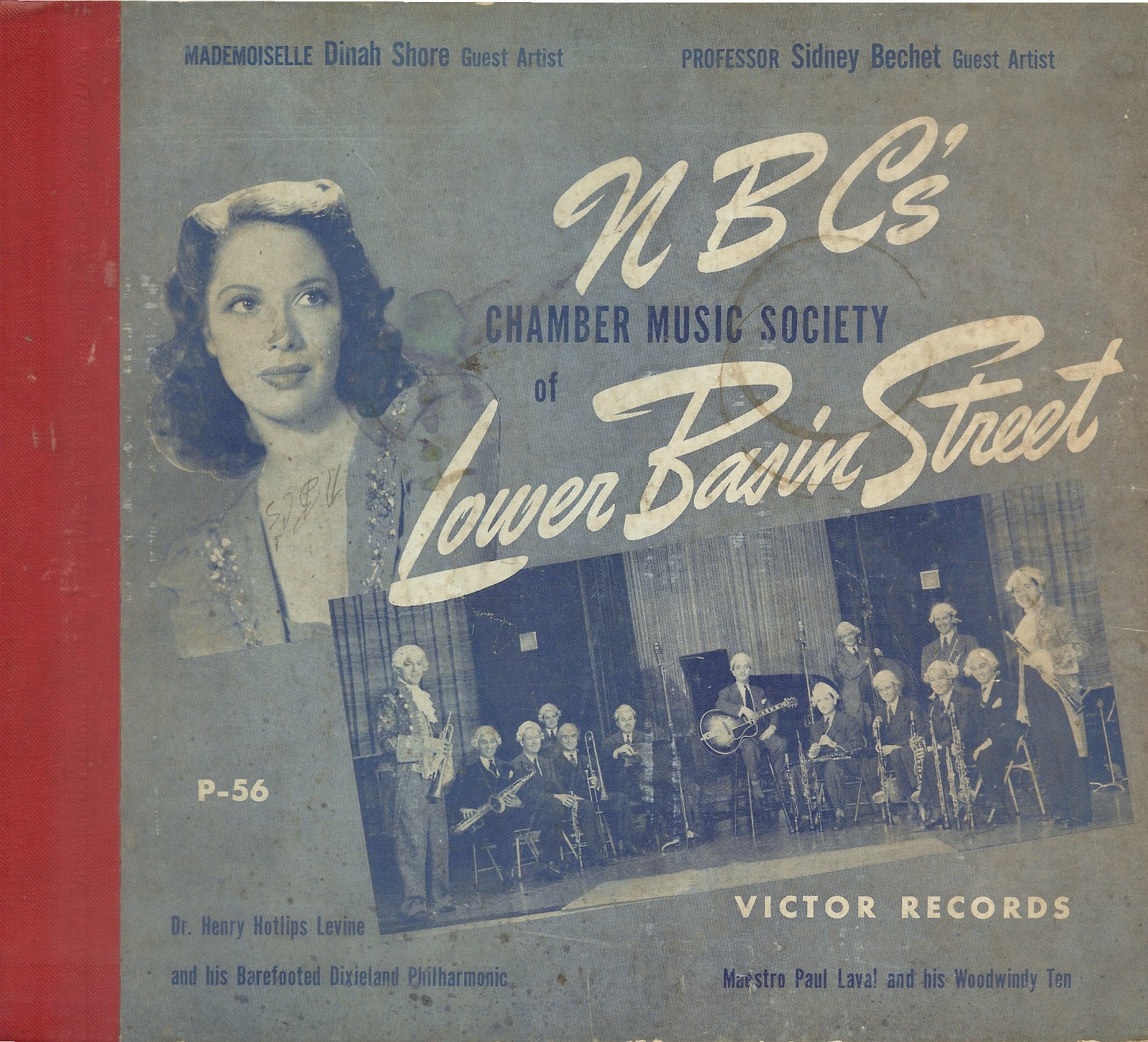
The Chamber Music Society of Lower Basin Street was a weekly radio program that began on NBC's Blue Network in 1940.  (The National Broadcasting Company originally had two radio networks, the Red and the Blue; the latter was sold off in 1942 and became the American Broadcasting Company - ABC - in 1945.)  The show featured some of the finest jazz musicians of the day, and had two resident bands (which shared the same rhythm section) - Henry Levine's Dixieland Octet, whose leader was a former member of the Original Dixieland Jazz Band, and Paul Laval's Woodwindy Ten.  On the Society's debut album, which I present here, Levine's group was rechristened the "Barefooted Dixieland Philharmonic" - although, as can be seen in the slightly coffee-stained picture, the members are not only very much shod, but periwigged!  For the Society's offerings, broadcast and recorded, were usually presented in a mock-serious format that poked fun at the stuffy classical music presentations of the day.  The album even comes with a booklet mimicking those of the Victor Musical Masterpiece Series, with tongue-in-cheek analyses of each song (a PDF file of this booklet is included with the download).

NBC's Chamber Music Society of Lower Basin Street
1. Mood Indigo (with Dinah Shore)
2. Muskrat Ramble (with Sidney Bechet)
3. Runnin' Wild
4. Dinah's Blues (with Dinah Shore)
5. Shoemaker's Holiday
6. Basin Street Blues
Recorded November 11, 1940
Victor set P-56, three 10" 78-rpm records
Link (FLAC files, 65.08 MB)
Link (MP3 files, 40.36 MB)

For me, the last three sides are the most enjoyable.  "Dinah's Blues" manages to work into its lyrics the names of the show's two corporate sponsors, NBC and its parent, RCA Victor; "Shoemaker's Holiday" is a delightful romp featuring the bassoon, and this arrangement of "Basin Street Blues," with its ending that spoofs Haydn's "Farewell" Symphony (the bass being the instrument left to finish the piece "in the doghouse, but good"), was apparently also the ending number on every broadcast.

Wednesday, February 8, 2012

The Incomparable Emanuel Feuermann

Emanuel Feuermann
Today I present three recordings featuring the man whom many, myself included, consider the greatest cellist of all time, the tragically short-lived Emanuel Feuermann (1902-1942).  He really should have lived into the era of stereo recording, but he died at age 39 of complications from an operation for hemorrhoids; Toscanini, who was one of the pallbearers at his funeral, is said to have wept during the procession, saying, "this is murder!"  At the time of his death, Feuermann was planning to take up the viola da gamba, so that he could present Bach's three sonatas for that instrument as authentically as possible.

Despite the short time available to him, he left a precious recorded legacy.  But, alas, no unaccompanied Bach suites - I suppose these works were perceived at the time as belonging to Casals, so Feuermann never got to record one - so the closest we can get to what that may have sounded like is via his 1938 set of a Reger suite, and this unaccompanied sonata by his friend, Paul Hindemith:

Hindemith: Sonata for unaccompanied cello, Op. 25, No. 3
Emanuel Feuermann, cello
Recorded January 27, 1934
Japanese Columbia S-1032, one 78-rpm record
Link (FLAC file, 22.17 MB)
Link (MP3 file, 9.3 MB)


Feuermann left us several concerto recordings, including a wonderful Brahms Double with Heifetz, and this one of the Haydn D major:

Haydn: Cello Concerto in D major, Op. 101
Emanuel Feuermann with orchestra conducted by Dr. Malcolm Sargent
Recorded November 25, 1935
Columbia Masterworks set MM-262, four 78-rpm records
Link (FLAC files, 76.38 MB)
Link (MP3 files, 37.26)

On a personal note: this is the third copy of MM-262 that I have owned; the first one I had as a boy of ten, inherited from the discarded 78 library of Emory University, where my mother was teaching music at the time.  It was my introduction to Feuermann's art, and to this day the Haydn D major is my favorite of all cello concertos, largely on the strength of this recording.

Finally, for fans of Eugene Ormandy, another of his early Victor recordings, featuring Feuermann - the first of four recordings Ormandy was to make of Strauss' "Don Quixote," but the only one with a cellist other than first-desk Philadelphia players:

Richard Strauss: Don Quixote, Op. 35
Philadelphia Orchestra conducted by Eugene Ormandy
Emanuel Feuermann, cello
Samuel Lifschey, viola
Alexander Hilsberg, violin
Recorded February 24, 1940
Victor Musical Masterpiece set DM-720, five 78-rpm records
Link (FLAC file, 87.25)
Link (MP3 file, 45.26)

Saturday, February 4, 2012

My 100th Post!

Bryan Bishop, 2008
Believe it or not, eighteen months after starting this blog, I have reached my 100th post!  So, something rather unique seems in order, and I therefore offer three of my own performances as a pianist.  I've posted the Haydn here before, but only as MP3 files, so here are the FLACs to go with them.  The Vaughan Williams I have posted to YouTube, but the Brandenburg Concerto is truly new - I only got the CD myself this past Monday.  So, without further ado, here are the links:


Bach: Brandenburg Concerto No. 5 in D, BWV 1050
DaSalo Solisti Chamber Orchestra conducted by Norman Bernal
Bryan Bishop, piano
Teodora Stoyanova, flute
Norman Bernal, violin
Live recording by Carey Carlan [a member of the orchestra], November 13, 2011
Link (FLAC files, 101.35)
Link (MP3 files, 24.33)

Haydn: Piano Trio in G, Hob.XV:25 ("Gypsy") and
Haydn: Andante with Variations in F minor, Hob.XVII:6
Bryan Bishop, piano
Laura Nadine, violin
James Woodall, cello
Live recording, November 7, 2009
Link (FLAC files, 95.58 MB)
Link (MP3 files, 33.49 MB)

Vaughan Williams: Suite of Six Short Pieces
Bryan Bishop, piano
Live recording, October 12, 2008
Link (FLAC files, 44.65 MB)
Link (MP3 files, 14.91 MB)

Thursday, February 2, 2012

Marjorie Hayward plays Purcell

Earlier, when I was doing my "reissue" program, I had occasion to post a recording by Marjorie Hayward, that of the Beethoven "Kreutzer" Sonata with Una Bourne, and to direct attention to other Hayward recordings available at the CHARM website.  Well, here's one CHARM doesn't have (although they do have a very fine Frederick Grinke recording of the same work, made a quarter of a century later).  It's a perfect gem of a Purcell sonata, first published only in 1901:

Purcell: Sonata in G minor, Z. 780
Marjorie Hayward, violin; Madame Adami, piano
Recorded August 15, 1919
HMV C 935, one 78-rpm record
Link (FLAC file, 20.48 MB)
Link (MP3 file, 7.66)

Does anyone out there have any information about the elusive Mme. Adami, who accompanies Miss Hayward on this recording?  Even her first name seems lost to posterity.  She must have been the Gramophone Company's house accompanist.  The HMV catalogues of the early 1920s (downloadable from the British Library) do not appear to have deemed it neccesary to credit her by name, except for this one disc.  Nor, of the sixteen or so records that CHARM possesses for which she plays accompaniments, does her name appear on any of the labels.

Sunday, January 29, 2012

Constant Lambert conducts Alan Rawsthorne

Alan Rawsthorne
Constant Lambert and Alan Rawsthorne, who were friends and drinking companions, shared not only the same year of birth (1905) but also a passion for cats and fish, and even the same wife!  (Not at the same time, of course.  Lambert died 20 years before Rawsthorne, who then married his widow, the painter Isabel Nicholas.)  It probably did no harm to their friendship that their compositional styles were utterly dissimilar.  Rawsthorne's music sounds to me like a kind of English Hindemith, neoclassical and a little dry at times, while Lambert's (to judge from the two works I know, "The Rio Grande" and the Piano Concerto) seems more like an English Gershwin.  Certainly Lambert the conductor was a persuasive advocate for the music of his friend, and he in fact made the first recordings of any of Rawsthorne's orchestral works, which I present here:

Rawsthorne: Symphonic Studies (1939) and
Rawsthorne: "Street Corner" Overture (1944)
Philharmonia Orchestra conducted by Constant Lambert
Recorded March 28 and 29, 1946
HMV C 3542 through 3544, and C 3502, four 78-rpm records
Link (FLAC files, 69.36 MB)
Link (MP3 files, 29.7 MB)

Wednesday, January 25, 2012

Roy Harris: Chamber Music

Roy Harris
During the 1930s, Oklahoma-born Roy Harris (1898-1979) was generally seen as the greatest hope for the future of American music.  After all, the facts of his life - born in a log cabin on Lincoln's birthday, worked as a truck driver while studying to be a composer - made good copy, but beyond this, the music he was writing in the 1930s was as good as, or better than, any being written in America at the time.  The two major American record companies, Victor and Columbia, were quick to seize on this, recording over a dozen of his works between 1933 and 1941 - more than any other contemporary American composer.  If this state of affairs seems incredible to us today, remember that Copland's reputation was that of an enfant terrible with his folksy ballet scores not yet written, Barber and William Schuman were in their 20s, the discovery of Ives was in its infancy, and Gershwin was considered a light music composer.

The two chamber music recordings I present here were among the last fruits of this Harris-mania, and I submit that not only are they two of Harris' finest works, but among the finest chamber music works written by an American.  That the publishers of these works (G. Schirmer and Mills Music, which is now part of Alfred Music Publishing) have allowed them to go out-of-print is a sad commentary on our musical life.

Roy Harris: Quintet for Piano and Strings (1936)
Johana Harris and the Coolidge String Quartet
Recorded January 24, 1939
Victor Musical Masterpiece set DM-752, four 78-rpm records
Link (FLAC file,  64.87 MB)
Link (MP3 file, 31.84 MB)

Roy Harris: String Quartet No. 3 (Four Preludes and Fugues, 1939)
Roth String Quartet (Roth-Weinstock-Shaier-Edel)
Recorded June 13, 1940, and January 6, 1941
Columbia Masterworks Set MM-450, four 78-rpm records
Link (FLAC files, 62.65 MB)
Link (MP3 files, 30.96 MB)