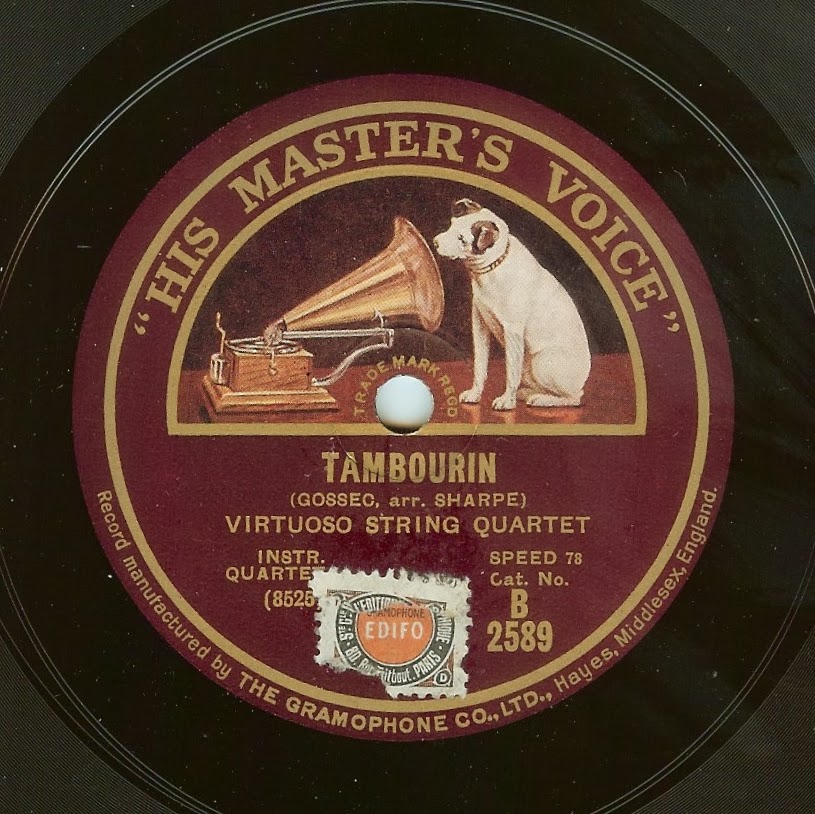
The Virtuoso String Quartet, with which I have dealt more extensively in this post, was founded late in 1923 by four British musicians apparently for the express purpose of making recordings. While earlier string quartet ensembles (such as the Flonzaley, Catterall and Lener String Quartets) had begun their recording careers by being limited to making potboilers, isolated movements and abridgements from the string quartet repertoire before being permitted to record complete works, the Virtuoso String Quartet took the opposite trajectory during their brief career in the studios (1924-29). They began by recording complete quartets by Tchaikovsky, Beethoven and Franck for HMV's more expensive Black Label series, but by 1927, had been switched to the cheaper Plum Label, and were recording potboilers! Among them were these two charming miniatures:
Gossec: Tambourin (arr. Cedric Sharpe)
Grainger: Molly on the Shore
Virtuoso String Quartet (Hayward-Virgo-Jeremy-Sharpe)
Recorded July 1, 1927
HMV B 2589, one 10-inch 78-rpm record
Link (FLAC files, 16.40 MB)
Link (MP3 files, 9.56 MB)
I should mention that at the same time as I acquired this record, I also got the Virtuoso String Quartet's 1925 acoustical set of the Franck Quartet in D, in its original album. This can be heard already at the CHARM website which has some 40 sides by the VSQ available for audition, some of them overlapping my offerings at the other post. (They don't, however, have B 2589.) But if there is any interest in my transfer I will attempt it (I probably will, anyway, sooner or later!).
Wednesday, November 27, 2013
Sunday, November 24, 2013
Strauss: Till Eulenspiegel (Rodzinski)
I must confess that the choice of "Till Eulenspiegel" for my latest post was inspired by being inundated with emails about "Black Friday" sales. I get so sick of these, that it puts me into an Eulenspiegel-like attitude, specifically the wish to go upsetting marketplace goods and wares as he does in Richard Strauss' tone poem! (When did the day after Thanksgiving get the name "Black Friday" anyhow? It seems to me a recent phenomenon. In the past the references were always to "after-Thanksgiving Day sales" in the papers.) So what better time to enjoy this impudent masterpiece than now, and in as brilliant and high-spirited a performance as you are likely to hear anywhere:
Strauss: Till Eulenspiegel's Merry Pranks, Op. 28
Cleveland Orchestra conducted by Artur Rodzinski
Recorded December 14, 1940
Columbia Masterworks set MX-210, two 78-rpm records
Link (FLAC file, 35.43 MB)
Link (MP3 file, 24.27 MB)
It's worth noting that though the piece had been recorded at least a dozen times previously (including a couple by the composer himself), Rodzinski's appears to have been the first to be issued as part of an album set series. Sets comprising only two records had been marketed for only five years, and then only in the USA.
Strauss: Till Eulenspiegel's Merry Pranks, Op. 28
Cleveland Orchestra conducted by Artur Rodzinski
Recorded December 14, 1940
Columbia Masterworks set MX-210, two 78-rpm records
Link (FLAC file, 35.43 MB)
Link (MP3 file, 24.27 MB)
It's worth noting that though the piece had been recorded at least a dozen times previously (including a couple by the composer himself), Rodzinski's appears to have been the first to be issued as part of an album set series. Sets comprising only two records had been marketed for only five years, and then only in the USA.
Tuesday, November 12, 2013
The New Music Quartet
The New Music Quartet, founded in 1948 by violinists Broadus Erle and Matthew Raimondi, violist Walter Trampler, and cellist Claus Adam (later of the Juilliard Quartet), was much admired during its brief history - I think it may have disbanded in 1956 when Erle moved to Japan for four years. (He later came back to teach at Yale and to head the Yale Quartet, where Trampler joined him.) The New Music Quartet made a handful of recordings for Bartók Records (including the première recording of the Third Quartet by that label's namesake), then moved to Columbia where they produced eight or nine albums, among them the first recording of Hugo Wolf's Quartet in D minor. Their last-issued recording, which occupied one side of an LP, was of this première recording of Roger Sessions' fine Second String Quartet:
Sessions: String Quartet No. 2 (1951)
The New Music Quartet (Erle-Raimondi-Trampler-Soyer)
Recorded May 12, 1955
Side 1 of Columbia ML-5105, one LP record
Link (FLAC files, 82.23 MB)
Link (MP3 files, 56.17 MB)
By the time of this recording, David Soyer, later to be one of the founding members of the Guarneri Quartet, had replaced Adam as cellist.
The Sessions quartet strikes me as a modern answer to Beethoven's Op. 131, with its opening slow fugue, its long central variation movement, and its one-in-a-bar scherzo following the variations. Instead of Beethoven's galloping finale, however, we get a particularly haunting slow movement. The work has only been recorded three times to my knowledge - in the early 70s by the Kohon Quartet for Vox, and in 1987 by the Juilliard Quartet for CRI. This pioneering version has, as far as I'm aware, never been reissued.
Its disc mate seems to me a mite incongruous - an early concerto for piano and winds by Colin McPhee (1900-1964), best known for his interest in Balinese folk music. This work, less than half the length of the Sessions quartet, would seem to owe a lot to Stravinsky, and it does bear some surface similarities to the latter's own piano concerto, especially in the last two movements. But the opening of the first movement is utterly dissimilar - instead of Stravinsky's pompous neo-Baroque introduction there is a quiet, Impressionistic texture that seems to start in medias res:
McPhee: Concerto for Piano and Wind Octet (1928)
Grant Johannesen with wind octet conducted by Carlos Surinach
Recorded February 22, 1955
Side 2 of Columbia ML-5105, one LP record
Link (FLAC files, 39.33 MB)
Link (MP3 files, 28.43 MB)
Sessions: String Quartet No. 2 (1951)
The New Music Quartet (Erle-Raimondi-Trampler-Soyer)
Recorded May 12, 1955
Side 1 of Columbia ML-5105, one LP record
Link (FLAC files, 82.23 MB)
Link (MP3 files, 56.17 MB)
By the time of this recording, David Soyer, later to be one of the founding members of the Guarneri Quartet, had replaced Adam as cellist.
The Sessions quartet strikes me as a modern answer to Beethoven's Op. 131, with its opening slow fugue, its long central variation movement, and its one-in-a-bar scherzo following the variations. Instead of Beethoven's galloping finale, however, we get a particularly haunting slow movement. The work has only been recorded three times to my knowledge - in the early 70s by the Kohon Quartet for Vox, and in 1987 by the Juilliard Quartet for CRI. This pioneering version has, as far as I'm aware, never been reissued.
Its disc mate seems to me a mite incongruous - an early concerto for piano and winds by Colin McPhee (1900-1964), best known for his interest in Balinese folk music. This work, less than half the length of the Sessions quartet, would seem to owe a lot to Stravinsky, and it does bear some surface similarities to the latter's own piano concerto, especially in the last two movements. But the opening of the first movement is utterly dissimilar - instead of Stravinsky's pompous neo-Baroque introduction there is a quiet, Impressionistic texture that seems to start in medias res:
McPhee: Concerto for Piano and Wind Octet (1928)
Grant Johannesen with wind octet conducted by Carlos Surinach
Recorded February 22, 1955
Side 2 of Columbia ML-5105, one LP record
Link (FLAC files, 39.33 MB)
Link (MP3 files, 28.43 MB)
Saturday, November 2, 2013
A Wagner Concert (Reiner)
| Cover design by Alex Steinweiss |
A Wagner Concert:
Prelude to Act I of "Die Meistersinger"
"Forest Murmurs" from "Siegfried"
Preludes to Acts I and III of "Lohengrin"
"The Ride of the Valkyries" from "Die Walküre"
Columbia Masterworks set MM-549, four 78-rpm records
and
Wagner: Bacchanale (Venusberg Music) from "Tannhäuser"
Columbia Masterworks set MX-193, two 78-rpm records
Pittsburgh Symphony Orchestra conducted by Fritz Reiner
Recorded March 14, 1940, January 9, 1941, and November 15, 1941
Link (FLAC files, 120.52 MB)
Link (MP3 files, 78.29 MB)
For those who like to burn CDs from my downloads, or make playlists, I would suggest following the order of the "Wagner Concert" but inserting the "Tannhäuser" extract before the "Ride of the Valkyries" - this seems to give the best balance of moods and tempi.
MM-549 was one of several albums of reissues that Columbia issued in the closing days of the Petrillo recording ban in 1944, when the supply of backlogged recordings had run dry, and new ones from Europe were unavailable due to the war. So they took four single records of Wagner already on the catalog, and cobbled them together into an album. The resulting "Wagner Concert" was also part of Columbia's initial LP launch, and in that form would have been the first Wagner compilation to be listed in the fondly-remembered Schwann Long Playing Record Guide. I always wondered why, under the Wagner listings, albums of compilations of his music were under the heading "Wagner Concert" while all the other composers' compilations were under headings like "Music of Beethoven," "Music of Brahms," etc. This issue, I've decided, has to be the reason....
Sunday, October 27, 2013
Hindemith by the Guilet Quartet
Yes, another LP, but this time one that's taken from 78-rpm originals. Truth to tell, I wish I had those 78 originals, because there's at least one side join in Concert Hall's c. 1950 transfer that I know I could have done a better job with, simply because I have technology that wasn't available to the good folks at Concert Hall Society back then. But I suspect this LP is easier to come by than the 78s, simply because the 78s were part of a subscription package whereby the subscriber had to buy all the releases for a given year (and besides that, they were expensive, and a limited edition to boot), whereas the LP was a general release that remained in the catalog until 1957. So here it is, this first (and, I believe, the only pre-digital) recording of this early Hindemith quartet:
Hindemith: Quartet No. 4 [new No. 5], Op. 32
Guilet String Quartet (Guilet-Gorodetzky-Brieff-Laporte)
Recorded c. 1947
Concert Hall CHS-1086, one ten-inch LP record
Link (FLAC files, 56.72 MB)
Link (MP3 files, 41.38 MB)
In this post I had some tart comments about the confusing issue of the numbering of Hindemith's quartets.
Hindemith: Quartet No. 4 [new No. 5], Op. 32
Guilet String Quartet (Guilet-Gorodetzky-Brieff-Laporte)
Recorded c. 1947
Concert Hall CHS-1086, one ten-inch LP record
Link (FLAC files, 56.72 MB)
Link (MP3 files, 41.38 MB)
In this post I had some tart comments about the confusing issue of the numbering of Hindemith's quartets.
Saturday, October 19, 2013
Tchaikovsky: Suite No. 3 (Little Orchestra Society)
I've been spending a lot more time lately with LPs than with 78s (easier, for one thing), particularly "6-eye" Columbias, and here's a comparatively rare one. Thomas K. Scherman (1917-1979) was the founder of the Little Orchestra Society, still going strong after 66 years, and right away established himself and the orchestra as a force for presenting new and unrecorded works on Columbia (as with this recording of Dello Joio's Harp Concerto). But it's likely that folks in the 1950s were more familiar with his speaking voice than with his conducting, simply because he presented so many spoken analysis records in connection with the Book-of-the-Month Club's series of Music Appreciation Records, of which Scherman was the musical director. (His father, Harry Scherman, had founded Book-of-the-Month Club in 1926.) Today I present the last recording I can trace that he made for Columbia:
Tchaikovsky: Suite No. 3 in G Major, Op. 55
Little Orchestra Society conducted by Thomas Scherman
Recorded February 1, 1955
Columbia ML-5256, one LP record
Link (FLAC files, 100.90 MB)
Link (MP3 files, 65.49 MB)
This was only the second recording of Tchaikovsky's delightful Third Suite with pretensions to completeness - in those days only its famous variation finale was usually heard. I say "pretensions" because an unfortunate cut is made in the second movement (Valse mélancolique), robbing it of almost half its length. The same cut was made in Walter Goehr's 1952 recording, for Concert Hall (which can be heard here), suggesting that a performing edition of the suite was floating around incorporating this cut.
Tchaikovsky: Suite No. 3 in G Major, Op. 55
Little Orchestra Society conducted by Thomas Scherman
Recorded February 1, 1955
Columbia ML-5256, one LP record
Link (FLAC files, 100.90 MB)
Link (MP3 files, 65.49 MB)
This was only the second recording of Tchaikovsky's delightful Third Suite with pretensions to completeness - in those days only its famous variation finale was usually heard. I say "pretensions" because an unfortunate cut is made in the second movement (Valse mélancolique), robbing it of almost half its length. The same cut was made in Walter Goehr's 1952 recording, for Concert Hall (which can be heard here), suggesting that a performing edition of the suite was floating around incorporating this cut.
Friday, October 11, 2013
Walton: Sinfonia Concertante
![]() |
| Sacheverell, Edith, and Osbert Sitwell |
Walton: Sinfonia Concertante (1927, rev. 1943)
Phyllis Sellick, piano
City of Birmingham Orchestra conducted by William Walton
Recorded August 8, 1945
and
Walton: Henry V (film music, 1944) - Two Pieces for Strings
(Death of Falstaff; Touch her soft lips and part)
Philharmonia String Orchestra conducted by William Walton
Recorded October 12, 1945
HMV C 7635 through C 7637, three 78-rpm records
Link (FLAC files, 58.28 MB)
Link (MP3 files, 37.07 MB)
The pieces from "Henry V" used as the filler for this set were recorded as part of a session, 68 years ago tomorrow, that Walton shared with his friend Constant Lambert, whose ballet "Romeo and Juliet" was the first English ballet presented by Diaghilev, and who thus inspired, indirectly, the Sinfonia Concertante. Lambert's contribution to the session produced several short pieces for Columbia, including a Purcell Chaconne.
Thursday, October 3, 2013
Two More American "Thirds"
| Cover design by Robert Selnick |
Wallingford Riegger: Symphony No. 3, Op. 42
Eastman-Rochester Symphony Orchestra conducted by Howard Hanson
Recorded April 30, 1952
Side 1 of Columbia Masterworks ML-4902, one LP record
Link (FLAC files, 71.62 MB)
Link (MP3 files, 44.13 MB)
Quite unusual repertoire, too, for Howard Hanson to conduct - he tended to favor more conservative styles among his numerous recordings of American works. But his advocacy for Riegger is quite persuasive in this, one of his few Columbia recordings with the Eastman orchestra. By the time it was released in 1955, he was already a fixture at Mercury, and I suspect that the issue was delayed because there was nothing else "in the can" conducted by Hanson to pair it with. The Mennin symphony, conducted by Mitropoulos, was recorded two years later:
Peter Mennin: Symphony No. 3 (1946)
New York Philharmonic conducted by Dimitri Mitropoulos
Recorded February 1, 1954
Side 2 of Columbia Masterworks ML-4902, one LP record
Link (FLAC files, 63.24 MB)
Link (MP3 files, 38.04 MB)
I'm sorry to say that I can't summon as much enthusiasm for this work as for the Riegger, although I recognize the importance of Peter Mennin (1923-1989) as a symphonist (he was another in that long list of those who wrote nine, although I think he suppressed the first one). But I hear too many echoes of Vaughan Williams' inimitable Fourth Symphony in Mennin's first movement for comfort. Still, it's good solid music, quite impressive for a 23-year-old youngster, and of course it gets a superb performance from Mitropoulos and his orchestra.
Both of these recordings were reissued around 1970 by Composers Recordings, Inc., but unfortunately with fake stereo effect added. I would hope that they removed this for the CD reissues they made, but it's a moot point in any case, since CRI went bankrupt some ten years ago.
Thursday, September 26, 2013
Brahms: Haydn Variations (Bartlett and Robertson)
![]() |
| Rae Robertson and Ethel Bartlett |
Brahms: Variations on a Theme of Haydn, Op. 56b
Ethel Bartlett and Rae Robertson, duo-pianists
Recorded January 4 and April 3, 1940
Columbia Masterworks set X-181, two 78-rpm records
Link (FLAC file, 41.29 MB)
Link (MP3 file, 25.26 MB)
Sadly, Bartlett and Robertson's recording career was not as extensive as artists of their caliber would warrant. It began with several NGS recordings of works by Arnold Bax in the late 1920s, continued in the 30s with a dozen or so sides for HMV, and when they moved to the USA in the late 30s they signed with Columbia, where they recorded 32 issued sides before Vronsky and Babin, who had been at Victor, displaced them as the reigning piano duo. In the early 50s, they made several LPs for MGM, which are so obscure that I knew nothing of them until researching for this post! They included a second recording of the Brahms Haydn Variations and their only recordings of works by Stravinsky.
Subscribe to:
Posts (Atom)


