Monday, May 26, 2014

Birth and Evolution of a Trademark

The discussions that took place in the comments section of this post spurred me to do a little thinking about and research into this famous Columbia trademark, the so-called "walking eye."

When I was a kid of four or five, I was always a bit spooked out by the logo, at least in its redesigned form as shown above, which was new at the time.  Those concentric circles, drawn more thickly on the sides than on the top and bottom, and surrounding that staring pupil, seemed so sinister to me!  I realized, even then, that it was a variant of the symbols lining the edges of the "6-eyes" label, several hand-me-down specimens of which I possessed:


...but those symbols looked so much "friendlier" to me, and the variant seemed like a corruption.

So where did that symbol come from?  Well, according to Gary Marmorstein's readable but inaccuracy-laden history of Columbia, "The Label" (Thunder's Mouth Press, 2007), it was the brainchild of Neil Fujita, who was brought in as Columbia's art director in 1954.  "Early in his tenure there," writes Marmorstein, "Fujita took a good long look at [CBS art director] Bill Golden's CBS Eye and reworked it so that it looked like a cartoon version of a decibel, a bug regurgitated in hi-fi.  With two legs added, it also looked like a TV antenna turned upside down; the lines that stood out showed a C and an R, mashed together, that stood for Columbia Records."

Sounds plausible enough, but lately I've been digging around in old Billboard magazines online, scouring Columbia ads from the middle 1950s, and the first appearance I can find of the "eye" logo is this one, where it forms the "O" in "COLUMBIA" (February 13, 1954):


(In case you're wondering, the snappy new musical in question is "Red Garters," the soundtrack of which was on CL 6282.) Yes, the C and the R do stand out (they're even inked more darkly in "COLUMBIA" and "Rosemary" so that you don't miss the point), but what also stands out is that without the "legs" the new logo looks like a record, not like an eye at all! So I'm a little suspicious of Marmorstein's (or Fujita's) story; the only part of it that really seems accurate is the "CR" origin of the logo.  Besides, the dates don't add up.  If Fujita came to Columbia in 1954, and this ad appeared in February, it seems highly unlikely the logo originated with him, whatever hand he may have had in developing it later.

It seems more likely that it was a happy accident, one that the folks at Columbia seized on eagerly.  By this time, the trusty old notes-and-microphone logo


may have seemed like a relic, one associated with a 78-rpm past rather than an LP future.  (After all, the "Magic Notes" in the left circle had been around since 1908!)   By the end of 1953 Columbia's Billboard ads were no longer showing the Notes prominently, instead relegating them to the fine print, as if setting the stage for something new to take their place.  (The picture above is from the Oct. 3, 1953, issue of Billboard, and represents the last occurrence I can find of so large a display of the Notes.)

The next time we encounter the Eye in Billboard advertising is in April 1954, when an ad appears encouraging dealers to obtain the 1954 catalog of 45-rpm Extended Play records, a small picture of which appeared in the ad.  I managed to find an Ebay listing for the catalog with a nice picture (but alas, not in time to actually buy it!), since the picture in the Billboard ad doesn't do it justice:


The "CR" origins of the new logo stand out really nicely here.  Appropriately, the Eye is combined here with the logo Columbia was using for EPs:


By May 22, the Eye is being displayed at the bottom of Billboard ads, and without the division down the middle that characterized its first appearances:
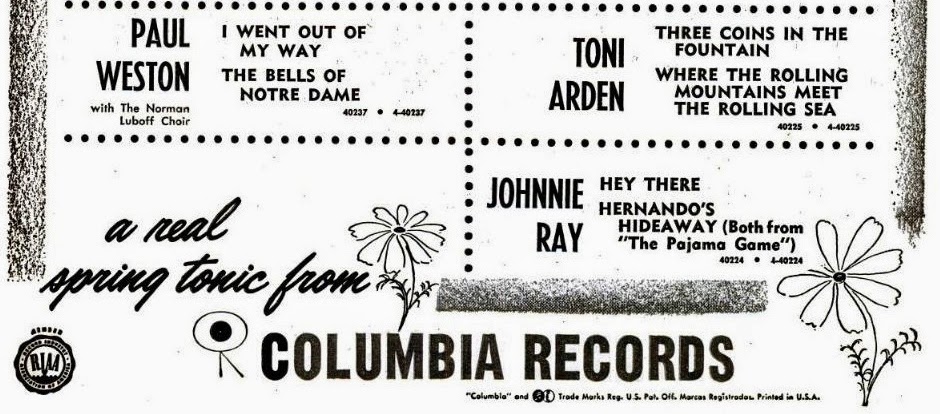

Meanwhile, on the back covers of Columbia's LP albums, we begin to find the following gracing the bottom (image taken from ML 4853, a Gold & Fizdale two-piano recital probably released in April 1954):


Finally, the Eye's first appearance on an actual record label:  In October, 1954, Columbia announced a new series in a Billboard ad, the "Hall of Fame" series, dedicated to reissues of pop material on 45s and 78s.  The 78 labels looked like this (image borrowed from "Note the Notes," Mike Sherman and Kurt Nauck's book about Columbia's 78 labels):


Notice that by now, Columbia has declared the Eye to be a trademark.  Notice, also, the subordinate position of the Notes.  They would be dropped altogether from the next label design, namely the "6-eyes" label pictured at the beginning of this article, developed for LPs and introduced in the summer of 1955, though they would continue appear on pop 78s until the end of their run in 1958, and on 45s until about the same time.

Part 2 of this series can be found here, with a survey of album cover branding from 1954-57.

Thursday, May 22, 2014

More Danish Chamber Music

Vagn Holmboe
During the Second World War, the Danish musicologist and critic Jürgen Balzer (1906-1976), acting in an advisory capacity to the Copenhagen branch of the Gramophone Company, established a recorded anthology of Danish music of all historical periods.  Under the aegis of this "Edition Balzer" some 50 works were recorded on 78-rpm records, including many small-scale gems of chamber music that could be accommodated complete on one record, as with the three examples I offer here:

Finn Høffding: Dialogues, Op, 10 (1927)
Waldemar Wolsing, oboe; P. Allin Erichsen, clarinet
Recorded c. January, 1951
HMV DB 5274, one 78-rpm record
Link (FLAC files, 50.17 MB)
Link (MP3 files, 27.43 MB)

Flemming Weis: Serenade Without Serious Intentions (1938)
Wind Quintet of 1932
Recorded Sept. 30, 1949
HMV DB 5293, one 78-rpm record
Link (FLAC file, 24.56 MB)
Link (MP3 file, 15.20 MB)

Vagn Holmboe: Serenata for flute, violin, cello and piano, Op. 18 (1940)
The Danish Quartet (Erling Bloch, violin)
Recorded c. Spring 1950
HMV DB 5297, one 78-rpm record
Link (FLAC file, 19.54 MB)
Link (MP3 file, 13.50 MB)

Of these three composers, Holmboe (1909-1996), pictured above in characteristic pose with his pipe, is by far the best known; his music, including 13 symphonies and 20 string quartets, has been disseminated fairly widely since the advent of CD, but this unpublished three-movement Serenata does not appear to have been recorded since.  Høffding (1899-1997), who was Holmboe's teacher at the Royal Danish Academy of Music, specialized in music for amateur performers, and excerpts from his "Dialogues" have been presented by several students on Youtube videos.  There are five movements, which are presented in a different order on the record than in the published score; accordingly, I present two files containing the complete work in both orderings, and you can be the judge which sequence you prefer.  For me, the real find here is the delightful piece by Weis (1898-1981), a composer about whom I can find out very little, save that he trained as an organist and has two symphonies to his credit.  This one-movement serenade for wind quintet is in several contrasting sections, by turns wistful and dance-like, beginning and ending with a polka.

Monday, May 12, 2014

Ormandy's First Copland Recordings

Cover photo by Tom Yee
Aaron Copland is not a composer commonly associated with Eugene Ormandy, and in fact the two works on this LP, as well as a 1962 version of "A Lincoln Portrait" with Adlai Stevenson narrating, represent the only major Copland works in Ormandy's discography.  This recording of "Appalachian Spring" is the first of the entire ballet score, which was originally for a 13-piece chamber ensemble.  The orchestral Suite which Copland arranged from the ballet in 1945 cut about eight minutes from it, and it was apparently at Ormandy's instigation that the composer orchestrated those eight minutes in 1954 so that the score could be presented complete as an orchestral work.  That is what you hear on this recording:

Copland: Appalachian Spring - Ballet
Recorded March 28, 1955
and
Copland: Billy the Kid - Ballet Suite
Recorded December 18, 1955
Philadelphia Orchestra conducted by Eugene Ormandy
Columbia Masterworks ML-5157, one LP record
Link (FLAC files, 128.28 MB)
Link (MP3 files, 82.43 MB)

Ormandy re-recorded both works for RCA in 1969, but "Appalachian Spring" was presented only in its form as a Suite.

Friday, May 2, 2014

Nielsen: Violin Sonata No. 2 (Erling Bloch)

Erling Bloch
Some weeks ago, when I offered the Erling Bloch Quartet in Nielsen's Third Quartet, there was a request for this 1938 recording by Erling Bloch - I believe the only one he made of a Nielsen sonata - as it was bypassed in favor of Emil Telmányi's 1954 recording of the same work in Danacord's series of Nielsen reissues on CD.  I don't have that set, but I do have Danacord's LP set from 1984 called "Carl Nielsen: The Premier Chamber Recordings" - which does have this recording, as well as that of the Quartet, but the transfers are so inept that I was moved to seek out the 78s in the belief that I could do better!  So here's my go at the Sonata:

Nielsen: Violin Sonata No. 2, Op. 35
Erling Bloch, violin; Lund Christiansen, piano
Recorded March 1 and May 20, 1938
HMV DB 5219 and DB 5220, two 78-rpm records
Link (FLAC files, 47.79 MB)
Link (MP3 files, 28.64 MB)

Both violinist and pianist were members of the Danish Quartet, as the labels proudly inform us, actually billing the ensemble before naming the players, even though only half of it participated:


Monday, April 21, 2014

Mozart: Jupiter Symphony (Coates)

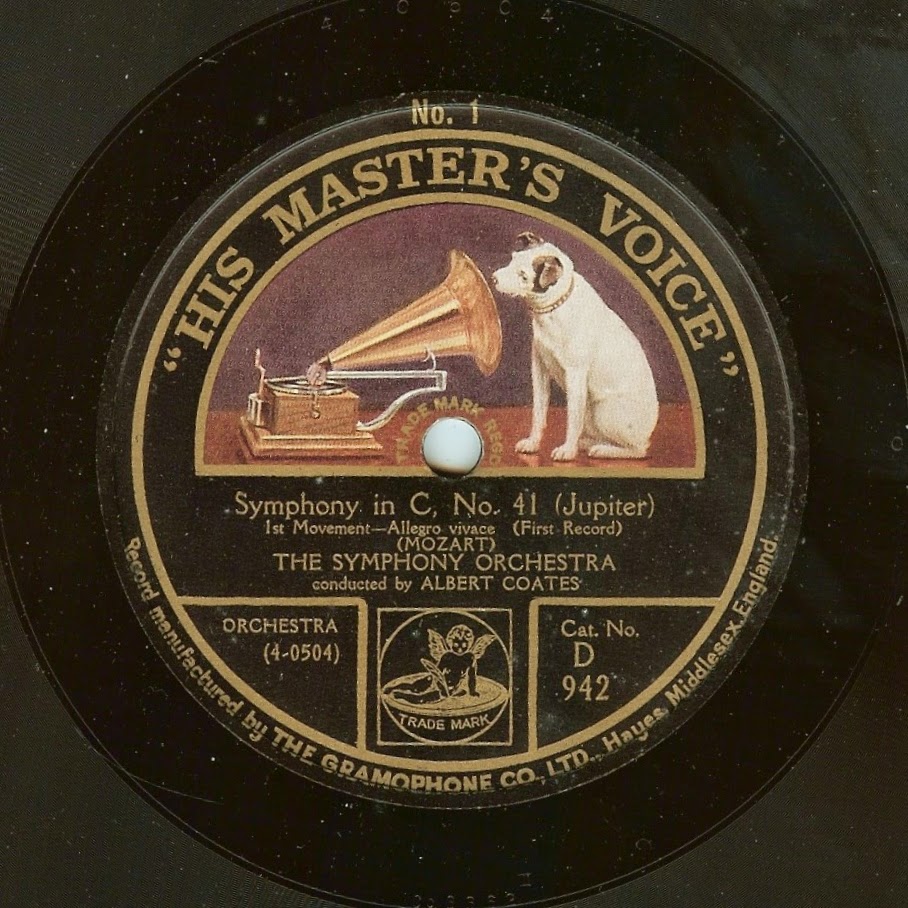
Last week we had Leopold Stokowski's 132nd birthday, and this week (April 23) we have the same for Albert Coates, that great gramophonic pioneer. And so I offer his first recording of Mozart's "Jupiter" Symphony (an electrically-recorded replacement succeeded it three years later). It isn't known whether it's the first complete recording of the work (an abridged one by the Victor Concert Orchestra had preceded it); the other contender would be a Deutsche Grammophon set conducted by Johannes Heidenreich, and since Deutsche Grammophon's recording ledgers were lost in the Second World War, we don't know when that recording was made. We do know that it was released in March, 1924, five months after the Coates version had been completed, but ten months before it actually appeared, having been held up by the need to record a suitable filler. (DG didn't bother about such niceties as suitable fillers - theirs was Richard Strauss conducting two movements from his "Bourgeois Gentilhomme" Suite!) What can be said about Coates' version is that it's probably the fastest on record - 28 minutes total, and that's with exposition repeats not only in the first movement and finale, but the slow movement as well, probably for the only time on 78-rpm discs for this particular symphony. (Had the repeats not been observed, the total timing would have amounted to only about 21 minutes.  Coates was well known for his speedy tempos.)

Mozart: Symphony No. 41 in C Major, K. 551 ("Jupiter")
Recorded August 27 and October 16, 1923
and
Mozart: Overture to "Der Schauspieldirektor" (The Impresario), K. 486
Recorded October 22, 1924
Symphony Orchestra conducted by Albert Coates
HMV D 942 through D 945, four 78-rpm records
Link (FLAC files, 102.47 MB)
Link (MP3 files, 57.25 MB)

Wednesday, April 16, 2014

The First American Recording of an Unabridged Symphony

For Leopold Stokowski's birthday this year (April 18, 1882), I present what is not only his first recording of an unabridged symphony, but the first such recording anywhere in the USA, in fact the only American recording of an unabridged symphony made during the acoustical era.  (I say "unabridged" instead of "complete" because some may consider Schubert's "Unfinished" Symphony not to qualify as a complete work.  I don't agree with that assessment myself; I have always suspected that Schubert didn't finish it because he knew that it is perfect as it stands, and that to add the obligatory scherzo and finale to create a finished symphony would be akin to drawing a mustache on the Mona Lisa!)  The first five sides were waxed on Stoki's 42nd birthday (after apparently unsuccessful attempts the previous December and January), ninety years ago:

Schubert: Symphony No. 8 in B Minor ("Unfinished")
Philadelphia Orchestra conducted by Leopold Stokowski
Recorded April 18 and 19, 1924
Victor 6459 through 6461, three 78-rpm records
Link (FLAC files, 64.29 MB)
Link (MP3 files, 39.38 MB)

This set was Victor's first entry in a series of albums they called the "Music Arts Library of Victor Records" - issued in tandem with an abridged recording of the Schumann Piano Quintet as a five-record package.  Alas, I don't have the album or the Schumann, but I did find online a newspaper ad (from the Brooklyn Daily Eagle, dated October 9, 1924) announcing the series, and here is a cross-section:


Victor's subsequent issues in this series included a number of Blue Label sets, among them Sir Landon Ronald's 1922 version of Beethoven's Fifth Symphony.  The series continued into the early electrical era before being supplanted by the much more famous "Victor Musical Masterpiece" sets in 1927.

Wednesday, April 9, 2014

Vaughan Williams: Symphony No. 4 (Mitropoulos)

"Hold your Hat!" - These were the words inscribed inside the album cover for the first copy I owned of Vaughan Williams conducting his Symphony in F Minor by the 78 set's original owner. An apt description of the work's anger and violence, and also of the composer's 1937 performance, which has never been equaled. The only one I've ever heard that even comes close is the one presented here. This was, I believe, the only Vaughan Williams symphony in Mitropoulos' repertoire, and he had conducted the New York Philharmonic in at least sixteen performances of it, since 1945, at the time this recording was made:

Vaughan Williams: Symphony No. 4 in F minor
New York Philharmonic conducted by Dimitri Mitropoulos
Recorded January 9, 1956
Columbia Masterworks ML-5158, one LP record
Link (FLAC files, 81.06 MB)
Link (MP3 files, 52.73 MB)

Vaughan Williams liked to say that the dissonant opening motto of the Fourth Symphony was "cribbed" from the opening of the finale of Beethoven's Ninth. If that is so, the overall form of the symphony was surely cribbed from that of Beethoven's Fifth, with its motto recurring at strategic points, the similar dimensions of its movements, and even its Scherzo being linked to its Finale by a similar crescendo.

Wednesday, April 2, 2014

Schumann: "Spring" Symphony (Leinsdorf)

Erich Leinsdorf
Spring is finally here, and after such a winter as we have had in the USA - one of the coldest I can remember - it's doubly welcome. And so here is Schumann's "Spring" Symphony, conducted by a young Erich Leinsdorf (1912-1993) in what appears to be his only commercial recording of the work. This was made during his first appointment conducting a major symphony orchestra, that of Cleveland, a position Leinsdorf would later characterize as "the bridge between the regimes" of Rodzinski and Szell. He was there for only three years, and all of his recordings with the orchestra were made over a period of three days in February, 1946. These include first American recordings of Dvořák's Sixth Symphony, Rimsky-Korsakov's "Antar" Symphony, and a suite from Debussy's "Pelléas et Mélisande" - the latter two sets released belatedly, after five Cleveland sets conducted by Szell had hit the market. The first of Leinsdorf's Cleveland recordings to be issued was the Schumann:

Schumann: Symphony No. 1 in B-Flat Major, Op. 38 ("Spring") and
Brahms: Chorale-Prelude "Es ist ein Ros' entsprungen" (orch. Leinsdorf)
The Cleveland Orchestra conducted by Erich Leinsdorf
Recorded February 24 and 25, 1946
Columbia Masterworks set MM-617, four 78-rpm records
Link (FLAC files, 79.06 MB)
Link (MP3 files, 55.08 MB)

Curiously, neither the cover nor the record labels indicate the symphony's familiar nickname, even though it originated from the composer himself - as discussed in Paul Affelder's liner notes. The Steinweiss cover does, however, graphically portray the transition from winter to spring.

Cover design by Alex Steinweiss
(restored by Peter Joelson)

Sunday, March 23, 2014

Nielsen: Quartet No. 3 (Erling Bloch Quartet)

Erling Bloch Quartet
Carl Nielsen wrote four string quartets, the last one dating from 1906.  This means that all of them are relatively early works, for he lived another twenty-five years.  It has been regretted by many (including the composer's daughter, who is said to have encouraged him, to no avail) that he made no contributions to the genre in his musical maturity, especially as Nielsen was a violinist himself and might be expected to have a special understanding of writing for stringed instruments.  But he wasn't interested, and on the basis of the direction his music took in the last fifteen years, I can understand why: his later works glory in contrasts between instruments, and the homogeneous sound of the string quartet wouldn't offer much scope for that kind of writing.  Be that as it may, there is much to enjoy in the Nielsen quartets, and the present one is, for me, the best of them:

Nielsen: Quartet No. 3 in E-Flat Major, Op. 14
The Erling Bloch String Quartet
Recorded September 22-23, 1946
HMV DB 20100 through DB 20103, four 78-rpm records
Link (FLAC files, 83.07 MB)
Link (MP3 files, 48.10 MB)

The distinguished Danish violinist Erling Bloch (1904-1992) founded the quartet bearing his name in 1933; its other members were Lavard Friisholm, second violin (who later directed the Copenhagen Collegium Musicum, whose recording of Bentzon's Chamber Concerto I uploaded recently), Hans Kassow, viola, and Torben Svendsen, cello.  With Svendsen, Bloch later founded the Danish Quartet, an ensemble consisting of flute (played by Gilbert Jespersen, the dedicatee of Nielsen's Flute Concerto), violin, cello and piano.